
メニュー
Revvity logo
Contact us
JP
Revvity Sites Globally

Select your location.

*e-commerce not available for this region.

australia.webp Australia
austria.webp Austria
belgium.webp Belgium
brazil.webp Brazil *
canada.webp Canada
china.webp China *
denmark.webp Denmark
finland.webp Finland
france.webp France
germany.webp Germany
hong-kong.webp Hong Kong (China) *
india.webp India *
ireland.webp Ireland
italy.webp Italy
japan.webp Japan *
luxembourg.webp Luxembourg
mexico.webp Mexico *
netherlands.webp Netherlands
norway.webp Norway
philippines.webp Philippines *
republic of korea.webp Republic of Korea *
singapore.webp Singapore *
spain.webp Spain
sweden.webp Sweden
switzerland.webp Switzerland
thailand.webp Thailand *
uk.webp United Kingdom
usa.webp United States
Breadcrumb
...
  • ホーム
  • Products
  • 研究・開発
  • ゲノム解析
    • ゲノム解析
    • タンパク質解析
    • 細胞分析
    • 研究ソリューション
  • ライブラリー調製キット
    • IncRNA in Functional Studies
    • Nucleic Acid Isolation
    • Reference Standards
    • NGSワークフロー
    • Microplate Readers
    • マイクロ流体核酸分析
    • CRISPR Technologies
    • RNA Interference
    • トランスフェクション試薬および補助試薬
    • Oligonucleotide Custom Synthesis
    • cDNAs and ORF Clones
    • Single-Cell Sequencing
    • Labeled Nucleotides
    • qPCR
    • ライブラリー調製キット
    • Magnetic Beads
    • Viral Vector Products
    • Microfluidic Nucleic Acid Analysis
  • CRISPR-based RNA depletion
    • 16S rRNAライブラリー調製ソリューション
    • CRISPR-based RNA depletion
    • NGS Accessories
    • Small RNA Sequencing Library Prep Kits
    • NEXTFLEX Quality Assurance
    • NEXTFLEX Tech Support
    • Library Prep OEM
    • NGSバーコードアダプター
    • RNA sequencing library prep kits
    • Ribodepletion Solutions
    • WGSライブラリー調製キット
    • Revvity NGS Certified Labs
    • NGS Certified Lab List

CRISPR-based RNA Depletion for RNA-Seq

CRISPR-based depletion for smarter RNA-seq.

The NEXTFLEX Cas9-gRNA Depletion Enzymes identify target DNA fragments within the NGS library and introduce precise double-strand breaks in the targeted RNA transcripts. Subsequent bead-based cleanup removes cleaved molecules, enriching for intact fragments prior to PCR amplification and sequencing. The result is cleaner libraries that yield more on-target reads and deeper coverage of transcripts of interest.

Gene expression analysis by RNA sequencing (RNA-seq) is often limited by highly abundant transcripts, particularly rRNA, as well as globin mRNA and mitochondrial RNA in some sample types. These species can dominate sequencing output and reduce sensitivity for transcripts of interest, especially in low-input or complex samples. While traditional depletion methods rely on probe-based hybridization, CRISPR-based depletion using Cas9–gRNA offers a programmable and highly targeted approach to remove these transcripts. Applied after library conversion to dsDNA, this strategy selectively cleaves unwanted fragments, increasing the proportion of reads assigned to informative targets.

Need help choosing the right workflow?

If you are evaluating RNA depletion strategies, our team can help you determine whether CRISPR-based depletion is the right fit for your workflow and assist with experimental design.
 

Request a consultation today
Application Revvity solution
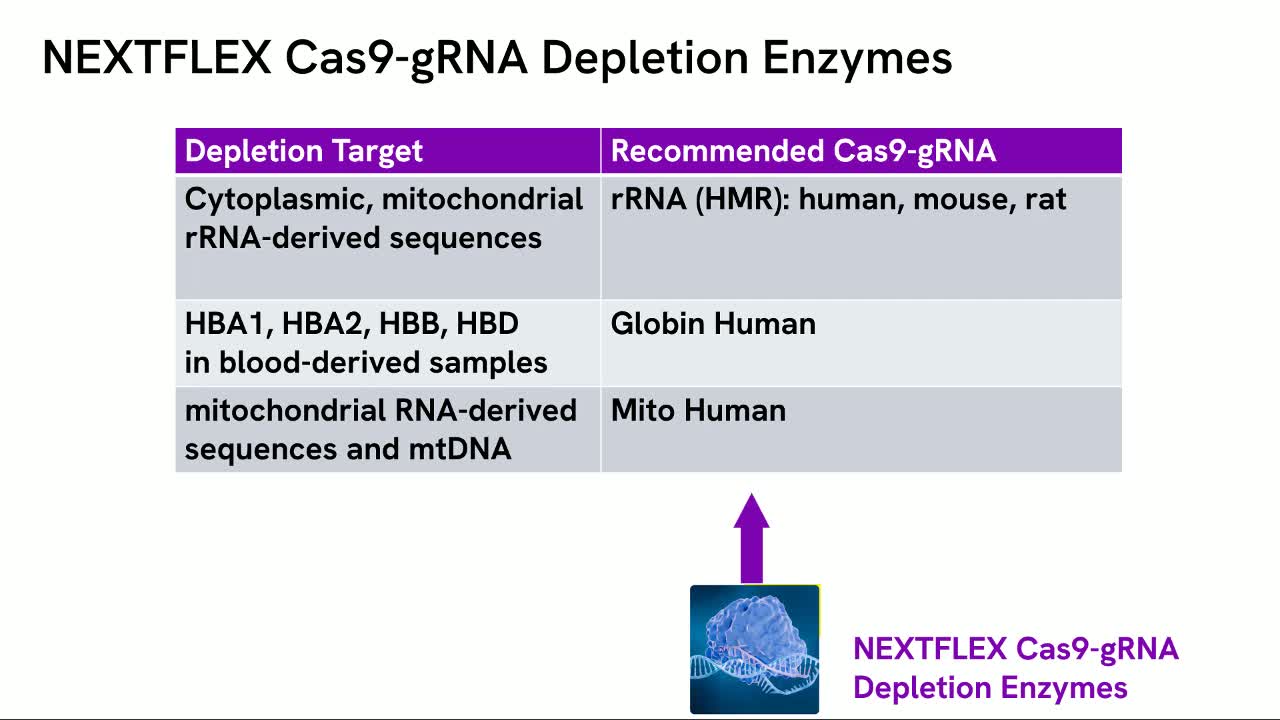
Removal of human rRNA sequences, increasing the representation of relevant transcripts NEXTFLEX™ Cas9-gRNA rRNA Depletion Enzyme (HMR)
Selective removal of highly expressed globin transcripts (HBA1, HBA2, HBB, & HBD), maximizing gene detection sensitivity NEXTFLEX™ Cas9-gRNA Globin Depletion Enzyme (Human)
Removal of human mitochondrial transcripts and DNA, enabling improved recovery of nuclear-derived information in samples with high mitochondrial content NEXTFLEX™ Cas9-gRNA Mito Depletion Enzyme (Human)

Main applications for CRISPR-based depletion

CRISPR-based RNA depletion selectively removes target transcripts, increasing the proportion of informative reads. Applied at the double-stranded DNA (dsDNA) stage, it enables precise, sequence-specific cleavage without affecting RNA handling, and integrates seamlessly into bulk and single-cell, short- and long-read RNA-seq workflows.

Bulk RNA sequencing

In whole transcriptome profiling, highly abundant RNA species can dominate reads and mask low-expression genes. CRISPR-based depletion improves transcriptome coverage by reducing rRNA and other abundant transcripts, enabling more accurate quantification and better detection of low-abundance mRNAs and non-coding RNAs. This approach is effective even with low-input samples or degraded material, such as FFPE or biofluids, where preserving RNA integrity and maximizing usable data are critical.

Single-cell RNA sequencing

Although many single-cell RNA-seq workflows include enrichment steps, abundant transcripts can still impact library complexity and sequencing efficiency, particularly in full-length or plate-based methods. Because CRISPR-based depletion is performed at the dsDNA stage, single-cell barcodes and cell-level resolution can be preserved enabling targeted depletion of dominant library fragments without affecting cell barcodes or UMI structure.

Long-read RNA sequencing

In long-read platforms, where sequencing throughput is lower and cost per read is higher, the presence of abundant RNA species can significantly reduce effective coverage. CRISPR-based depletion helps prioritize informative transcripts, enabling better characterization of isoforms, splice variants, and transcript structure while preserving RNA integrity by acting downstream at the dsDNA stage.

CRISPR-based RNA depletion hero

rRNA Depletion Enzyme (HMR)

The NEXTFLEX™ Cas9-gRNA rRNA Depletion Enzyme (HMR) targets ribosomal RNA–derived sequences from human, mouse, and rat, including both cytoplasmic (e.g., 18S and 28S) and mitochondrial rRNA species that commonly persist after library preparation.

Globin Depletion Enzyme (Human)

The NEXTFLEX™ Cas9-gRNA Globin Depletion Enzyme (Human) is designed to target highly abundant globin transcripts present in blood-derived samples, specifically hemoglobin alpha (HBA1, HBA2) and beta (HBB) genes. This targeted approach is particularly relevant for workflows involving whole blood, PBMCs, or dried blood spots.

Mito Depletion Enzyme (Human)

The NEXTFLEX™ Cas9-gRNA Mito Depletion Enzyme (Human) targets sequences derived from the human mitochondrial genome, including highly abundant mitochondrial rRNAs and mitochondrial mRNAs such as MT-CO1, MT-CO2, MT-CO3, MT-CYB, and MT-ND genes (ND1–ND6, ND4L). In addition to mitochondrial RNA–derived sequences, the enzyme also targets mitochondrial DNA (mtDNA), making it useful for applications such as ATAC-seq where mitochondrial DNA can dominate library reads.
Explore our solutions

library-prep-kits-512x288

ライブラリー調製キット

次世代シーケンス(NGS)において信頼性の高い結果を得るためには、堅牢なライブラリー調製が重要なステップとなります。
Learn more
rna-category-page-512x288

RNA sequencing library prep kits

RNA sequencing (RNA-seq) is used to analyze the quantity, and the sequence of all RNA transcripts present in a sample at any given time, which is often referred as transcriptome.
Learn more
全てを表示 View less

Featured resources

Flyer

CRISPR-based depletion for smarter RNA-seq

Learn more
Application note

Single‑cell gene fusion and rare event discovery with ribodepletion‑enhanced 10x–ONT sequencing

Learn more
Application note

Tackling the globin problem in single-cell malaria research.

Learn more

For research use only. Not for use in diagnostic procedures.

line

ご質問がございましたら、
お気軽にお問い合わせください。

お問合せ
Revvity Logo

©2026 Revvity - All rights reserved

Revvity is a trademark of Revvity, Inc. All other trademarks are the property of their respective owners.
