


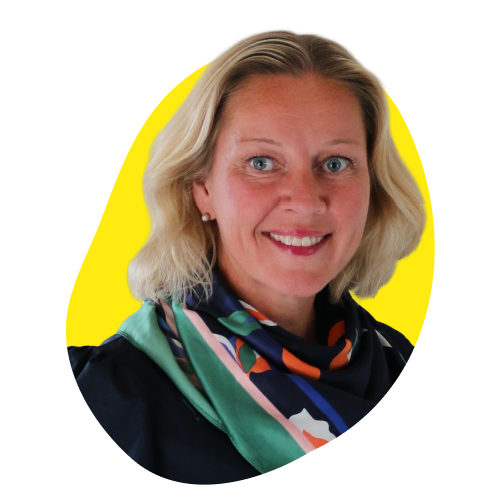
An interview with Sonja Nybom, Global Application Support Manager
Most people think innovation ends when a product reaches the customer. Sonja Nybom has spent much of her career proving otherwise.
Based in Turku, Finland, she leads a global team of Application Support Scientists within Revvity's reproductive health diagnostics business. Her team works at the point where science meets reality, helping laboratories implement complex technologies, solving technical challenges, and ensuring that products perform reliably in everyday healthcare environments.
It's a role that sits between customers, R&D, quality, manufacturing, and commercial teams. Over time, it has given Sonja a unique perspective on how scientific innovation actually becomes practical healthcare.
We spoke with her about the hidden side of diagnostics, the lessons she's learned across different roles, and why understanding the bigger picture matters more than ever.
Q: Most people have no idea what application support actually does. How do you explain it?
Sonja: People often assume it's mainly about troubleshooting. Of course, that's part of the role. But it's only one part.
Application support sits between product development and real-world use. We work directly with customers, helping them implement technologies, solve challenges, and get the best possible performance from the solutions they're using.
At the same time, we're working closely with R&D, quality, manufacturing, and commercial teams. We see how products perform in practice, what customers struggle with, and where improvements can be made. Because of that, the role gives you a view across the organization that many people don't expect.
Q: When did you realize the role was bigger than technical troubleshooting?
Sonja: Early in my career, I was involved in a customer case that required input from several different functions. The technical problem itself was complex, but what stayed with me was something else.
When the issue was finally resolved, the customer could continue their work. Results could be generated again. The laboratory could move forward.
That experience changed how I thought about application support. I realized that technical support is closely connected to scientific and clinical outcomes. It also made me understand how much visibility and influence the role has across different parts of the organization.
You start by solving individual problems. Before long, you begin to see how those problems connect to a much larger system.
Q: What's happening behind the scenes when a customer faces a critical issue?
Sonja: Usually, far more than the customer sees. A customer may be speaking to one person, but behind that conversation, there can be application scientists, local field support, quality specialists, product experts, R&D teams, and commercial colleagues all working towards the same goal.
One situation that stands out involved a global product challenge that required support across multiple sites and time zones. What impressed me wasn't only the technical expertise. It was how naturally people worked together. Teams handed over information, shared updates, and built on each other's progress so that the investigation could continue without losing momentum.
The customer saw a solution. Internally, it was the result of many people contributing their expertise.
Q: Looking back at your own career, what surprises you most?
Sonja: Probably how connected it all seems now. I started as an Application Support Scientist. Later, I moved into product management, then into a global business management role, and eventually into my current position leading a global team.
At the time, each move felt quite different.
Looking back, I can see that every role was helping me understand a different part of the same picture.
As an application scientist, I learned how customers use our technologies. Product management gave me a deeper understanding of strategy and product lifecycle. The business role broadened my perspective further by shaping the business direction, aligning regional needs, and ensuring that our product portfolio delivered both scientific and commercial value.
Today, I draw on all of those experiences. The roles changed. The objective didn't. It has always been about understanding how science, products, customers, and business priorities connect.
Q: You recently opened a position for a Global Application Support Scientist — the same role where your own journey began. What do people find most surprising when they join?
Sonja: The scope. Most people arrive expecting a highly technical role. What they discover is something much broader.
You're working directly with customers and local field support teams. You're collaborating with R&D, quality, manufacturing, and commercial teams. You're learning not only about the technology itself, but also about laboratory workflows, clinical applications, and the realities of supporting customers around the world.
The role develops technical expertise, but it also gives people exposure to how a global organization operates. That's something many don't expect when they first join.
Q: Who tends to thrive in that environment?
Sonja: People who are curious about how things work. Not just the technology, but the wider context around it.
The strongest people don't stop once they've solved a customer issue. They want to understand why it happened, whether it could happen again, and what can be improved.
They are comfortable working with complexity. They ask questions and connect information from different sources.
Most importantly, they understand that they won't have all the answers on day one. Nobody does.
Q: You stepped into your current leadership role shortly after returning from maternity leave. What did that experience mean to you?
Sonja: A great deal. Professionally, it was an exciting opportunity. Personally, it was also a strong signal of trust.
I felt that my experience and contribution were being recognized at a time when many people are balancing significant responsibilities both at work and at home.
What stayed with me wasn't the title itself. It was the confidence behind the decision. It reinforced my belief that careers don't always follow a standard timeline and that opportunities can appear at moments when you least expect them.
Q: Looking ahead, what interests you most about the future of the field?
Sonja: The amount of information we're able to work with. Data, automation, and AI are already changing how support organizations operate. We can identify patterns more effectively, share knowledge more efficiently, and become more proactive in how we support customers.
At the same time, I don't think technology reduces the need for human expertise. If anything, it increases it. The challenge is no longer access to information. The challenge is understanding what matters, connecting different perspectives, and making good decisions based on what we know.
That's where I think some of the most interesting opportunities lie.
One final thought
Ask Sonja what she's most proud of, and she doesn't talk about a specific title or career milestone.
She talks about perspective. About seeing how a customer challenge can influence product development. How knowledge moves across teams. How decisions made in one part of the organization can affect outcomes somewhere else entirely.
Over the course of her career, she has worked in support, product management, and business management. Each role offered a different view of the business. Together, they revealed something larger.
Developing a technology is only the first step. The real challenge is making sure it works reliably, consistently, and effectively in the hands of the people who depend on it every day.
For Sonja, that's where the most meaningful work happens.
For Research Use Only. Not for use in diagnostic procedures.