
Revvity Sites Globally
Select your location.
*e-commerce not available for this region.

AlphaLISA SureFire Biotin-Free Human and Mouse Phospho-Histone H3 (Ser10/Thr11) Detection Kit, 500 Assay Points
AlphaLISA SureFire Biotin-Free Human and Mouse Phospho-Histone H3 (Ser10/Thr11) Detection Kit, 500 Assay Points
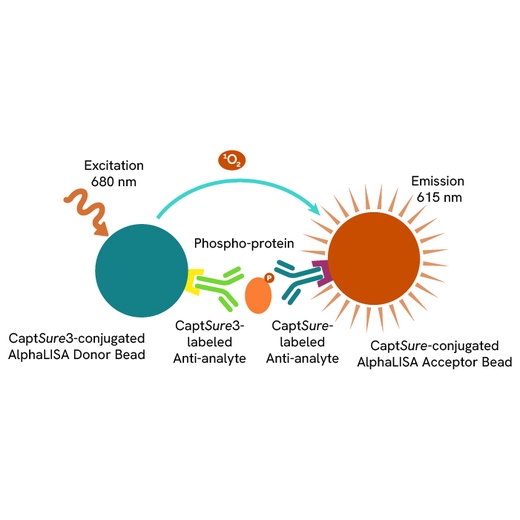
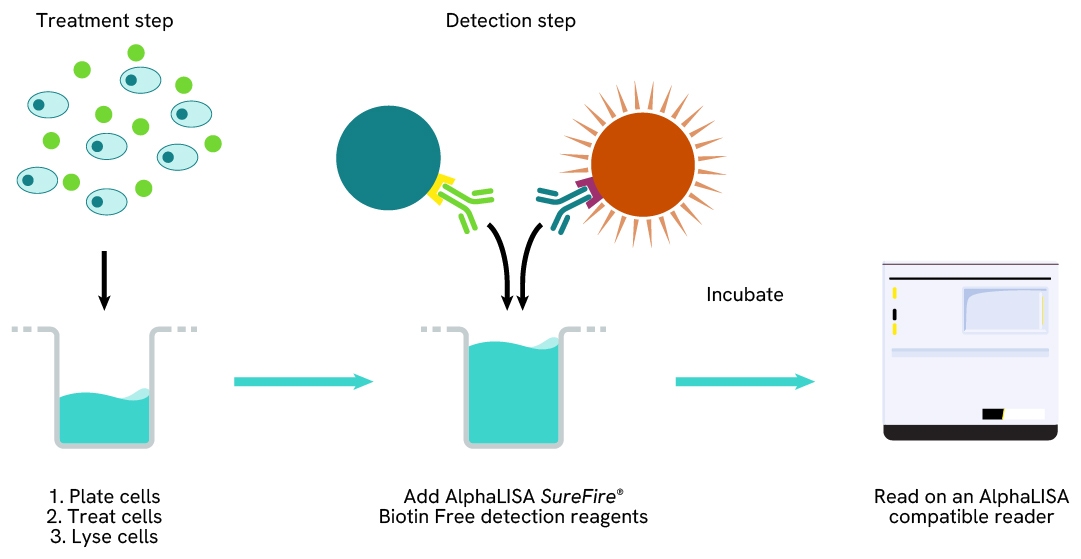
AlphaLISA SureFire Biotin Free Phospho Kit Schematic
The AlphaLISA™ SureFire® Biotin-Free Human and Mouse Phospho-Histone H3 (Ser10/Thr11) assay is a sandwich immunoassay for quantitative detection of phospho-Histone H3 (Ser10/Thr11) in cellular lysates using Alpha Technology.
| Feature | Specification |
|---|---|
| Application | 細胞シグナル伝達 |
| Protocol Time | 2h at RT |
| Sample Volume | 10 µL |
The AlphaLISA™ SureFire® Biotin-Free Human and Mouse Phospho-Histone H3 (Ser10/Thr11) assay is a sandwich immunoassay for quantitative detection of phospho-Histone H3 (Ser10/Thr11) in cellular lysates using Alpha Technology.
Product variants
Unit Size: 100 Assay Points
Part #:
ASBF-PHISH3-A-HV
Unit Size: 500 Assay Points
Part #:
ASBF-PHISH3-A500
Unit Size: 10,000 Assay Points
Part #:
ASBF-PHISH3-A10K
Unit Size: 50,000 Assay Points
Part #:
ASBF-PHISH3-A50K
For research use only. Not for use in diagnostic procedures. All products to be used in accordance with applicable laws and regulations including without limitation, consumption and disposal requirements under European REACH regulations (EC 1907/2006).
AlphaLISA SureFire Biotin-Free Human and Mouse Phospho-Histone H3 (Ser10/Thr11) Detection Kit, 500 Assay Points
AlphaLISA SureFire Biotin Free Phospho Kit Schematic
Loading...
Product information
Overview
Phosphorylation of histone H3 at serine 10 (H3S10p) and threonine 11 (H3T11p) is a histone post-translational modification (PTM) that plays a critical role in regulating chromatin structure and gene expression during cell cycle progression and mitosis. H3S10p and H3T11p are deposited by Aurora kinases, Rsk, and other mitotic kinases, and these modifications are associated with chromosome condensation, spindle assembly, and the transition from prophase to metaphase. Phosphorylation of H3S10 disrupts the interaction between histone H3 and the heterochromatin protein HP1, leading to chromatin decompaction and transcriptional activation of genes involved in cell cycle progression and proliferation. H3T11p, on the other hand, blocks the binding of the transcriptional repressor Rph1 to chromatin, thereby relieving transcriptional repression. The dynamic regulation of H3S10p and H3T11p is essential for proper chromosome segregation and cell division, and dysregulation of these modifications has been linked to chromosomal instability and tumorigenesis. Quantitative assessment of H3S10p and H3T11p levels can provide insights into mitotic activity, cell cycle state, and chromatin dynamics in both physiological and pathological contexts.
The AlphaLISA SureFire Biotin-Free Human and Mouse Phospho-Histone H3 (Ser10/Thr11) Detection Kit is a sandwich immunoassay for the quantitative detection of phospho-Histone H3 (Ser10/Thr11) in cellular lysates, using Alpha Technology.
Formats:
- The HV (high volume) kit contains reagents to run 100 wells in 96-well format, using a 60 μL reaction volume.
- The 500-point kit contains enough reagents to run 500 wells in 384-well format, using a 20 μL reaction volume.
- The 10,000-point kit contains enough reagents to run 10,000 wells in 384-well format, using a 20 μL reaction volume.
- The 50,000-point kit contains enough reagents to run 50,000 wells in 384-well format, using a 20 μL reaction volume.
AlphaLISA SureFire Biotin Free kits are compatible with:
- Cell and tissue lysates
- Antibody modulators
- Biotherapeutic antibodies
- Biotin rich samples
AlphaLISA SureFire Biotin Free kits can be used for:
- Cellular kinase assays
- Receptor activation studies
- High-throughput screening for preclinical studies
How it works
Phospho-AlphaLISA SureFire Biotin Free assay principle
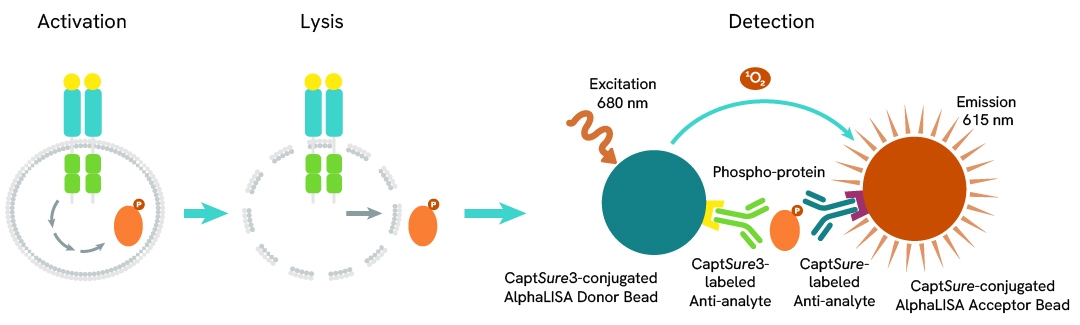
The Phospho-AlphaLISA SureFire Biotin Free assay measures a protein target when phosphorylated at a specific residue in a biological sample (e.g. cell lysate).
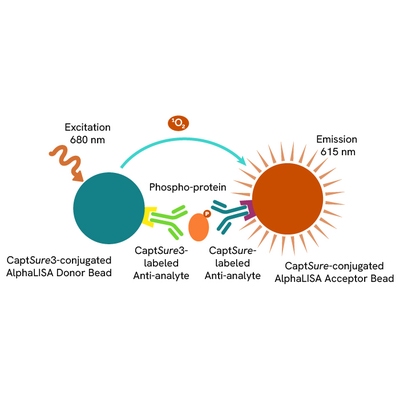
The assay uses two antibodies which recognize the phospho epitope and a distal epitope on the target protein. AlphaLISA assays require two bead types: Acceptor and Donor Beads. Acceptor Beads are coated with a proprietary CaptSure™ agent to specifically immobilize the assay specific antibody, labeled with a CaptSure tag. Donor Beads are coated with a proprietary CaptSure3 agent to capture one of the detection antibodies, which is labeled with CaptSure3 tag. In the presence of phosphorylated protein, the two antibodies bring the Donor and Acceptor Beads in close proximity whereby the singlet oxygen transfers energy to excite the Acceptor Bead, allowing for the generation of a luminescent Alpha signal. The amount of light emission is directly proportional to the quantity of phosphoprotein present in the sample.
Phospho-AlphaLISA SureFire Biotin Free two-plate assay protocol
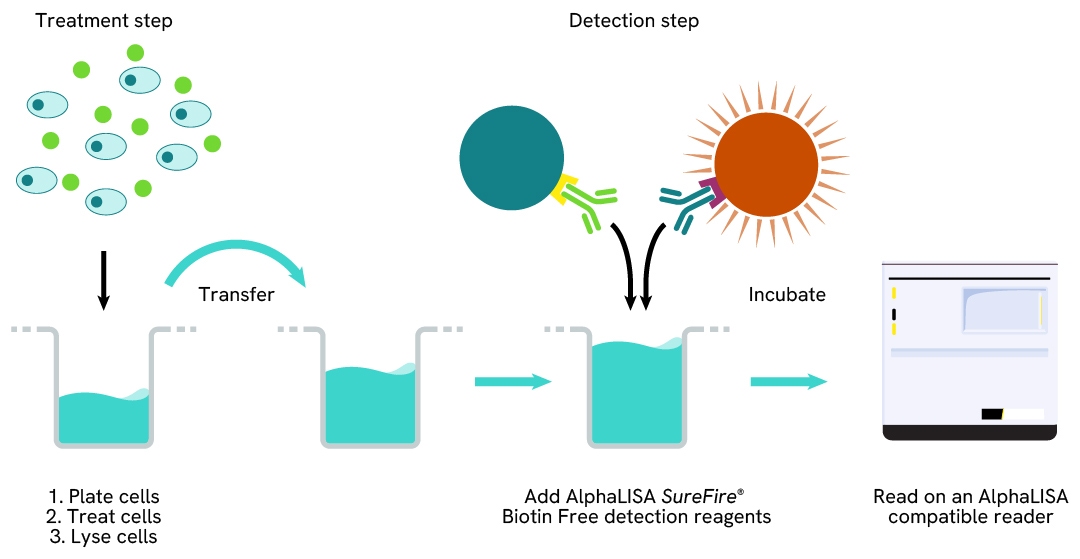
The two-plate protocol involves culturing and treating the cells in a 96-well plate before lysis, then transferring lysates into a 384-well OptiPlate™ plate before the addition of Phospho-AlphaLISA SureFire Biotin Free detection reagents. This protocol enables cell viability and confluence to be monitored. In addition, lysates from a single well can be used to measure multiple targets.
Phospho-AlphaLISA SureFire Biotin Free one-plate assay protocol
Detection of Phosphorylated target protein with AlphaLISA SureFire Biotin Free reagents can be performed in a single plate used for culturing, treatment, and lysis. No washing steps are required. This HTS designed protocol allows for miniaturization while maintaining robust AlphaLISA SureFire quality.
Assay validation
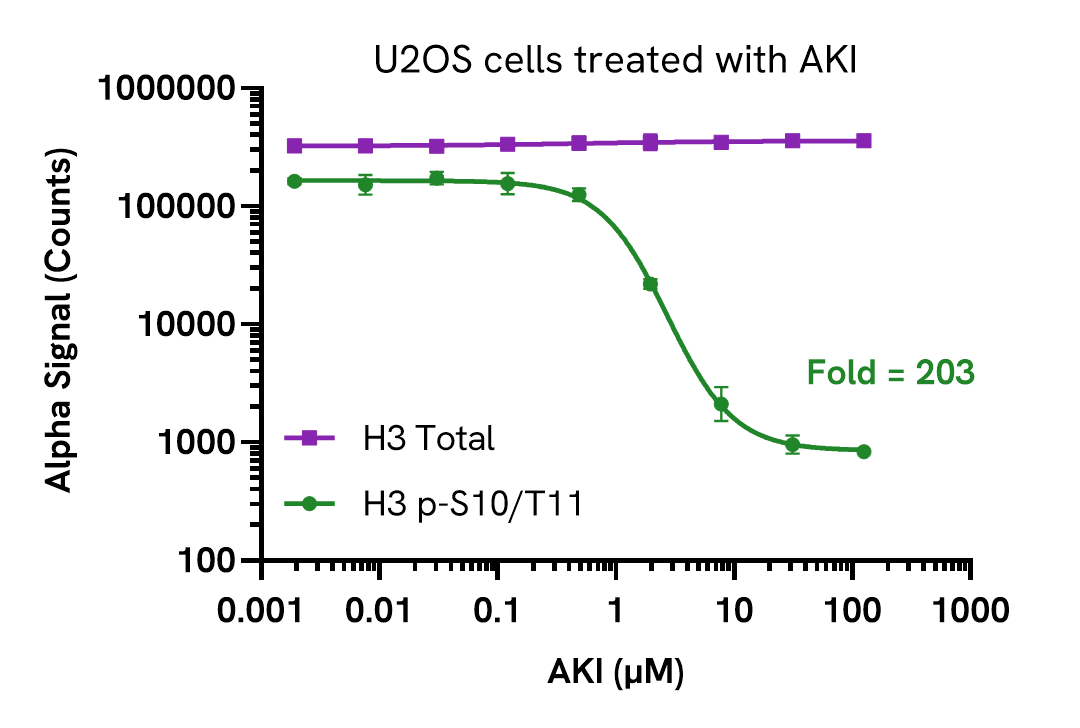
Inhibition of Phospho Histone H3 (Ser10/Thr11) in cells treated with AKI
U2OS cells were seeded in a 96-well plate (1,000 cells/well) in complete medium and incubated overnight at 37°C, 5% CO2. Cells were pretreated with increasing concentrations of Aurora Kinase Inhibitor (AKI) for 30 minutes and then treated with 100 nM Nocodazole for 16 hours.
After treatment, the cells were lysed with 100 µL of Lysis Buffer C for 30 minutes at RT with shaking (350 rpm). Histone H3 Phospho (Ser10/Thr11) and Total levels were evaluated using respective AlphaLISA SureFireBiotin Freeassays. For the detection step, 10 µL of cell lysate (approximately 400 cells) was transferred into a 384-well white OptiPlate, followed by 5 µL of Acceptor mix and incubated for 1 hour at RT. Finally, 5 µL of Donor mix was then added to each well and incubated for 1 hour at RT in the dark. The plate was read on an Envision using standard AlphaLISA settings.
As expected, AKI treatment resulted in a decrease of Phospho Histone H3 (Ser10/Thr11) levels, while H3 Total levels remained unchanged.
Assay sensitivity
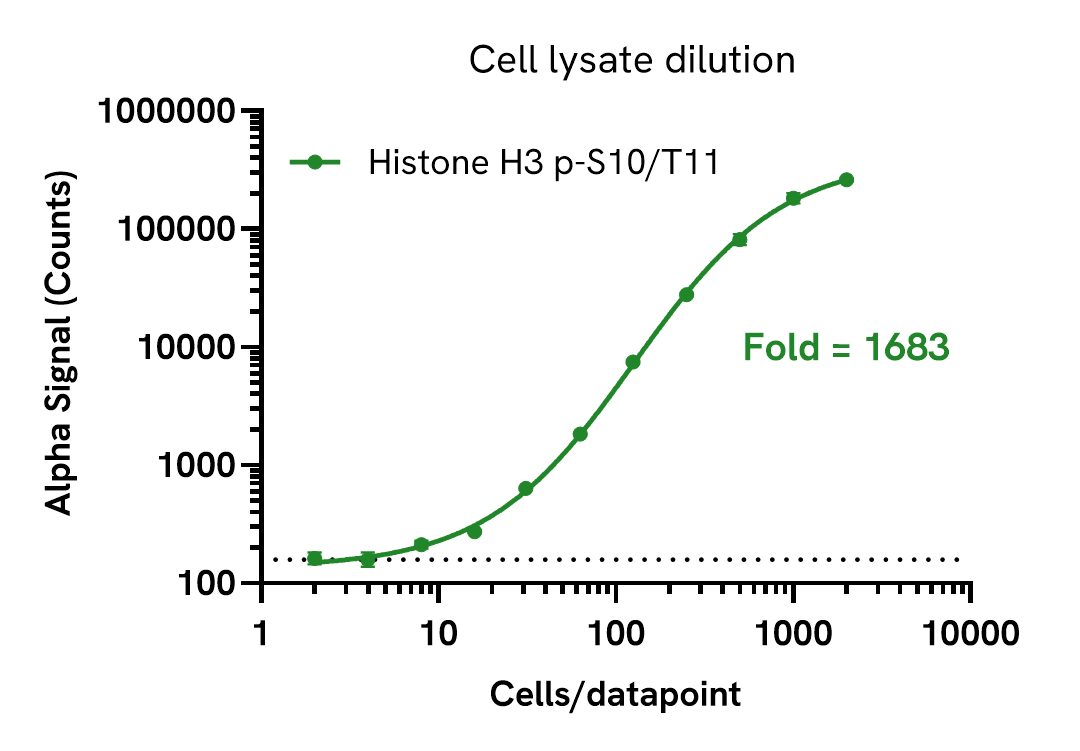
Assay sensitivity - cell lysate
Cell lysate was prepared from U2OS cells cultured to confluency in a T175 flask, treated with 10 µM Nocodazole for 16 hours and lysed in 120 mL of Lysis Buffer C for 30 minutes at RT with shaking.
Lysate was serially diluted and Phospho Histone H3 (Ser10/Thr11) levels were evaluated by AlphaLISA SureFire Biotin Free. For the detection step, 10 µL of lysate was transferred into a 384-well white OptiPlate, followed by 5 µL of Acceptor mix and incubated for 1 hour at room temperature. Finally, 5 µL of Donor mix was then added to each well and incubated for 1 hour at RT in the dark. The plate was read on an Envision using standard AlphaLISA settings.
Approximate number of cells per datapoint is indicated. The dotted line represents assay background. The assay can detect Phospho Histone H3 (Ser10/Thr11) levels in fewer than 100 cells.
Specifications
| Application |
Cell Signaling
|
|---|---|
| Automation Compatible |
Yes
|
| Brand |
AlphaLISA SureFire Biotin-Free
|
| Detection Modality |
Alpha
|
| Product Group |
Kit
|
| Protocol Time |
2h at RT
|
| Sample Volume |
10 µL
|
| Shipping Conditions |
Shipped in Blue Ice
|
| Target |
Histone H3
|
| Target Class |
Phosphoproteins
|
| Target Species |
Human
Mouse
|
| Technology |
Alpha
|
| Therapeutic Area |
Oncology
|
| Unit Size |
500 Assay Points
|
Resources
Are you looking for resources, click on the resource type to explore further.

Brochure
Alpha assays and reagents catalog
Alpha technolgy enables the rapid and straightforward mesaure of virtually any target. This includes enzymes, receptor-ligand...

Guide
AlphaLISA SureFire Ultra: the ultimate guide for successful experiments
The definitive guide for setting up a successful AlphaLISA SureFire Ultra assay
Several biological processes are regulated by...
Brochure
Alpha SureFire Ultra no-wash immunoassay catalog
Discover Alpha SureFire® Ultra™ assays, the no-wash cellular kinase assays leveraging Revvity's exclusive bead-based technology...
Brochure
Species compatibility for HTRF, AlphaLISA SureFire Ultra and Alpha SureFire Ultra Multiplex assays
This document includes detailed tables listing HTRF™, AlphaLISA™ SureFire® Ultra™, and Alpha SureFire® Ultra™ Multiplex assays...
Loading...


How can we help you?
We are here to answer your questions.