



Targeted next-generation sequencing has become the workhorse for applications such as oncology panels, inherited disease testing, and focused research panels. Instead of sequencing an entire genome, hybrid capture workflows enrich only the regions of interest before sequencing, which saves instrument time, simplifies data analysis, and reduces sequencing cost. Within these workflows, a class of reagents called blocking oligos, and in particular universal blockers, plays a crucial role in making capture efficient and cost-effective.
This article walks through hybrid capture at a practical level, explains why adapters create problems during enrichment, and shows how universal blockers, Cot-1 DNA, and salmon sperm DNA work together to improve on-target performance.
Hybrid capture targeted sequencing
In a hybrid capture workflow, input DNA is converted into a standard NGS library, then the regions of interest are pulled out using long, biotinylated oligonucleotide probes.
During library prep, genomic DNA is fragmented to the desired insert size, usually around 150 to 300 base pairs. The fragments are end-repaired and A-tailed if needed, then ligated to platform-specific adapters containing flow cell binding sites and index sequences. A short pre-capture PCR step often follows to generate enough library material for enrichment. This generates a conventional indexed library.
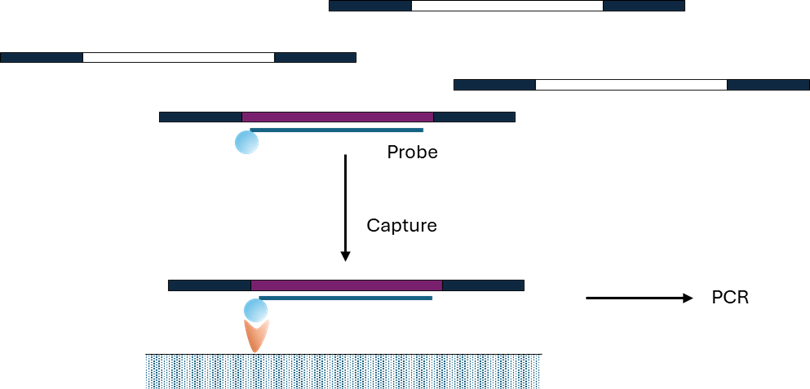
Hybrid capture then adds a second layer. The library is then denatured to single strands, and a pool of biotinylated probes (often called baits) that are complementary to your targets is introduced. During a long hybridization at an elevated temperature, probes anneal to library fragments containing the targeted sequence. Afterwards, streptavidin-coated magnetic beads bind the biotinylated probes. Any library fragment that is attached to a probe gets pulled out of solution with the beads, while the rest is washed away. A post-capture PCR step then amplifies the enriched pool for sequencing (Figure 1).
Figure 1. During the hybridization reaction, biotinylated probes anneal with libraries containing complementary target sequences. Hybridized libraries are then pulled down by streptavidin-coated magnetic beads and amplified by PCR before sequencing.
In the idealized version of this process, probes only find their intended targets, and everything else disappears in the washes. In real life, adapter sequences and repetitive DNA complicate that simple picture, and this is where blocking reagents enter the story.
The hidden problem: adapters and off-target capture
Every library fragment in a hybrid capture experiment is flanked by the same adapter sequences. Those adapters are required for cluster generation and indexing, but they also introduce unwanted binding surfaces.
Adapter sequences can hybridize to one another during the capture hybridization step, especially if the library is concentrated and the hybridization is long. That leads to several issues.
Adapters can form duplexes between fragments, so two or more library molecules become connected through their adapters. Probes that bind one fragment can inadvertently drag along a second fragment that does not contain any target sequence. This is often referred to as “daisy chaining” of on-target and off-target molecules (Figure 2).
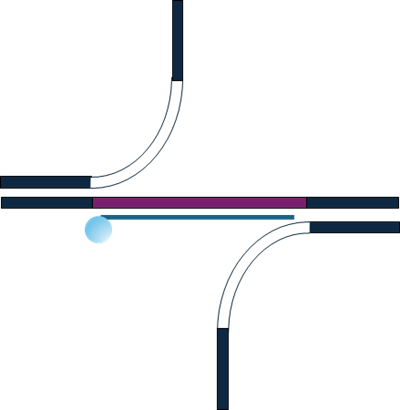
Figure 2. Adapters are the sequences at highest concentration during hybridization reaction. They can anneal with the complementary adapter sequence strand of other library molecules. When this happens, streptavidin-coated beads will pull down also libraries that do not contain the intended target sequences. Please note that this interaction is independent of the design and specificity of the biotinylated probes used.
Short adapter dimers and other library artifacts are also rich in adapter sequence. If probes have any incidental complementarity to the adapter, or if dimers get incorporated into higher order complexes, they can be captured despite having no informative insert sequence.
The net effect is a reduction in on-target fraction and an increase in wasted reads. When adapter sequences drive hybridization events, more off-target fragments and adapter dimers are carried into the captured pool, so a larger share of total reads fails to cover the regions of interest. Using adapter blocking oligos to mask these sequences has therefore become standard practice in modern hybrid capture workflows, because it improves the specificity of enrichment and makes sequencing more efficient.
In parallel, repetitive and low complexity genomic regions can also bind probes non-specifically, especially in exome and large panel captures. That is why Cot-1 DNA or related repetitive DNA blocks are typically included in hybridization kits. These reagents are enriched for repetitive sequences and serve as decoys that prevent probes from spending time on repeats in the library. They are sometimes supplemented with nonspecific competitor DNA such as fragmented salmon sperm DNA to further suppress low-affinity interactions.
So, there are two distinct problems: non-specific capture driven by adapters, and non-specific capture driven by repetitive genomic content. Different blockers address each one.
Classes of blocking reagents in hybrid capture
Modern hybrid capture cocktails typically contain three conceptual types of blockers that work together.
Adapter blocking oligos are synthetic oligonucleotides that are complementary to the adapter sequence on library molecules. When present during hybridization, they bind to the adapter regions and mask them, preventing the adapters from hybridizing to one another. Most commercial protocols recommend adapter-specific or universal blocking oligos in the hybridization mix to prevent capture of fragments via adapter sequences and to raise on-target specificity.
Cot-1 DNA or similar repetitive DNA sequences are enriched for high copy number repetitive elements. When added in excess, they shield repetitive portions of both probes and library fragments and suppress cross-hybridization of repeats, which is particularly important in large genomes that contain substantial repetitive content.
Salmon sperm DNA, or an equivalent non-specific DNA, acts as a general competitor. It is usually heavily fragmented genomic DNA from a species that is evolutionarily distant from the sample of interest. Its role is to soak up residual non-specific interactions by providing a large excess of “irrelevant” DNA. Suppliers describe its purpose as minimizing non-specific interactions and background noise during hybridization experiments, a concept that originated in blotting and in situ hybridization workflows and carries over directly into capture.
From adapter blockers to universal blockers
The earliest adapter blocking strategies used index-specific oligos. For each index sequence in a library pool, a unique blocking oligo is needed that matches that exact adapter plus index segment. That design works but becomes unwieldy as you increase multiplexing and mix libraries from different kits.
Universal blockers solve that problem. Rather than blocking a single index, a universal blocker is a single oligo or small oligo mix that can bind the adapter region in all libraries that share a given architecture, regardless of which indices are present. In practice this is achieved by targeting constant regions of the adapter and by designing the blocker so that it can tolerate index diversity while still forming stable duplexes during hybridization. A universal blocker kit for Illumina® adapters, for example, is described as a single reagent intended to optimize on-target performance by reducing adapter to adapter hybridization across both single and dual indexed libraries (Figure 3).
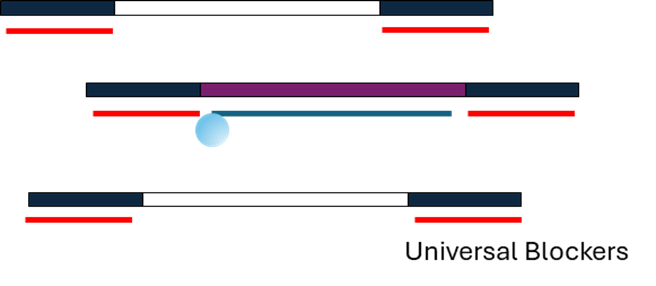
Figure 3. Universal blockers are oligos that bind to the adapters of any library during hybridization, disrupting the interaction among complementary adapter sequences and therefore boosting on-target rate.
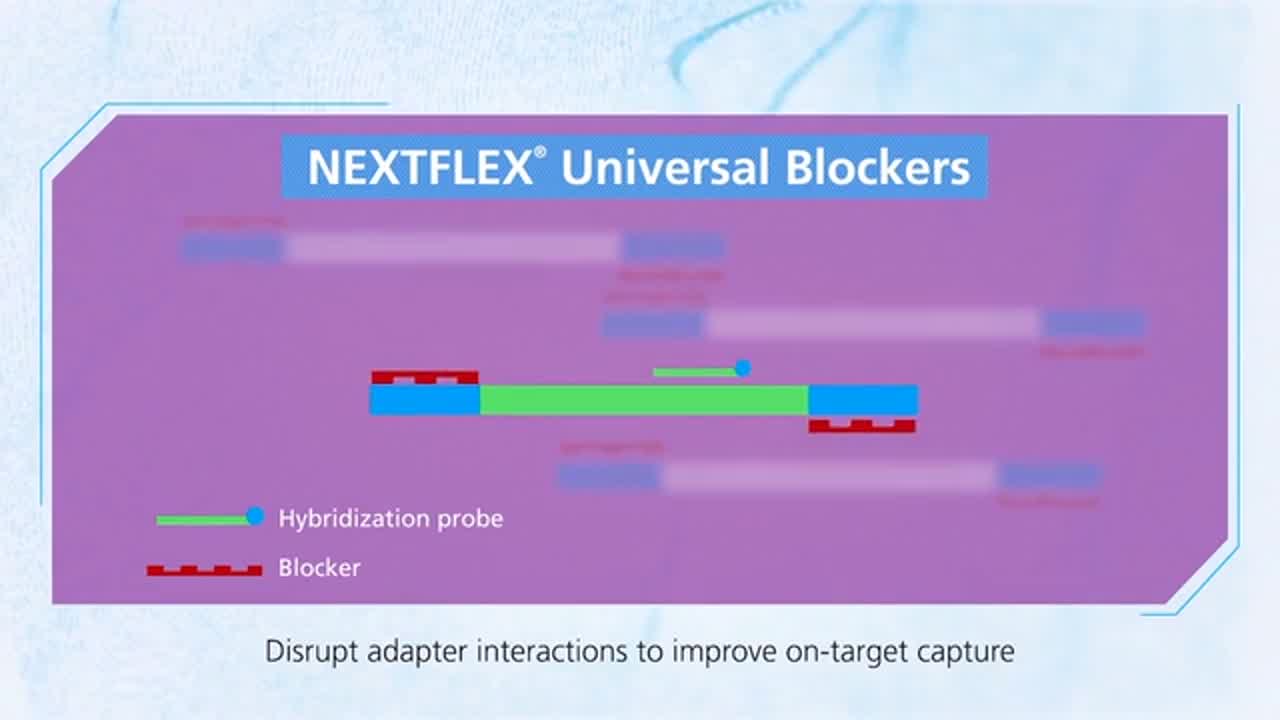
NEXTFLEX Universal Blockers take this approach. They are defined as short DNA oligos that block non-specific hybridization between adapter sequences and thereby enhance target capture specificity and reduce sequencing costs, compatible across standard ligation and tagmentation-based workflows for Illumina® and related platforms.
For the user, the practical advantages are obvious. A universal blocker mix can be dropped into any capture run that uses that adapter architecture, without worrying about whether the correct index-specific blockers were included for each sample. This is particularly attractive for service labs, core facilities and industrial workflows that must support multiple library prep kits and index sets on the same capture run.
The NEXTFLEX Universal Blockers work in conjunction with Cot-1 and/or salmon sperm DNA as part of a total package optimized to improve on-target capture, reduce wasted reads, and lower total sequencing costs.
References:
- Gnirke A, Melnikov A, Maguire J, Rogov P, LeProust EM, Brockman W, et al. Solution hybrid selection with ultra-long oligonucleotides for massively parallel targeted sequencing. Nature Biotechnology. 2009;27(2):182–189. doi: 10.1038/nbt.1523.
- Blumenstiel B, Cibulskis K, Fisher S, DeFelice M, Barry A, Fennell T, et al. Targeted exon sequencing by in-solution hybrid selection. Current Protocols in Human Genetics. 2010 Jul;Chapter 18:Unit 18.4. doi: 10.1002/0471142905.hg1804s66.
- Andermann T, Torres Jiménez MF, Matos-Maraví P, Batista R, Blanco-Pastor JL, Gustafsson ALS, et al. A guide to carrying out a phylogenomic target sequence capture project. Frontiers in Genetics. 2020;10:1407. doi: 10.3389/fgene.2019.01407.
For research use only. Not for use in diagnostic procedures.