



Diverse biospecimens enter as starting materials in many molecular biology labs. These sometimes include solid tissues or complex matrices for which early analytical sample prep can quickly become a bottleneck in process efficiency.
Video 1: Learn more about this DNA/RNA application and dual extraction chemistry by watching the full webinar.
Limitations and contributing characteristics of samples at intake
There are several challenges and limitations labs can encounter on any given day: physical limitations in the sample source (mg or cm2 or mL of a precious tissue, biofluid, biowaste, environmental sample, etc.), limits of throughput capacity due to downtime or resource gaps, or limits in currently existing technologies tied to saturation points or margin of change needed for analytical LOD or LOB, amongst others. Even before we enter the core of analytical sample prep that identifies and optimizes the nuances associated with extraction and purification of your lab’s favorite analytes from a specific type of sample, limitations in availability of said starting input needs to be verified from the first step.
This is particularly true when we discuss additional insights researchers wish to gain in multi-omics that require sample splitting into diverse analyte-specific workstreams. For small n studies, such as pre-clinical animal models or in vitro complex models or clinical research samples, one might imagine the reality behind the word ‘irrecuperable’. Even within the realm of nucleic acids, there are many benefits of unifying workflows that could potentially extract high yields of both DNA and RNA from the same source/stock of the sample material, including the benefit of reducing operational risk associated with either an additional split/aliquot for sample management or in the full execution of a whole other protocol. One can further imagine the likely decrease in variability from a 1 tube = 1 automated step for both analytes vs a 1 tube → 2 tube → 2 segregated extraction path per analyte workflow. In our recent collaborative webinar, available to view now, featuring our well-plate homogenizer, we do just that by exploring how our bead milling technologies could streamline this process and offer a scalable, analytically-reproducible, and cryogen-free lysis solution into downstream high-throughput dual DNA/RNA nucleic acid extraction.
Unifying pre-extraction workstreams to help lessen process variability
While not every lab may need a tissue homogenizer, those working with a complex range of samples that are inherently variable and solid in nature like mouse organs, plant material, or microbial pellets will likely see it as an essential lab equipment for the day-to-day bench. A staple apparatus for those who wish to rely on mechanical disruption to help ensure thorough lysis and robust access to their favorite analytes.
Notably, bead mill homogenization offers a possible workflow alternative. A quick, efficient, buffer-agnostic, and programmable option for analytical reproducibility vs say, manual grinding that can be slow, inconsistent, and operator dependent or vs say, harsh chemical or enzymatic lysis found in some traditional methods the rely heavily on digestion efficiency that could require an overnight incubation or that could lead to unwanted introduction of inhibitors or another layer of complex variability to sensitive downstream assays. Therefore, bead mill homogenizers are useful for those looking to streamline many workflows involving different analytes, such as DNA, RNA, proteins, or small molecules.
Here, the goal was to extract both DNA and RNA from the same tissue samples using a single tissue lysis step into a magnetic bead-based chemistry that could isolate both nucleic acids from a single tube of lysate, which can be challenging, as most nucleic acid extraction kits are designed to isolate one analyte at a time, often using nucleases to degrade the other, which may not be prudent for some labs working with small or precious samples that can’t be subdivided.
Balancing aspiration with data-driven requirements when scaling throughput
We leveraged the Omni Bead Ruptor™ 96+ well-plate homogenizer this time for its high-throughput utility of robustly processing up to 192 samples per run using 2 x 96-well plates, as opposed to its ability to also use milling jars or standard lab tubes. Its flexibility for supporting different sample-volume plasticware, plus known compatible with a wide range of sample types such as soft tissues to hard matrices like bone or tough matrices like skin, makes it a strong fit for high-throughput sample prep operations in genomics, transcriptomics, or proteomics that often uses a 96-well plate.
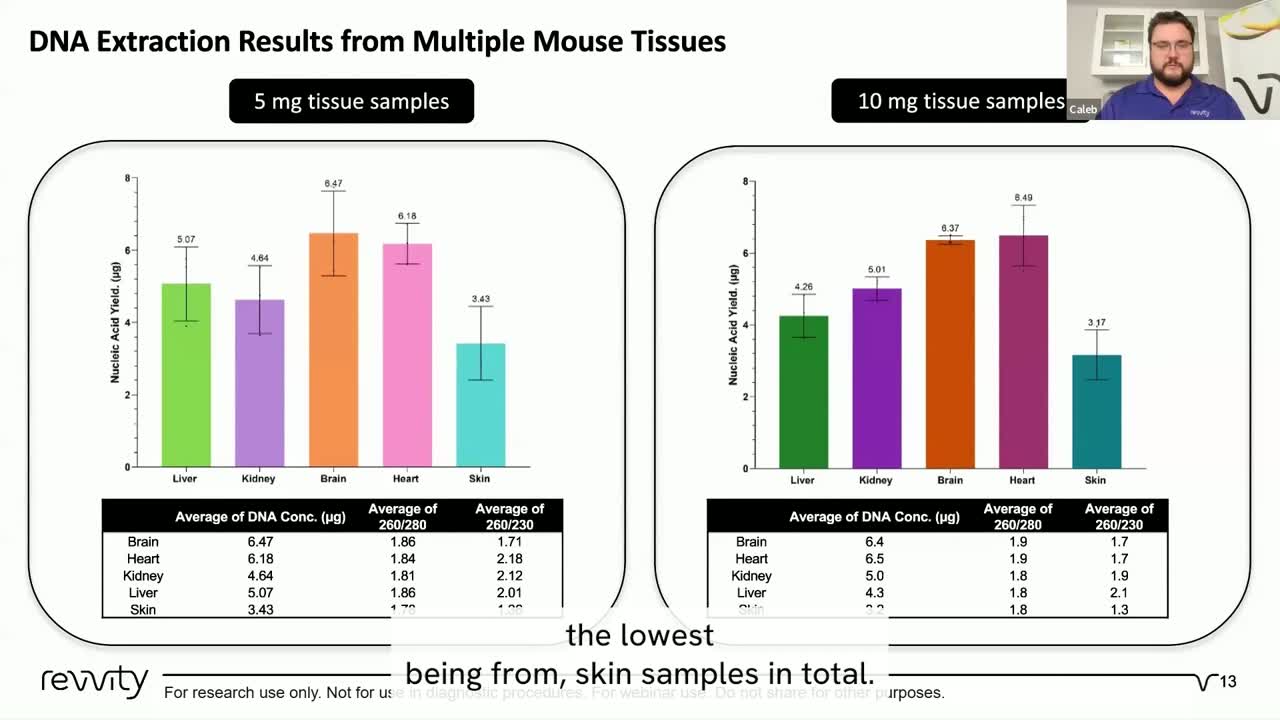
To generate data and technically validate the workflow, we processed the following fresh mouse tissues: liver, heart, kidney, brain, and skin. These were loaded into a prefilled 96-well deep plate containing 1.4 mm ceramic beads and 300 µL of the kit’s lysis buffer at the same parameters listed, except for skin that required an additional 30 sec due to its toughness. After homogenization and tissue lysis, samples were centrifuged and proceeded into manual processing for dual DNA and RNA extraction using magnetic bead-based chemistry, which is compatible with a variety of automated workflows for those working in high-throughput spaces.
Analytes were assessed for general associated QC metrics and concentration. Of note, DNA fragment sizes or similarity in shear within the replicates was observed as proof-of-concept work for sequencing applications. And for RNA, homogenization in this study was performed at room temperature without the use of cryogenics and assessed for yield, OD ratio, and RIN at two starting sample sizes (mg) for each tissue. The intention being, a conceptual foray for labs entering high-throughput processing by maximizing the combination of the speed and robustness of well-plate bead milling with automatability of magnetic bead-based extraction leveraging 96-well plate-based processes in molecular labs.
Our initial results suggest an effective and simplified workflow that leverages rapid room-temp homogenization followed by (cold) temperature-controlled extraction as an effective alternative that helps reduce over-reliance on specialized cryogenic equipment for those more trepidatious about sample RNA integrity.
Read the app note to see the data and connect with us to start the dialogue about scaling your workflows with chemistry-agnostic bead mill homogenization.
For research use only. Not for diagnostic procedures.