



Modern next-generation sequencing (NGS) workflows depend on long synthetic oligonucleotides, used as adapters added during ligation or amplification. In a previous blog we discussed design features that are relevant for NGS adapter performance. In this blog, we focus our attention on the synthesis procedures of these molecules.
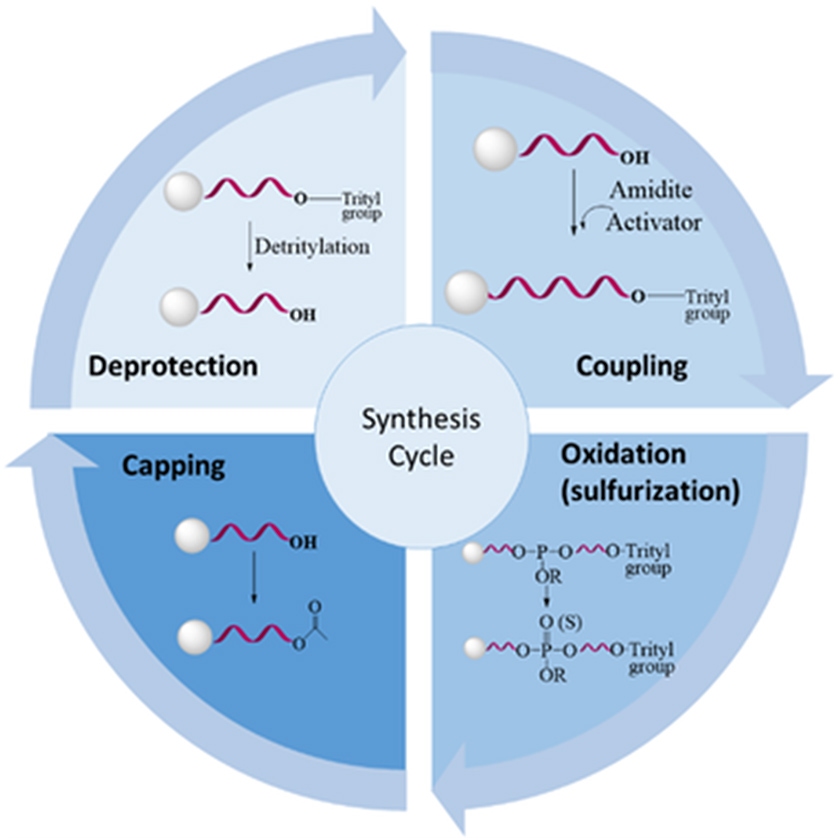
Synthetic oligonucleotides are produced by a stepwise chemical process known as phosphoramidite solid-phase synthesis, which constructs DNA one nucleotide at a time on an inert solid support. Although alternative methods such as enzymatic synthesis and microarray-based approaches exist, phosphoramidite chemistry is by far the most widely used method today. Every cycle adds a single base through four key steps (Figure 1). After the final addition, the oligo is cleaved from the solid support and deprotected.
Figure 1. The four steps of the synthesis cycle using the phosphoramidite approach. From Catani, M.D.L., et al (2020)1.
Adapters can reach 60–75 nt per strand, and sometimes longer when unique molecular identifiers (UMIs) or specialized linkers are incorporated. At these lengths, oligonucleotide synthesis becomes challenging. The reason for this is that each addition step is rarely 100% efficient. The coupling efficiency (denoted as c) is the percentage of growing chains that successfully receive the next nucleotide in each cycle.
Real coupling efficiency reported in the industry is in the range of 98.5–99.6%. A coupling efficiency of 99.6% means that in each round, 0.4% of chains fail to extend correctly. The probability that a chain is complete after N cycles is roughly cᴺ. Thus, with c = 0.996 and N = 70, only ~ 75% of the population is full-length; the rest are truncated.
Impact of truncated species in NGS adapters
Truncated species (n–1, n–2, etc.) retain a free 5′-hydroxyl terminus, identical to that of the full-length species. In NGS adapter manufacturing, a 5′-phosphate modification is introduced so that DNA ligase can covalently attach the adapter to library fragments. This reaction acts on any strand possessing a free 5′-hydroxil. Consequently, truncated oligos generated during synthesis also receive a 5′-phosphate if they survive purification. Once phosphorylated, these shorter species can ligate to library fragments, generating adapter dimers or mis-primed molecules. These artifacts directly lower usable library yield and can distort index balance.
Desalting only removes small molecules, therefore purification by anion exchange and/or HPLC is essential to eliminate incomplete species and enrich the amount of full-length product. These methods are used by all NGS adapter suppliers, including Revvity.
Cross-contamination in high-throughput oligo manufacturing
In large-scale oligonucleotide production facilities, one often-overlooked factor is cross-contamination between synthesis runs. Multiple sources indicate that “carryover” during purification is a principal route by which complete adapters from prior runs can enter subsequent products2-4. Because these contaminants are full-length molecules, they are harder to remove than n-1 species and can persist as low-level “foreign” full-length species in the final product.
Even contamination levels below 0.1% are problematic for NGS adapters, where barcode carryover may manifest as index misassignment or false-positive reads in downstream sequencing2. This source of misassignment is independent of platform-associated index hopping. To mitigate this risk, manufacturing operations apply different methods such as the physical segregation of synthesis batches using dedicated columns.
Revvity uses a proprietary method for NGS barcode adapters manufacturing that has been shown to reduce cross-contamination to levels as low as 0.01%. These safeguards are essential, since even traces of contamination can compromise the detection of low frequency variants in some applications.
Conclusion
The synthesis of NGS adapters approaches the practical limits of phosphoramidite chemistry. For NGS laboratories, the lesson is clear: purity equals performance. Full-length adapter integrity such as the one obtained with the NEXTFLEX™ Barcodes governs ligation efficiency, cluster formation, and sequencing balance, providing the reliability required for consistent library preparation.
References:
- Catani, M.D. L., et al. (2020). Oligonucleotides: Current Trends and Innovative Applications in the Synthesis, Characterization, and Purification. Biotechnology Journal. 15. 1900226. doi:10.1002/biot.201900226.
- Next-Gen Sequencing Oligos Application Note
- Gilar, M., Bouvier, E.S.P. (2000). Purification of crude DNA oligonucleotides by solid-phase extraction and reversed-phase high-performance liquid chromatography. J Chromatogr A. 890(1):167-77. doi: 10.1016/s0021-9673(00)00521-5.
- HPLC Troubleshooting | Thermo Fisher Scientific - ES
For research use only. Not for use in diagnostic procedures.