


For years, the field of cell and gene therapy has been laser-focused on what to edit - which gene, which mutation, which target. But a growing body of evidence is indicating that the editing system itself is one of the biggest drivers of therapeutic success.
Two development teams can share the same genomic target and end up with different outcomes. One program struggles with low viability, high variability, and scaling challenges. The other expands efficiently, delivers a consistent product, and moves forward with confidence. The difference isn't the target; it's the tool used to reach it.
Key takeaways
- The editing system (not just the edit) determines therapeutic outcome
- Nucleases and fixed-architecture base editors each carry inherent limitations
- Modular, decoupled systems enable precision tuning that fused architectures cannot
- Revvity's Pin-point™ base editing platform is purpose-built for controlled, high-performance editing across CGT applications
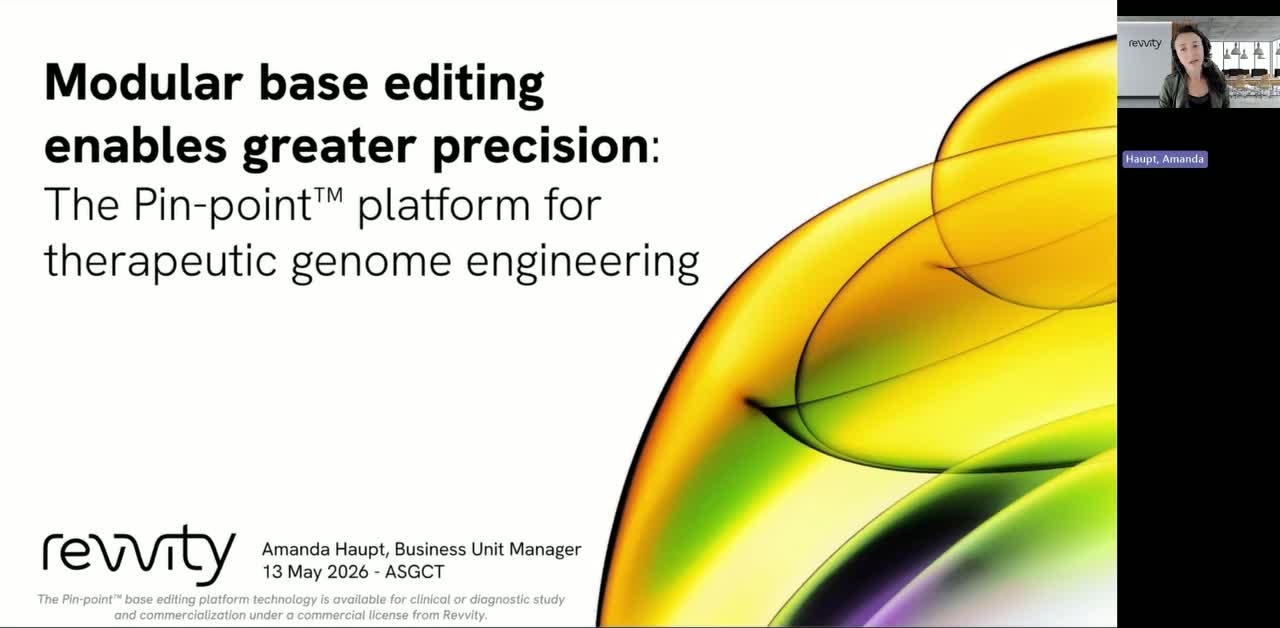
The editing step is no longer a black box
For a long time, the editing step was treated as a means to an end and a necessary but largely opaque step in the manufacturing process.
The field has broadly followed two paths. Nucleases are powerful and efficient, but they introduce double-strand DNA breaks, trigger DNA damage responses, and generate variability that is difficult to control at scale. Base editing was a meaningful step forward, by relying on single nucleotide changes, it avoids double-strand breaks.
But the dominant base editing systems available are built on fixed architectures, where the Cas and deaminase elements are fused into a single protein with two catalytic domains. While these fusion systems have improved cell health compared to nucleases, they don't offer the level of precision and control needed to build the best possible therapies.
What if the system wasn't fused?
This is the foundation on which Revvity's Pin-point base editing platform is built. Rather than accepting the limitations of a fixed architecture, the Pin-point platform is a modular system uniquely designed for highly controlled editing. Each component - the DNA-targeting element (the nickase), the catalytic element (the deaminase), and the guide RNA - is separate and independently configurable. They are brought together through an aptamer-binding protein interaction facilitated by the guide RNA.
This modularity isn't just an architectural detail, it has direct, measurable consequences for what you can achieve in the lab and in the clinic.
Precision you can control
We often think of base editing precision as a fixed property of the enzymes involved. The Pin-point platform demonstrates that it doesn't have to be.
In editing experiments at a target site containing multiple adenines within the editing window, the Pin-point system was able to achieve high on-target editing at the desired position while dramatically reducing bystander edits at a nearby, unwanted site, simply by titrating the amount of deaminase delivered. The same enzymes, configured in a fused architecture, could not replicate this. Reducing the concentration of the fused editor reduced overall editing levels but could not decouple on-target from bystander activity.
Designed for the full spectrum of CGT applications
Precision is one dimension of success but it's not the only one. Depending on the application, the critical metrics shift.
For CAR-T applications, the challenge isn't just editing efficiency; it's maintaining cell performance as the number of simultaneous edits increases. Published data from a collaboration with Rutgers and AstraZeneca demonstrated that a Pin-point cytosine base editor (CBE) achieved protein knockout at all four target sites without enrichment, while preserving cell expansion compared to Cas9-based approaches.
As edits are added in multiplex, Cas9-edited cells show a significant drop in expansion rate, which is most likely driven by the accumulation of double-strand breaks. Cells edited with the Pin-point system do not.
The practical implication is significant as all edits can be made in a single step, reducing manufacturing timelines, lowering costs, and eliminating the need for sequential editing rounds. Recent publications from Carl June's lab further confirm that base-edited cells outperform their Cas9-edited counterparts on every meaningful functional metric.
HSC-based therapies
For therapies derived from hematopoietic stem cells (HSCs), the constraints are different. These edited cells will go on to repopulate the patient's entire immune system, making it critical to maintain stemness, minimize perturbation, and ensure long-term durability.
The Pin-point platform has demonstrated the ability to reproduce published fetal hemoglobin induction phenotypes with high editing purity, while achieving near-baseline results for markers of both DNA damage and apoptosis, a meaningful signal of cellular health preservation.
In vivo gene correction
For in vivo applications, safety and specificity become the primary constraints. The Pin-point platform offers multiple levers to adapt the system to the biology. Enzyme selection, precision tuning, and delivery flexibility, including LNP (RNA-based) and AAV delivery, can be adjusted without requiring a split intein system, thanks to the platform's modular design.
High-throughput screening capabilities allow rapid evaluation of multiple base editor configurations, and an established bioinformatics foundation means that in many cases, the optimal configuration can be predicted upfront, without exhaustive empirical screening in the wet lab.
Through a partnership with Profluent, Revvity is also able to offer novel AI-engineered adenine deaminases with a range of enzymatic properties, now available as Pin-point base editing reagents.
Complex biology demands complex editing
As therapeutic programs become more ambitious, so do the editing requirements. Increasingly, editing systems are being asked to perform multiple tasks simultaneously, such as multiplex knockouts, targeted knock-ins, and combinations of both, without compromising cell health.
The modular architecture of the Pin-point platform makes this possible by tasking a single nickase species with different activities. Guide RNAs containing an aptamer recruit the deaminase to induce base editing at knockout sites. Guide RNAs without an aptamer, designed to work in pairs, drive site-specific knock-in. Both can be delivered in a single reaction.
In a published example in T cells, and replicated in an iPSC line for a collaborator, this approach was used to install four knockouts and a knock-in simultaneously. The entire process, from parental cell line to a fully banked edited clone with five distinct edits, was completed in five passages.
Beyond the efficiency gains, this combined approach also appears to eliminate off-target donor template integration that is observed with standard nuclease methods, a precision advantage with direct implications for therapeutic safety.
The editing system influences therapeutic success
Scaling challenges, variability, and unpredictable precision are not isolated problems but signals of how the editing system is causing cells to react.
With the Pin-point base editing platform, Revvity is giving therapeutic developers access to a tool that addresses these challenges at their root with a modular, tunable, and manufacturable system designed to make higher-precision edits in healthier cells.
The question is no longer whether the editing system matters. It's whether yours is working for you or against you.
Pin-point™ base editing reagents are available for research use only and are not for diagnostic use or direct administration into humans or animals. The Pin-point™ base editing platform technology is available for clinical or diagnostic study and commercialization under a commercial license from Revvity.