


Not all problems are solved once a single clone is selected. While CHO cells are an excellent production system, there are two major issues that hamper biologic productivity [Dahodwala & Lee, 2019]:
- Chromosomal rearrangements and stability issues
- A phenotype characterized by titer instability and product quality instability
Following SCC, constant monitoring is needed to ensure that the clonal pool is table and producing a consistent product. Cultured cells can show decreased recombinant protein production over many passages and during extended periods at the final bioreactor scale [Tharmalingam et al. 2018].
Revvity can be used to monitor cell populations produced from a clonally derived clone, including assessment of:
- Performance
- Productivity
- Product quality characteristics
In collaboration between Revvity and Beth Israel Deaconess Medical Center, Zhang et al. [2017] employed the Celigo™ image cytometer
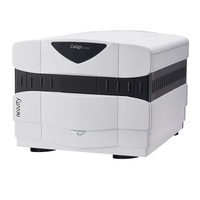
 Celigo Image Cytometer
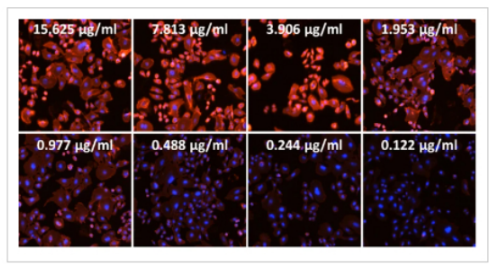
to screen for high protein producers from hybridoma supernatants. Fluorescence labeling of CHO cells (left) with a CD39 antibody was used to determine the amounts of target protein they produced. Different levels of target protein binding showed various fluorescence intensities, and the high intensities were identified as possible hybridoma candidates (green wells, right). The results were validated with standard flow cytometry.
Celigo Image Cytometer
to screen for high protein producers from hybridoma supernatants. Fluorescence labeling of CHO cells (left) with a CD39 antibody was used to determine the amounts of target protein they produced. Different levels of target protein binding showed various fluorescence intensities, and the high intensities were identified as possible hybridoma candidates (green wells, right). The results were validated with standard flow cytometry.
Fluorescence labeling of CHO cells with CD39 antibody
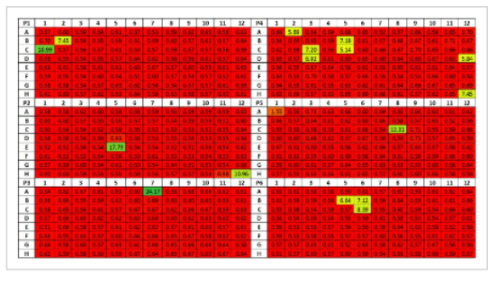
High-intensity levels of target protein binding indicated by green wells
For research use only. Not for use in diagnostic procedures.