
JP

Revvity Sites Globally
Select your location.
*e-commerce not available for this region.

HTRF VHL Red Ligand
HTRF VHL Red Ligand

Revvity Vial from a Kit, Standard, or Control lysate
HTRF VHL-Red Ligand is a derivative of VH-032 and can be used as a fluorescent tracer for HTRF VHL-Red Ligand binding assays, associated with the HTRF VHL Binding kit to investigate cooperativity effects within PROTAC drug discovery.
HTRF VHL-Red Ligand is a derivative of VH-032 and can be used as a fluorescent tracer for HTRF VHL-Red Ligand binding assays, associated with the HTRF VHL Binding kit to investigate cooperativity effects within PROTAC drug discovery.
Product variant
Unit Size: 1 unit
Part #:
64BDVHLRED
For research use only. Not for use in diagnostic procedures. All products to be used in accordance with applicable laws and regulations including without limitation, consumption, and disposal requirements under European REACH regulations (EC 1907/2006).
HTRF VHL Red Ligand
Revvity Vial from a Kit, Standard, or Control lysate
Loading...
Product information
Overview
HTRF VHL-Red Ligand is primarily intended to perform affinity binding curves to VHL protein using HTRF® technology.
VHL, also known as von Hippel-Lindau, is involved in many biological processes and is closely associated with the regulation of angiogenesis, cell growth, or cell survival. VHL is one of the most popular E3 ligases recruited by bifunctional Proteolysis-targeting chimeras (PROTACs) to induce ubiquitination and subsequent proteasomal degradation of a targeted protein. VHL interacts with several proteins to form the functional von Hippel-Lindau ubiquitination complex, in which VHL seems to act as a target recruitment subunit in the E3 ubiquitin ligase complex and targets various proteins to proteolysis, such as the hydroxylated hypoxia-inducible factor (HIF) under normoxic conditions.
Identifying new PROTAC VHL ligands can improve selective proteasomal-dependent degradation of proteins of interest involved in the onset of diseases such as cancers.
The HTRF VHL-Red Ligand is primarily intended to perform cooperativity binding studies. It enables calculation of the affinity of the VHL-Red Ligand for VHL protein in the presence of the targeted protein of interest. The determination of the Bmax and the Kd of HTRF VHL-Red Ligand for VHL protein, in absence and presence of the targeted protein, enables the accurate preliminary analysis required for studying cooperative effects assessed with the HTRF Human VHL Binding Kit.
How it works
HTRF VHL ligand binding assay principle
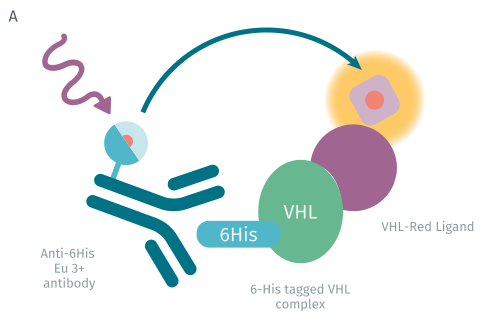
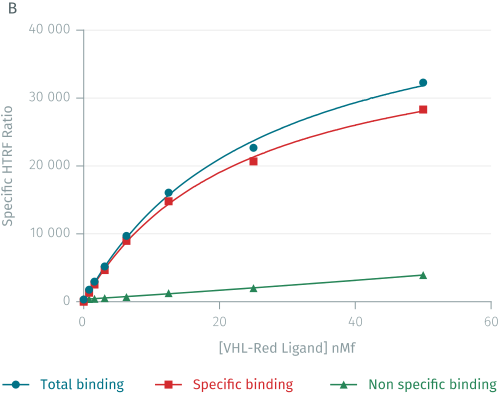
HTRF VHL-Red Ligand binding is detected in a direct binding assay format, using an anti 6His-Europium Cryptate antibody which binds to a 6His-tagged Human VHL protein complex. When the dyes are in close proximity, the excitation of the donor with a light source (laser or flash lamp) triggers a Fluorescence Resonance Energy Transfer (FRET) towards the acceptor, which in turn fluoresces at a specific wavelength (665 nm) (Image A). The specific binding signal is calculated by subtracting the non-specific binding signal from the total signal, enabling Kd determination for the HTRF VHL Red Ligand (Image B).
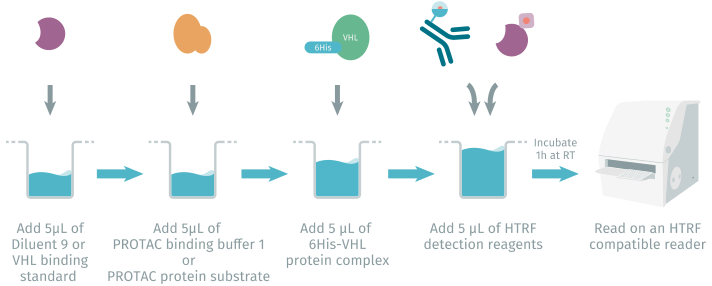
HTRF VHL-Red Ligand binding assay protocol
VHL saturation binding experiments of HTRF VHL-Red Ligand can be run in 384-well plates by dispensing 5 µL of Diluent 9 buffer (for Total binding) or VHL Binding standard (for non specific binding). Then 5 µL of PROTAC Binding Buffer 1 (for reference) or the targeted protein diluted in PROTAC Binding Buffer 1 (for cooperativity studies) are added, followed by 5 µL of 6His-tagged VHL protein complex. Finally, 5 µL of a pre-mixed solution of HTRF VHL-Red Ligand and Anti-6His Europium cryptate antibody are added.
The HTRF Ratio is measured after 1 hour of incubation at room temperature.
Assay details
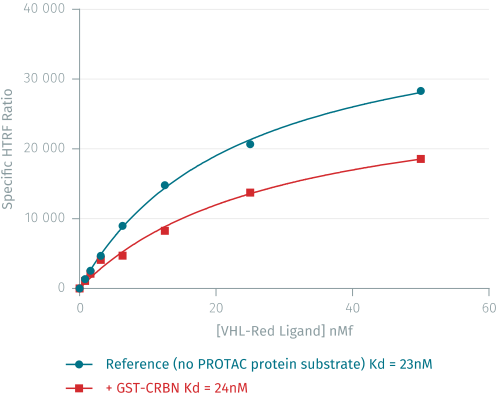
| HTRF VHL-Red Ligand Kd (reference without PROTAC protein substrate) | 24.8 nM +/- 9.7 (2SD) |
Assay validation
Determination of the affinity binding (Kd) of VHL-Red Ligand in the presence of targeted protein
In this example, the binding affinity (Kd) of the VHL-Red Ligand to 6His-VHL protein complex was assessed in the absence or presence of the target protein CRBN as example of preliminary cooperativity studies of CRBN/VHL PROTAC compounds. These results indicate that the presence of 65nM of CRBN protein does not change the Kd of the Red Ligand.
Specifications
| Automation Compatible |
Yes
|
|---|---|
| Brand |
HTRF
|
| Detection Modality |
HTRF
|
| Product Group |
Fluorescent Reagent
|
| Shipping Conditions |
Shipped in Dry Ice
|
| Target |
VHL
|
| Technology |
TR-FRET
|
| Therapeutic Area |
Inflammation
Neuroscience
Oncology & Inflammation
|
| Unit Size |
1 unit
|
Video gallery
HTRF VHL Red Ligand
Resources
Are you looking for resources, click on the resource type to explore further.

Technical Note
How to access true Kd values in Protein-Protein Interaction assays
Investigate the dynamics of Interactions
Kinetic values are of importance for characterizing protein-protein interactions...

Brochure
HTRF assays and reagents product list
Discover the versatility and precision of Homogeneous Time-Resolved Fluorescence (HTRF) technology. Our HTRF portfolio offers a...

Guide
HTRF solutions, guide to major applications
This guide provides you an overview of HTRF applications in several therapeutic areas.
Guide
The ultimate guide to PPI assays with HTRF
Your dream assay does not exist yet? Create it!
This guide will provide you with tools to help you develop your very own protein...
Loading...


How can we help you?
We are here to answer your questions.