
JP

Revvity Sites Globally
Select your location.
*e-commerce not available for this region.

HTRF Human Total SYK Detection Kit, 500 Assay Points

HTRF Human Total SYK Detection Kit, 500 Assay Points

generic HTRF total primary image
The Total SYK kit is designed to monitor the expression level of cellular SYK (Spleen Tyrosine Kinase), and can be used as a normalization assay for the Phospho-SYK (Tyr525/526) kit.
| Feature | Specification |
|---|---|
| Application | 細胞シグナル伝達 |
| Sample Volume | 16 µL |
The Total SYK kit is designed to monitor the expression level of cellular SYK (Spleen Tyrosine Kinase), and can be used as a normalization assay for the Phospho-SYK (Tyr525/526) kit.
Product variants
Unit Size: 500 assay points
Part #:
64SYKTPEG
Unit Size: 10,000 assay points
Part #:
64SYKTPEH
Unit Size: 50,000 assay points
Part #:
64SYKTPEY
For research use only. Not for use in diagnostic procedures. All products to be used in accordance with applicable laws and regulations including without limitation, consumption, and disposal requirements under European REACH regulations (EC 1907/2006).
HTRF Human Total SYK Detection Kit, 500 Assay Points
generic HTRF total primary image
Loading...
Product information
Overview
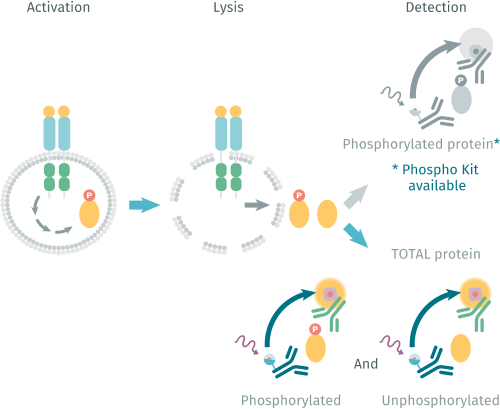
The Total SYK cellular assay monitors total SYK, and can be used as a normalization assay with our phospho-SYK (Tyr525/526) kit. This kit is compatible with the buffers from the phospho-SYK kit, so the same lysate can be used for analyses of both the phosphorylated and the total protein populations.
SYK (Spleen Tyrosine Kinase) is a cytoplasmic tyrosine/serine kinase which plays a crucial role in signal transduction, especially in immune cells such as B cells, macrophages, microglia (brain-resident macrophages), neutrophils and mast cells. Upon cell stimulation, SYK interacts with the cytoplasmic domains of activated immune receptors and binds to the specific phosphorylated receptor motifs (called "p-ITAMs"), leading to its activation by auto-phosphorylation of its catalytic domain at Tyr525/526.
SYK phosphorylation is a readout of key inflammatory pathways such as BCR, FcR and TREM2 signaling pathways that are altered in various pathologies such as auto-immune diseases, neurodegeneration, cancers and allergic disorders.
How it works
Total-SYK assay principle
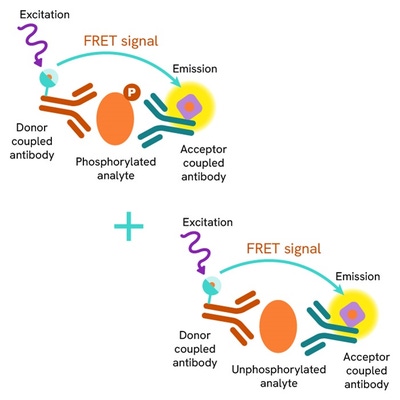
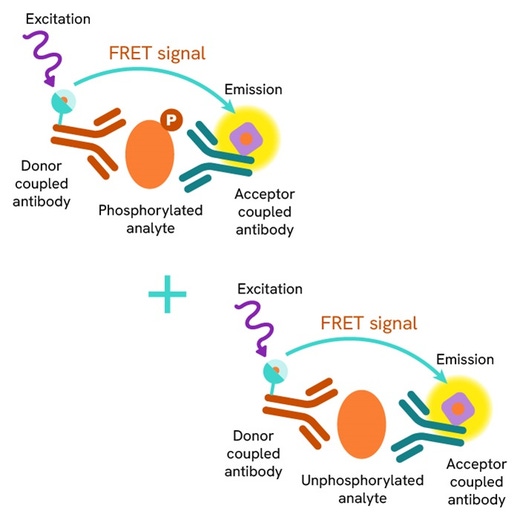
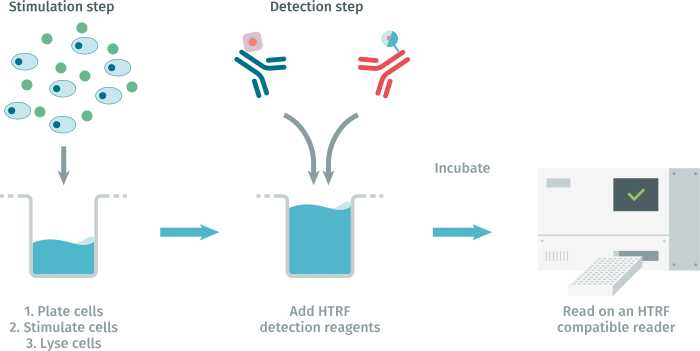
The Total SYK assay quantifies the expression level of SYK in a cell lysate. Unlike Western Blot, the assay is entirely plate-based and does not require gels, electrophoresis, or transfer. The Total-SYK assay uses two labeled antibodies, one coupled to a donor fluorophore and the other to an acceptor. Both antibodies are highly specific for a distinct epitope on the protein. In the presence of SYK in a cell extract, the addition of these conjugates brings the donor fluorophore into close proximity with the acceptor and thereby generates a FRET signal. Its intensity is directly proportional to the concentration of the protein present in the sample, and provides a means of assessing the protein's expression under a no-wash assay format.
Total-SYK two-plate assay protocol
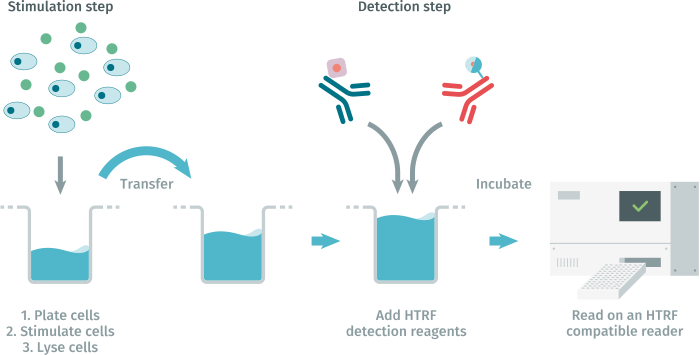
The two-plate protocol involves culturing cells in a 96-well plate before lysis, then transferring lysates to a 384-well low volume detection plate before the addition of Total-SYK HTRF detection reagents. This protocol enables the cells' viability and confluence to be monitored.
Total-SYK one-plate assay protocol
Detection of Total SYK with HTRF reagents can be performed in a single plate used for culturing, stimulation, and lysis. No washing steps are required. This HTS designed protocol enables miniaturization while maintaining robust HTRF quality.
Assay validation
SYK activation in anti-IgM-stimulated Ramos B cells
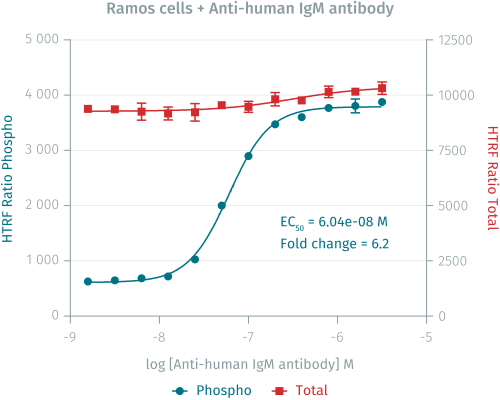
The human B cell lymphoma Ramos cell line was seeded in a half 96-well culture-treated plate at 100,000 cells/well in 20 µL FBS-free culture medium. After an overnight incubation at 37 °C, 5% CO2, cells were stimulated with 10 µL of increasing concentrations of an anti-human IgM antibody for 10 minutes, and then lyzed with 10 µL of supplemented lysis buffer #3 (4X) for 30 minutes at RT under gentle shaking. For the detection step, 16 µL of cell lysate were transferred into a 384-well low volume white microplate and 4 µL of the HTRF Phospho-SYK (Tyr525/526) or Total-SYK detection reagents were added. The HTRF signal was recorded after an overnight incubation.
The anti-human IgM antibody induced a dose-dependent increase in SYK phosphorylation at Tyr525/526 without changing the expression level of the protein, demonstrating the activation of the BCR complex at the cell surface.
SYK inhibition in macrophage-differentiated THP-1 cells treated with P505-15
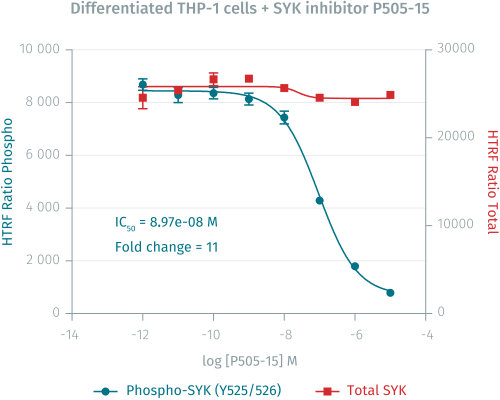
The human monocytic THP-1 cell line was seeded in a 96-well culture-treated plate at 200,000 cells/well and differentiated into macrophages by incubation with 100 ng/mL PMA for 24h at 37 °C, 5% CO2. After differentiation, cells were first treated with increasing doses of the SYK inhibitor P505-15 for 1h, and then with 250 µM pervanadate for 10 minutes. After treatment, cells were lyzed with 50 µL of supplemented lysis buffer #3 (1X) for 30 minutes at RT under gentle shaking, and 16 µL of cell lysate were transferred into a 384-well low volume white microplate before the addition of 4 µL of the HTRF Phospho-SYK (Tyr525/526) or Total-SYK detection reagents. The HTRF signal was recorded after an overnight incubation.
As expected, the SYK inhibitor P505-15 induced a dose-dependent decrease in SYK phosphorylation at Tyr525/526, while the expression level of the kinase was not modulated by the treatment.
HTRF total SYK assay compared to Western Blot
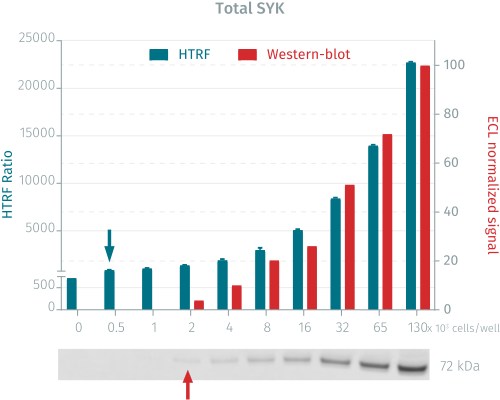
The human B cell lymphoma Ramos cell line was cultured in a T175 flask in complete culture medium for 48h at 37 °C, 5% CO2. After centrifugation, pelleted cells were stimulated with 20 µg/mL of an anti-human IgM antibody for 10 minutes, and after an additional centrifugation step, cells were lyzed with 10 mL of supplemented lysis buffer #3 (1X) for 30 minutes at RT under gentle shaking.
Serial dilutions of the cell lysate were performed using supplemented lysis buffer, and 16 µL of each dilution were transferred into a low volume white microplate before the addition of 4 µL of HTRF total-SYK detection reagents. Equal amounts of lysates were used for a side by side comparison between HTRF and Western Blot.
Using the HTRF total-SYK assay, 500 cells/well were enough to detect a significant signal, while 2,000 cells were needed to obtain a minimal chemiluminescent signal using Western Blot. Therefore in these conditions, the HTRF total-SYK assay was 4 times more sensitive than the Western Blot technique.
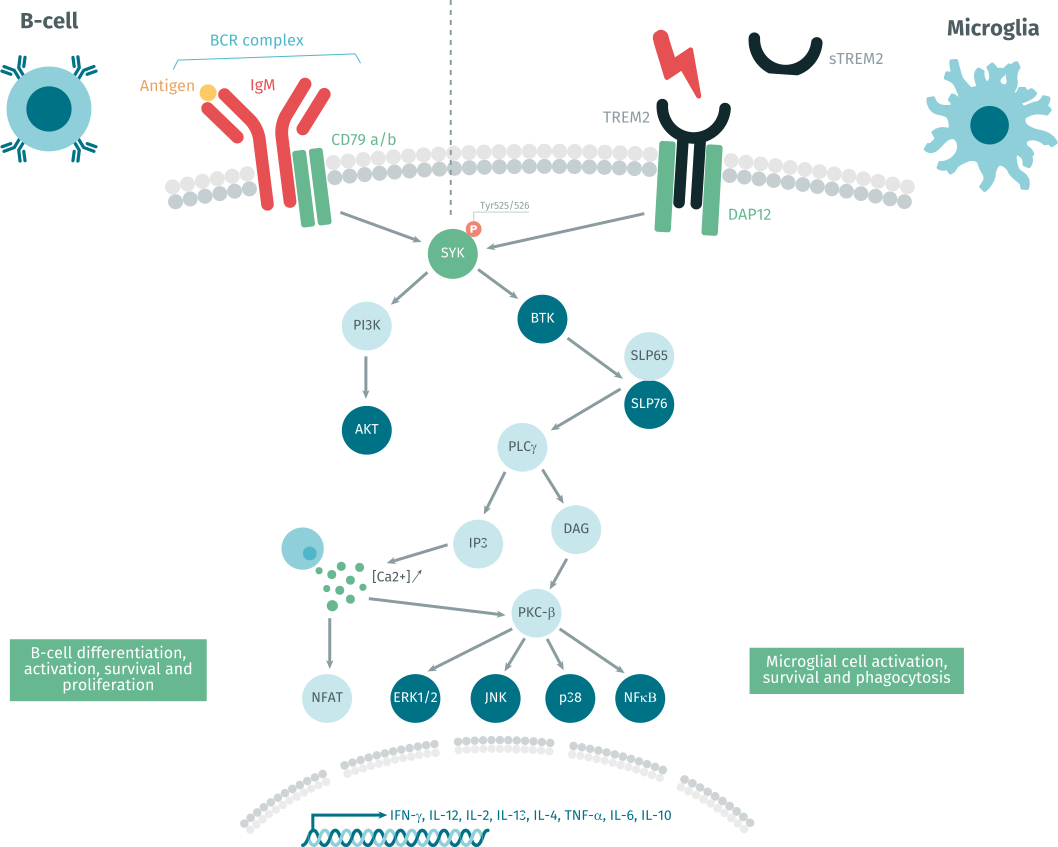
Simplified pathway
Simplified pathway of SYK signaling
SYK (Spleen Tyrosine Kinase) is a cytoplasmic tyrosine/serine kinase which plays a crucial role in signal transduction, especially in immune cells such as B cells and microglia (brain-resident macrophages).
Upon stimulation of B cell or TREM2/DAP12 receptor complexes, SYK interacts with the cytoplasmic domains of CD79 subunits or DAP12 respectively by binding to their specific phosphorylated receptor motifs, called 'p-ITAMs'. This leads to SYK activation by auto-phosphorylation of its catalytic domain at Tyr525/526. SYK in turn phosphorylates downstream substrates such as BTK, triggering the activation of multiple signaling pathways and cellular responses, including cell activation, proliferation, and survival.
Specifications
| Application |
Cell Signaling
|
|---|---|
| Automation Compatible |
Yes
|
| Brand |
HTRF
|
| Cellular or Signaling Pathway |
TREM2 signaling
|
| Detection Modality |
HTRF
|
| Lysis Buffer Compatibility |
Lysis Buffer 2
Lysis Buffer 3
|
| Molecular Modification |
Total
|
| Product Group |
Kit
|
| Sample Volume |
16 µL
|
| Shipping Conditions |
Shipped in Dry Ice
|
| Target |
SYK
|
| Target Class |
Phosphoproteins
|
| Target Species |
Human
|
| Technology |
TR-FRET
|
| Therapeutic Area |
Neuroscience
Oncology & Inflammation
|
| Unit Size |
500 assay points
|
Video gallery
HTRF Human Total SYK Detection Kit, 500 Assay Points
Resources
Are you looking for resources, click on the resource type to explore further.

Brochure
HTRF assays and reagents product list
Discover the versatility and precision of Homogeneous Time-Resolved Fluorescence (HTRF) technology. Our HTRF portfolio offers a...
Loading...


How can we help you?
We are here to answer your questions.