
JP

Revvity Sites Globally
Select your location.
*e-commerce not available for this region.

HTRF Human KEAP1 Binding Kit, 500 Assay Points
 View All
HTRF Human KEAP1 Binding Kit, 500 Assay Points
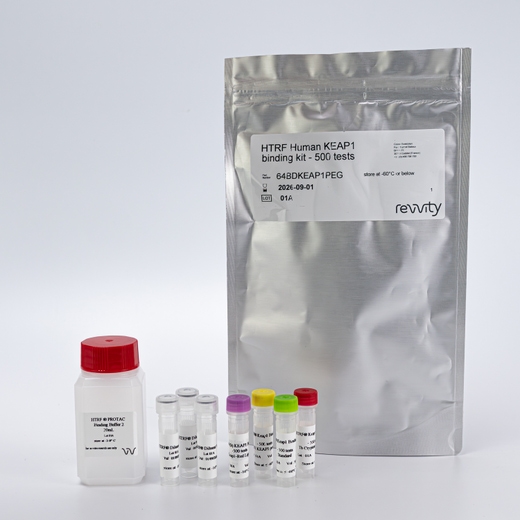
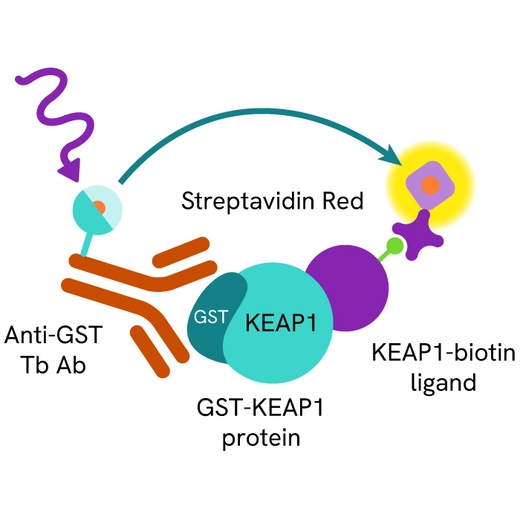

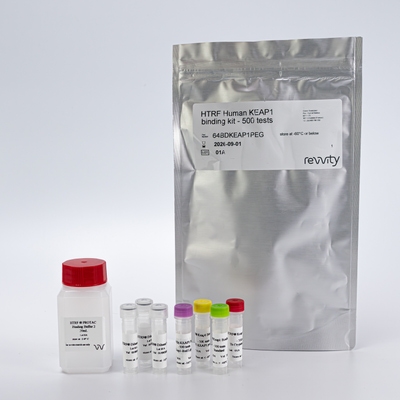
Photo of KEAP1 Kit
The KEAP1 binding assay is designed to screen and characterize compounds that specifically bind to the E3 ligase, KEAP1.
| Feature | Specification |
|---|---|
| Application | タンパク質定量 |
| Sample Volume | 5 µL |
The KEAP1 binding assay is designed to screen and characterize compounds that specifically bind to the E3 ligase, KEAP1.
Product variants
Unit Size: 500 assay points
Part #:
64BDKEAP1PEG
Unit Size: 10,000 assay points
Part #:
64BDKEAP1PEH
For research use only. Not for use in diagnostic procedures. All products to be used in accordance with applicable laws and regulations including without limitation, consumption, and disposal requirements under European REACH regulations (EC 1907/2006).
HTRF Human KEAP1 Binding Kit, 500 Assay Points
Photo of KEAP1 Kit
Loading...
Product information
Overview
The KEAP1-NRF2-ARE pathway plays an important role in the response to oxidative stress and in maintaining redox homeostasis. KEAP1 (Kelch-like ECH-associated protein 1) is an adaptor subunit of the Cullin 3-based E3 ubiquitin ligase, involved in oxidative stress response. By promoting UPS mediated degradation, KEAP1 controls the expression level of NRF2, a key transcription that regulates the expression of antioxidant proteins, therefore ensuring cells' protection from oxidative stress. Sustained activation of NRF2 has been associated with cancer resistance, and its inhibition has been shown to weaken drug resistance. Targeted protein degradation (TPD) uses small molecules to recruit E3 ubiquitin ligases into the proximity of the targeted protein of interest, promoting its ubiquitination-dependent degradation. Exploiting KEAP1 inhibitors for the development of bifunctional Proteolysis-targeting chimeras (PROTACs) is expected to expand the toolbox of E3 ligases to the removal of undesired proteins (e.g. NRF2) involved in various diseases such as cancers, neurodegenerative diseases, and metabolic disorders.
How it works
Assay principle
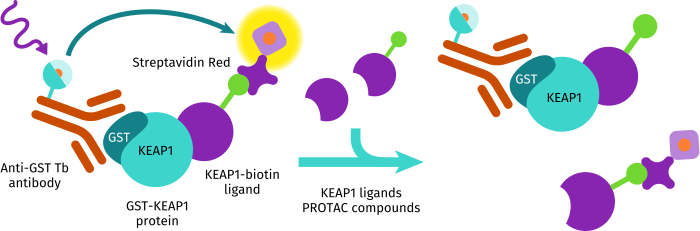
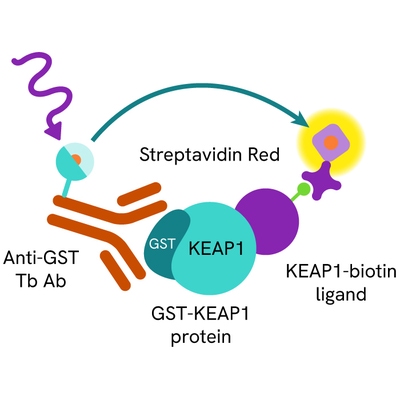
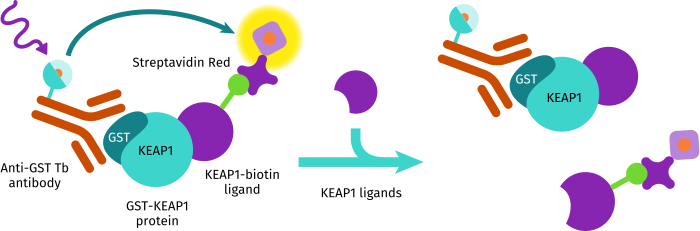
The HTRF Human KEAP1 Binding Kit is a competitive assay format implementing a KEAP1-Red Ligand, a GST-tagged human KEAP1 protein complex, and an anti GST Terbium Cryptate-labeled antibody. KEAP1 binding compounds compete with the KEAP1-Red Ligand and thereby prevent FRET from occurring.
Assay protocol
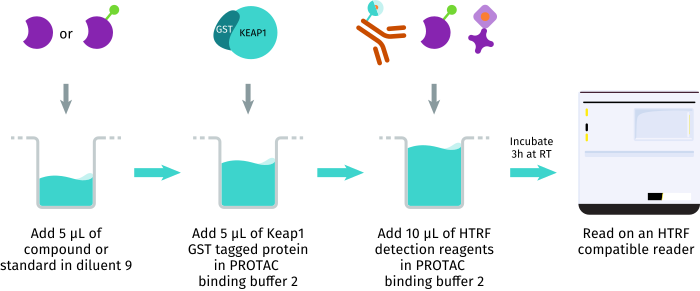
The KEAP1 binding assay can be run in 96- or 384-well low volume white plates (20 µL final). As described here, samples or standards are dispensed directly into the assay plate. The GST-tagged KEAP1 protein complex is then added, followed by the dispensing of the HTRF reagents: The anti GST antibody labeled with Terbium cryptate and the KEAP1 Ligand labeled with a Red HTRF acceptor. The reagents labeled with HTRF fluorophores may be pre-mixed and added in a single dispensing step. No washing steps are needed. The protocol can be further miniaturized or upscaled by simply resizing each addition volume proportionally.
Assay validation
Screening of KEAP1 orthosteric and non orthosteric (allosteric) ligands
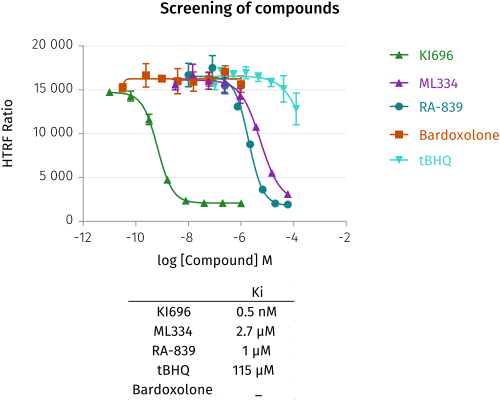
Orthosteric KEAP1 compounds such as Ki696 and ML334, as well as allosteric KEAP1 compounds such as Bardoxolone, were characterized according to the protocol described in the manual.
Potency and pharmacological ranking of Ki696 and ML334 were consistent with the literature. On the other hand, Bardoxolone did not compete with the KEAP1 fluorescent ligand. This was unexpected.
Ki696 effect on HTRF KEAP1 binding assay and HTRF Total NRF2 assay
NRF2 protein expression is controled by the KEAP1 E3 ligase complex, which mediates its rapid degradation by the proteasome. The orthosteric compound Ki696 binds to KEAP1 protein, disrupting NRF2-KEAP1 interaction and leading to an NRF2 expression level increase. Therefore monitoring the NRF2 expression level is a valuable readout of KEAP1 ligands' mechanism of action.
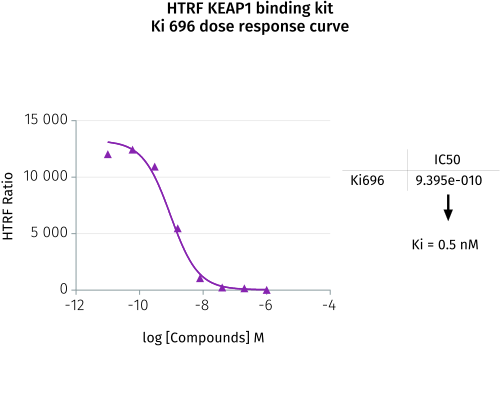
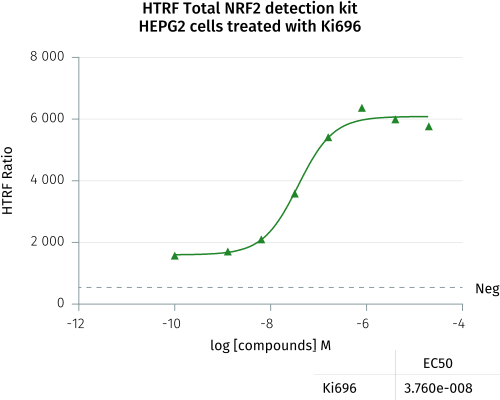
Here, the KI696 KEAP1 orthosteric ligand was characterized with the biochemical HTRF KEAP1 binding kit (64BDKEAP1PEG) as well as the cell-based HTRF Total NRF2 detection kit (64NRF2TPEG).
The cell-based Total NRF2 kit assay was performed in HepG2 cells (200,000 cells/96 well) treated with increasing concentrations of Ki696 (overnight).
Our results show that Ki696 IC50/EC50 determined in biochemical and cell-based experiments are consistent (1nM and 40nM respectively).
DMSO effect on assay performance
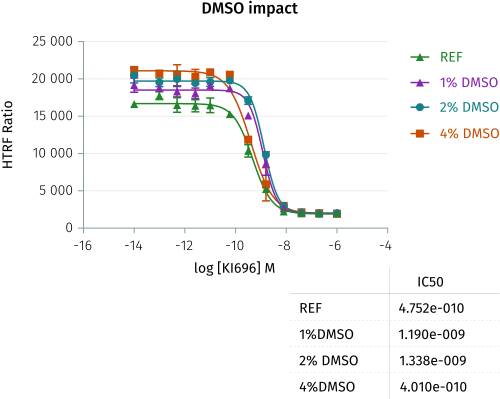
The HTRF KEAP1 Binding kit performance was evaluated in the presence of different DMSO percentages (1% up to 4% final). Our results indicate that the assay window, as well as the pharmacology, are not significantly impacted by increasing DMSO concentrations (at least up to 4%).
Specifications
| Application |
Protein Quantification
|
|---|---|
| Automation Compatible |
Yes
|
| Brand |
HTRF
|
| Detection Modality |
HTRF
|
| Product Group |
Kit
|
| Sample Volume |
5 µL
|
| Shipping Conditions |
Shipped in Dry Ice
|
| Target |
KEAP1
|
| Target Class |
Biomarkers
|
| Target Species |
Human
|
| Technology |
TR-FRET
|
| Unit Size |
500 assay points
|
Video gallery
HTRF Human KEAP1 Binding Kit, 500 Assay Points
Resources
Are you looking for resources, click on the resource type to explore further.

Brochure
HTRF assays and reagents product list
Discover the versatility and precision of Homogeneous Time-Resolved Fluorescence (HTRF) technology. Our HTRF portfolio offers a...

Guide
HTRF solutions, guide to major applications
This guide provides you an overview of HTRF applications in several therapeutic areas.

Flyer
Reagent solutions for targeted protein degradation
Proteolysis Targeting Chimaeras (PROTACs) are innovative small molecules that revolutionize drug discovery. They consist of two...
Loading...


How can we help you?
We are here to answer your questions.