
JP

Revvity Sites Globally
Select your location.
*e-commerce not available for this region.

HTRF Human IL-21 Detection Kit, 500 Assay Points
HTRF Human IL-21 Detection Kit, 500 Assay Points
Generic HTRF cytokine image
The HTRF Human IL-21 detection kit is an immunoassay developed for the simple, rapid detection and quantification of soluble human IL-21 protein in cell supernatant, in a homogeneous (no wash steps, no separation steps) format.
| Feature | Specification |
|---|---|
| Application | タンパク質定量 |
| Dynamic Range | 82,9-2000 pg/mL |
| Limit of Detection | 8 pg/mL |
| Limit of Quantification | 37 pg/mL |
| Sample Volume | 14 µL |
The HTRF Human IL-21 detection kit is an immunoassay developed for the simple, rapid detection and quantification of soluble human IL-21 protein in cell supernatant, in a homogeneous (no wash steps, no separation steps) format.
Product variants
Unit Size: 500 Assay Points
Part #:
62HIL21PEG
Unit Size: 10,000 Assay Points
Part #:
62HIL21PEH
For research use only. Not for use in diagnostic procedures. All products to be used in accordance with applicable laws and regulations including without limitation, consumption and disposal requirements under European REACH regulations (EC 1907/2006).
HTRF Human IL-21 Detection Kit, 500 Assay Points
Generic HTRF cytokine image
Loading...
Product information
Overview
IL-21 (interleukin-21) is a type I cytokine belonging to the common gamma chain cytokine family. It is mainly produced by activated CD4⁺ T cells, particularly T follicular helper and Th17 subsets. IL-21 signals through a heterodimeric receptor and activates JAK1 and JAK3, leading to phosphorylation and activation of STAT3. IL-21 exerts a broad range of immune-modulatory effects on T cells, B cells, NK cells, dendritic cells, and macrophages, making it a central player in immune regulation, inflammation, and tumor immunity.
HTRF assays offer many advantages over other technologies:
- Homogeneous add-and-read format
- No wash steps
- Low background
- Straightforward miniaturization from 96- or 384-well microplates to high density assay formats such as 384-well low volume and 1536-well plates
- Stable signal, providing flexibility in readout time or assay size
How it works
Principle of the HTRF human IL-21 assay
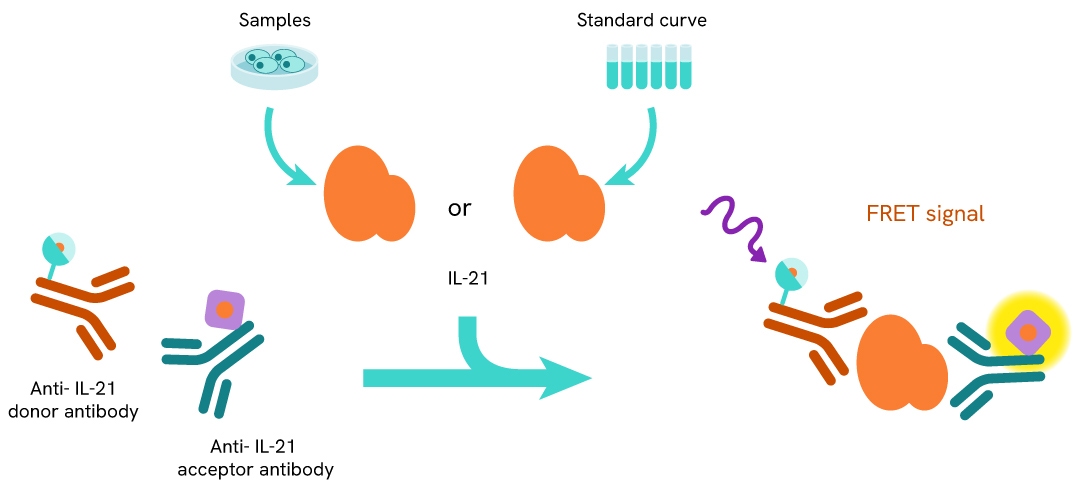
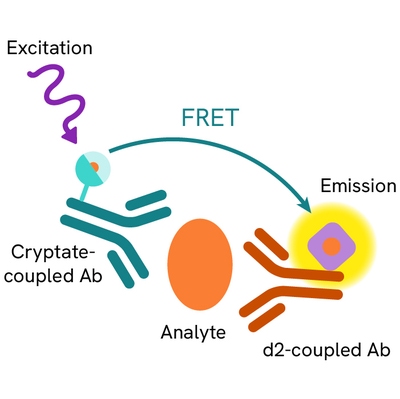
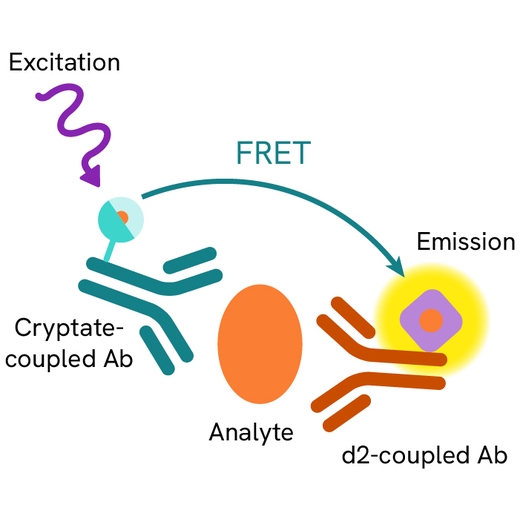
The HTRF human IL-21 assay is based on a TR-FRET sandwich immunoassay involving two specific antibodies, one labelled with Eu3+-cryptate (donor) and the other with d2 (acceptor). Both antibodies bind to soluble human IL-21, and the donor-acceptor proximity leads to a fluorescent TR-FRET signal. The intensity of the signal is directly proportional to the concentration of soluble IL-21 present in the sample.
Protocol of the HTRF human IL-21 assay
The HTRF human IL-21 assay can be run in a 96- or 384-well low volume white detection plate (20 µL final). As shown here, samples or standards are dispensed directly into the assay plate for the detection of IL-21 by HTRF reagents. The antibodies labelled with HTRF fluorophores may be pre-mixed and added in a single dispensing step. No washing steps are needed. The protocol can be further miniaturized or upscaled by simply resizing each addition volume proportionally.
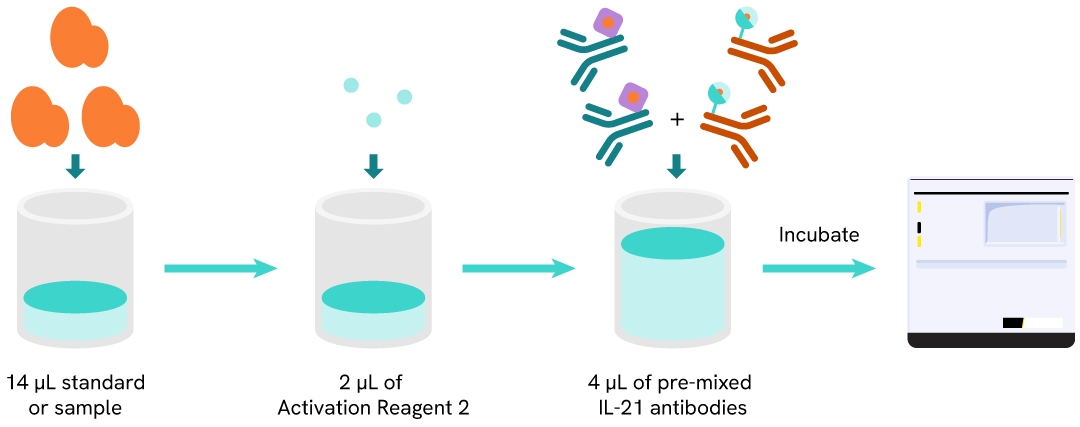
Assay details
| Sample size | 14 µL |
|---|---|
| Final assay volume | 20 µL |
| Kit component | Lyophilized standard, frozen detection antibodies & buffers |
| LOD & LOQ (in Diluent) | 8 & 37 pg/mL |
| LOD & LOQ (in RPMI) | 9 & 51 pg/mL |
| LOD & LOQ (in DMEM) | 13 & 43 pg/mL |
| Range | 82.9 - 2000 pg/mL |
| Time to result | 3h at RT |
| Species | Human |
Analytical performance
Intra-assay precision table
Each of the 3 samples was measured 24 times, and the %CV was calculated for each sample. Samples were human recombinant IL-21.
| Sample | Mean [IL-21] pg/ml | CV |
|---|---|---|
| 1 | 180 | 10% |
| 2 | 463 | 13% |
| 3 | 1541 | 13% |
| Mean CV | 12% |
Inter-assay precision table
Each of the samples was measured in 3 independent experiments (3 separate days), and the %CV was calculated for each sample. Samples were human recombinant IL-21.
| Sample | Mean [IL-21] pg/ml | CV |
|---|---|---|
| 1 | 280 | 3% |
| 2 | 579 | 7% |
| 3 | 1648 | 1% |
| Mean CV | 4% |
Dilution linearity
The recovery percentages obtained from these experiments show the good dilution linearity of the assay. Human recombinant IL-21 was diluted in RPMI cell medium.
| Dilution factor | Expected [IL-21] pg/mL | Measured [IL-21] pg/mL | % dilution recovery |
|---|---|---|---|
| Neat | 1097 | 1097 | 100% |
| 2 | 548 | 608 | 111% |
| 4 | 274 | 300 | 109% |
| 8 | 137 | 160 | 117% |
| 16 | 69 | 78 | 113% |
Spike and recovery
A known amount of recombinant IL-21 was spiked into a dilution of supernatant from PBMC culture medium stimulated with PMA and ionomycin. The expected concentrations were compared to those measured in order to compute antigen recoveries (acceptance criteria: 80-120%). A 100% recovery indicates similar measurements of cytokine from a sample and the kit standard.
| Standard [IL-21] pg/mL | Native [IL-21] pg/mL | Expected [IL-21] pg/mL | Obtained [IL-21] pg/mL | Recovery % |
|---|---|---|---|---|
| 213 | 0 | 213 | 204 | 96% |
| 213 | 100 | 313 | 295 | 94% |
| 213 | 193 | 406 | 392 | 97% |
| 213 | 606 | 819 | 790 | 96% |
| 213 | 975 | 1188 | 1160 | 98% |
Cross-reactivity
Cross reactivities were assessed using recombinant proteins tested at a concentration of 2000 pg/mL. Signals were interpolated on the assay standard curve to calculate concentrations. The assay is only compatible with human IL-21.
| Tested protein | Cross reactivity |
|---|---|
| Human IL-21 | 100% |
| Mouse IL-21 | 0% |
Assay validation
Validation of HTRF human IL-21 detection kit on PBMC cell supernatant
Human PBMCs (peripheral blood mononuclear cells) were seeded at 100,000 to 800,000 cells in a 96-well culture-treated plate in RPMI + 10% FBS medium, and stimulated with PMA (50ng/mL) and ionomycin (1µg/mL) for 48 hours at 37°C. Then 14 µL of supernatant were transferred into a white detection plate and 2 µL of activation reagent-2 and 4 µL of the pre-mixed HTRF IL-21 detection reagents were added. The HTRF signal was recorded after 3 hours of incubation at room temperature. The standard curve prepared in RPMI + 10% FBS allowed the interpolation of the human IL-21 concentration in each sample.
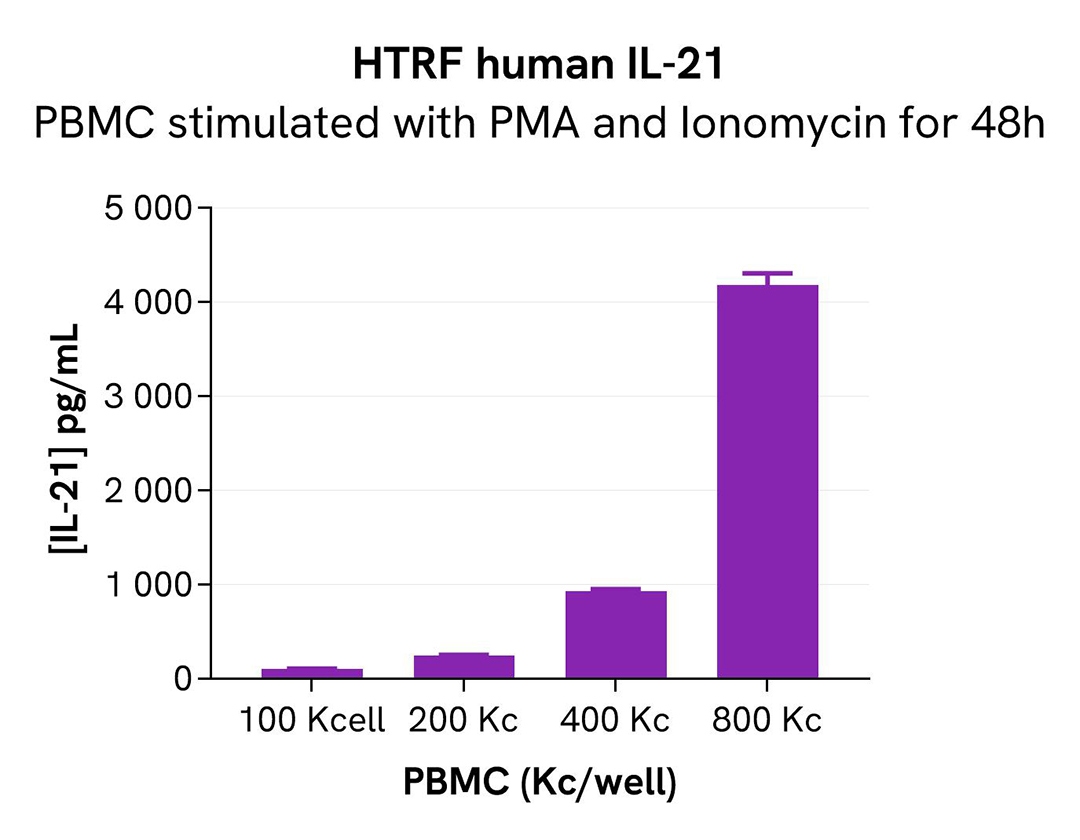
Validation of HTRF human IL-21 detection on PMA and ionomycin treated PBMC cells
Human PBMC cells were seeded at 400,000 cells in a 96-well culture-treated plate in RPMI + 10% FBS culture medium and stimulated with increasing concentrations of PMA and Ionomycin for 48 hours at 37°C. Then 14 µL of supernatant were transferred into a white detection plate and 2 µL of activation reagent 2 and 4 µL of the pre-mixed HTRF IL-21 detection reagents were added. The HTRF signal was recorded after 3 hours of incubation at room temperature. The standard curve prepared in RPMI + 10% FBS allowed the interpolation of the human IL-21 concentration in each sample.
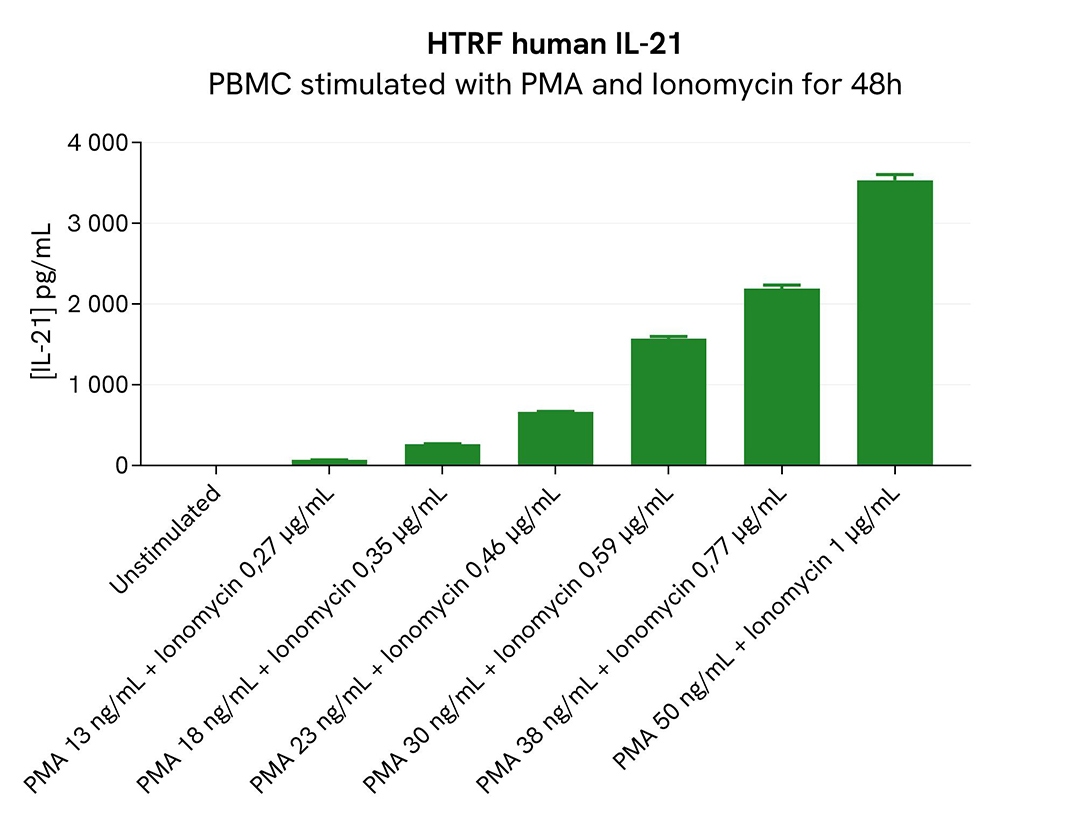
Specifications
| Application |
Protein Quantification
|
|---|---|
| Automation Compatible |
Yes
|
| Brand |
HTRF
|
| Detection Modality |
HTRF
|
| Dynamic Range |
82,9-2000 pg/mL
|
| Limit of Detection |
8 pg/mL
|
| Limit of Quantification |
37 pg/mL
|
| Product Group |
Kit
|
| Sample Volume |
14 µL
|
| Shipping Conditions |
Shipped in Dry Ice
|
| Target |
IL-21
|
| Target Class |
Cytokine
|
| Target Species |
Human
|
| Technology |
TR-FRET
|
| Unit Size |
500 Assay Points
|
Resources
Are you looking for resources, click on the resource type to explore further.
Loading...


How can we help you?
We are here to answer your questions.