
JP

Revvity Sites Globally
Select your location.
*e-commerce not available for this region.

HTRF Human and Mouse Total β-Catenin Detection Kit, 500 Assay Points
HTRF Human and Mouse Total β-Catenin Detection Kit, 500 Assay Points

generic HTRF total primary image

The total beta-Catenin kit monitors cytosolic total beta-Catenin and can be used as a normalization assay for the phospho beta-Catenin kit.
| Feature | Specification |
|---|---|
| Application | 細胞シグナル伝達 |
| Sample Volume | 16 µL |
The total beta-Catenin kit monitors cytosolic total beta-Catenin and can be used as a normalization assay for the phospho beta-Catenin kit.
Product variants
Unit Size: 500 assay points
Part #:
64NCAPEG
Unit Size: 10,000 assay points
Part #:
64NCAPEH
Unit Size: 50,000 assay points
Part #:
64NCAPEY
For research use only. Not for use in diagnostic procedures. All products to be used in accordance with applicable laws and regulations including without limitation, consumption, and disposal requirements under European REACH regulations (EC 1907/2006).
HTRF Human and Mouse Total β-Catenin Detection Kit, 500 Assay Points
generic HTRF total primary image
HTRF Human and Mouse Total β-Catenin Detection Kit, 500 Assay Points
Product information
Overview
The Total ß-Catenin cellular assay offers a robust monitoring of total ß-Catenin, and is used as a normalization assay with the phospho ß-Catenin kit. Total ß-Catenin is an important co-transcriptional activator of many significant genes involved in embryonic development, adult homeostasis, and cell proliferation.
HTRF assays offer many advantages over other technologies:
- Homogeneous add-and-read format
- No wash steps
- Low background
- Straightforward miniaturization from 96- or 384-well microplates to high density assay formats such as 384-well low volume and 1536-well plates
- Stable signal, providing flexibility in time of readout or size of assays
How it works
Total-ß-Catenin assay principle
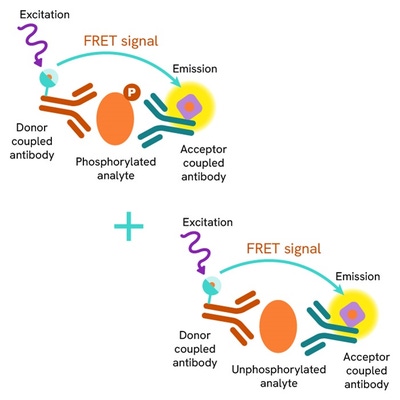
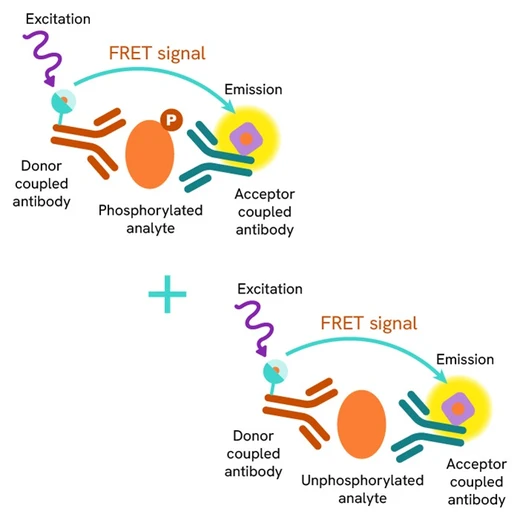
The Total-ß-Catenin assay quantifies the expression level of ß-Catenin in a cell lysate. Contrary to Western Blot, the assay is entirely plate-based and does not require gels, electrophoresis or transfer. The Total-ß-Catenin assay uses two labeled antibodies: one coupled to a donor fluorophore, the other to an acceptor. Both antibodies are highly specific for a distinct epitope on the protein. In presence of ß-Catenin in a cell extract, the addition of these conjugates brings the donor fluorophore into close proximity with the acceptor and thereby generates a FRET signal. Its intensity is directly proportional to the concentration of the protein present in the sample, and provides a means of assessing the proteins expression under a no-wash assay format.
Total-ß-Catenin 2-plate assay protocol
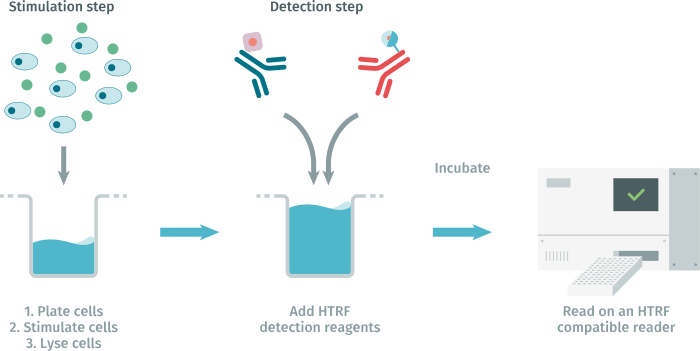
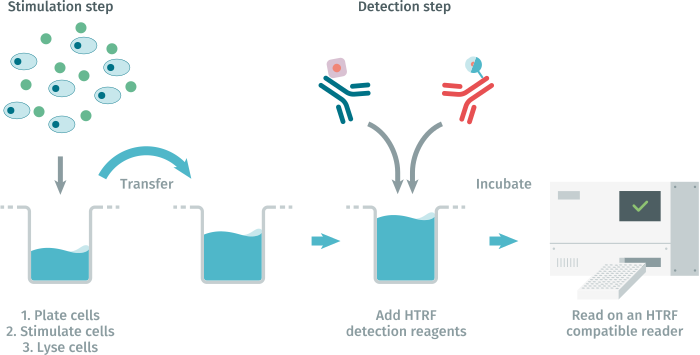
The 2 plate protocol involves culturing cells in a 96-well plate before lysis then transferring lysates to a 384-well low volume detection plate before adding Total ß-Catenin HTRF detection reagents. This protocol enables the cells' viability and confluence to be monitored.
Total-ß-Catenin 1-plate assay protocol
Detection of total ßCatenin with HTRF reagents can be performed in a single plate used for culturing, stimulation and lysis. No washing steps are required. This HTS designed protocol enables miniaturization while maintaining robust HTRF quality.
Assay validation
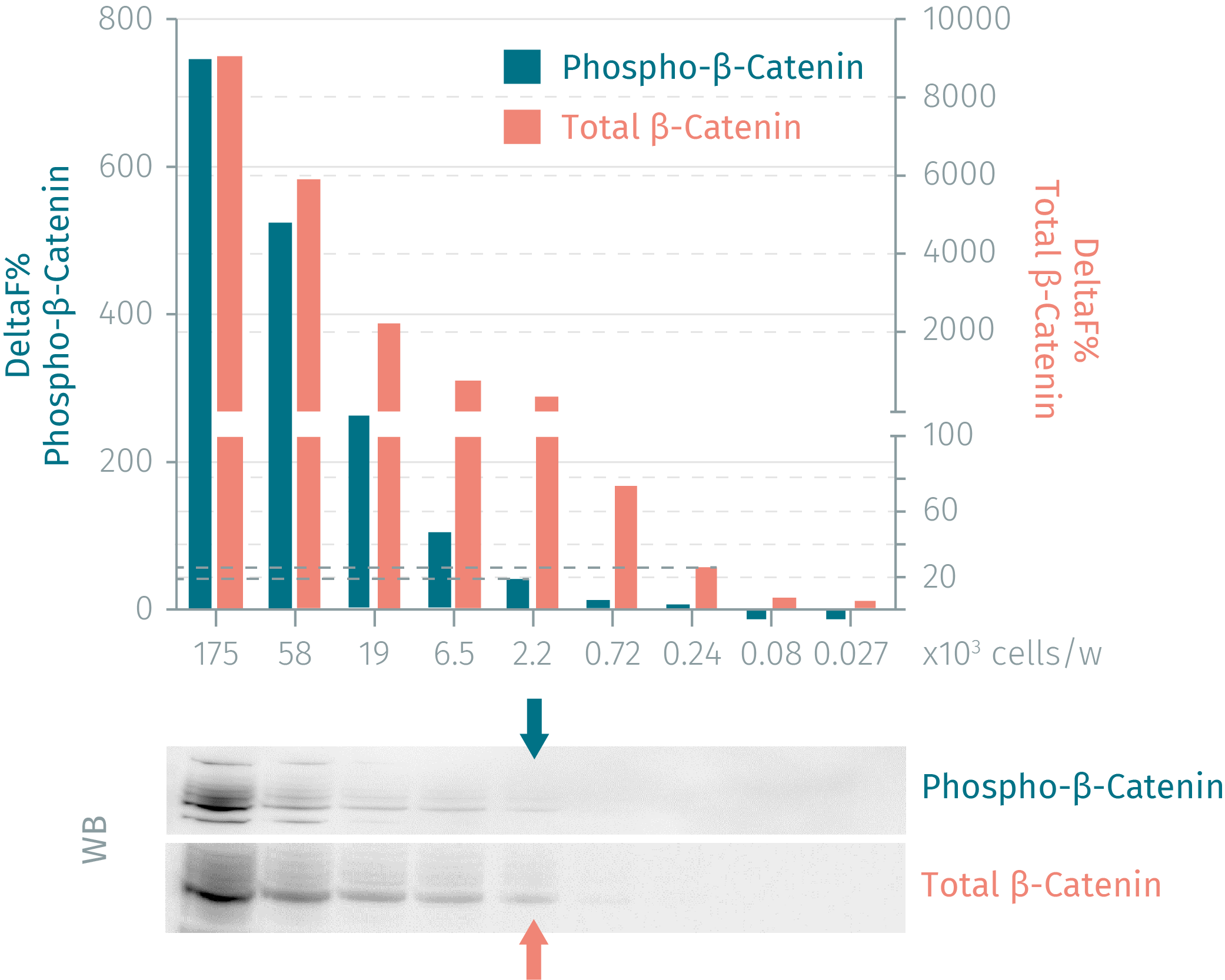
HTRF assay compared to Western blot using phospho-ß-Catenin and total ß-Catenin cellular assays
Human HEK293 cells were grown in a T175 flask at 37°C, 5% CO2 until 80% confluence and treated with MG132 at 5µM (3h). Cell culture medium was discarded, and 3 mL of supplemented lysis buffer were added for a 30 minutes incubation at room temperature. Soluble supernatants were collected after a 10 minute centrifugation. Serial dilutions of the cell lysate were performed in the supplemented lysis buffer and 16 µL of each dilution were dispensed and analyzed side-by-side by Western Blot and by HTRF. The HTRF phospho-ß-Catenin (T41/S33/S37) assay is as sensitive as WB, whereas HTRF total ß-Catenin is 9-fold more sensitive than the Western Blot.
BIO dose-response, a GSK3 inhibitor, on HEK293 cells using phospho-beta-Catenin and total beta-Catenin cellular assays
200,000 human HEK293 cells were plated in 96 well plates and incubated for 24h at 37 °C - 5% CO2. The cells were then treated with MG-132 and increasing concentrations of BIO for 3h. For cells lysis, 50µl of lysis buffer were added for 30min at RT under gentle shaking. 16 µL of lysate were transferred into a 384-well sv white microplate and 4 µL of the HTRF phospho-beta-Catenin and total beta-Catenin detection reagents were added. The HTRF signal was recorded after an overnight incubation.

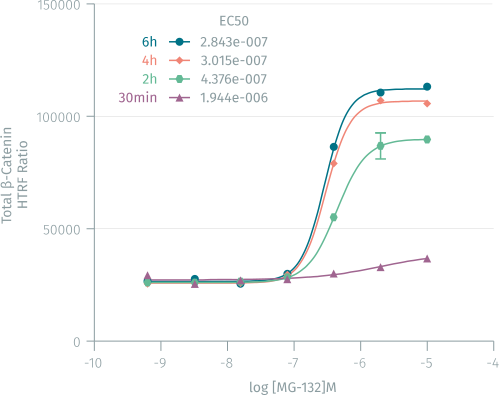
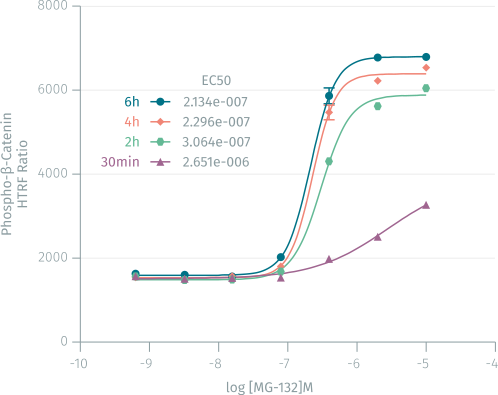
Inhibition of proteasome activity by MG-132, measured by the HTRF phospho-ß-Catenin and total beta-Catenin cellular assays
200,000 human HEK293 cells were plated in 96 well plates and incubated for 24h at 37 °C - 5% CO2. The cells were then treated with increasing concentrations of MG-132 for different incubation time. For cells lysis, 50µl of lysis buffer were added for 30min at RT under gentle shaking. 16 µL of lysate were transferred into a 384-well sv white microplate and 4 µL of the HTRF phospho-beta-Catenin and total beta-Catenin detection reagents were added. The HTRF signal was recorded after an overnight incubation.
Simplified pathway
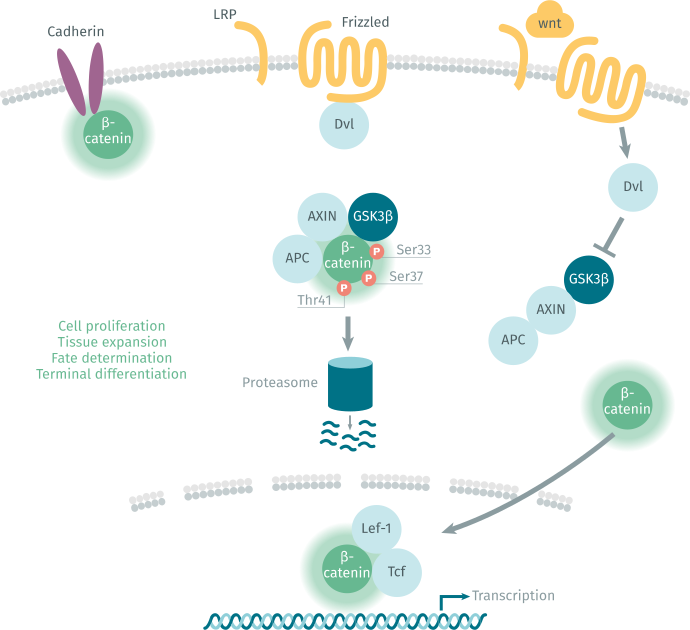
The role of ß-Catenin in the canonical Wnt pathway
In the absence of extracellular WNT ligands, cytosolic ß-Catenin is phosphorylated on Thr41/Ser37/Ser33, thereby targeting the protein for ubiquitination, degradation and inactivation. Binding of extracellular WNT ligands Frizzled receptor and/or the LDL receptor related proteins LRP 5 and 6, transduces their signal intracellularly via activation of disheveled DVL proteins. This results in the inactivation of the destruction complex, allowing cytosolic, non-phosphorylated ß-Catenin to accumulate and thereafter to translocate to the nucleus.
Specifications
| Application |
Cell Signaling
|
|---|---|
| Brand |
HTRF
|
| Detection Modality |
HTRF
|
| Lysis Buffer Compatibility |
Lysis Buffer 3
Lysis Buffer 4
Lysis Buffer 5
|
| Molecular Modification |
Total
|
| Product Group |
Kit
|
| Sample Volume |
16 µL
|
| Shipping Conditions |
Shipped in Dry Ice
|
| Target Class |
Phosphoproteins
|
| Target Species |
Human
Mouse
|
| Technology |
TR-FRET
|
| Therapeutic Area |
Metabolism/Diabetes
Oncology & Inflammation
|
| Unit Size |
500 assay points
|
Video gallery
HTRF Human and Mouse Total β-Catenin Detection Kit, 500 Assay Points
HTRF Human and Mouse Total β-Catenin Detection Kit, 500 Assay Points
Resources
Are you looking for resources, click on the resource type to explore further.

Guide
HTRF solutions, guide to major applications
This guide provides you an overview of HTRF applications in several therapeutic areas.
Guide
Protein degradation awareness in a single guide
An in-depth review of molecular and cellular pathways
The maintenance of proteostasis, the biological mechanisms that control the...
Guide
Understanding obesity: exploring cellular pathways and mechanisms
Obesity is a complex condition characterized by excessive fat accumulation, posing significant health and socioeconomic challenges...


How can we help you?
We are here to answer your questions.