
JP

Revvity Sites Globally
Select your location.
*e-commerce not available for this region.



AlphaLISA Human PD1 / PDL1 Binding Kit, 500 Assay Points

AlphaLISA Human PD1 / PDL1 Binding Kit, 500 Assay Points

AlphaLISA Binding
The AlphaLISA™ human PD-1/PD-L1 binding kit is designed for the detection of binding activity between human PD-1 and PD-L1, using a fast and simple homogeneous AlphaLISA assay (no wash steps). This assay can be used to screen for small molecules that inhibit binding, as a competitive ligand binding (CLB) assay to screen therapeutic blocking antibodies, and for potency assays.
| Feature | Specification |
|---|---|
| Application | タンパク質間相互作用 |
| Sample Volume | 10 µL |
The AlphaLISA™ human PD-1/PD-L1 binding kit is designed for the detection of binding activity between human PD-1 and PD-L1, using a fast and simple homogeneous AlphaLISA assay (no wash steps). This assay can be used to screen for small molecules that inhibit binding, as a competitive ligand binding (CLB) assay to screen therapeutic blocking antibodies, and for potency assays.
Product variants
Unit Size: 100 assay points
Part #:
AL356HV
Unit Size: 500 assay points
Part #:
AL356C
Unit Size: 5,000 assay points
Part #:
AL356F
For research use only. Not for use in diagnostic procedures. All products to be used in accordance with applicable laws and regulations including without limitation, consumption, and disposal requirements under European REACH regulations (EC 1907/2006).
AlphaLISA Human PD1 / PDL1 Binding Kit, 500 Assay Points
AlphaLISA Binding
Loading...
Product information
Overview
This kit is designed for the detection of binding activity between PD-1 and PD-L1 using a homogeneous AlphaLISA assay (no wash steps). This assay can facilitate the design and development of therapetics by using competitive binding.
Features:
- No-wash steps, no separation steps
- Ease-of-use: few addition steps, fast assay development
- Broad range of affinities: detect strong or weak interactions, from pM to mM affinity
- Distance: measure very large protein or antibody complexes – spanning up to 200 nm or more
- High avidity: multiple binding sites on each bead enables use of nanomolar concentrations of antibodies or proteins, as well as use of low affinity binders
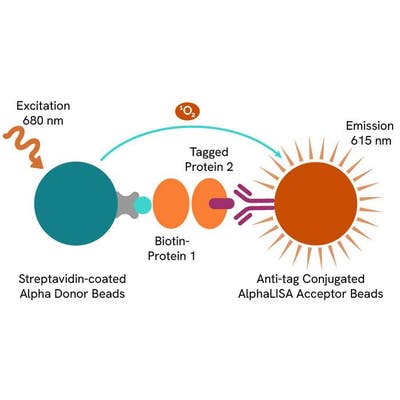
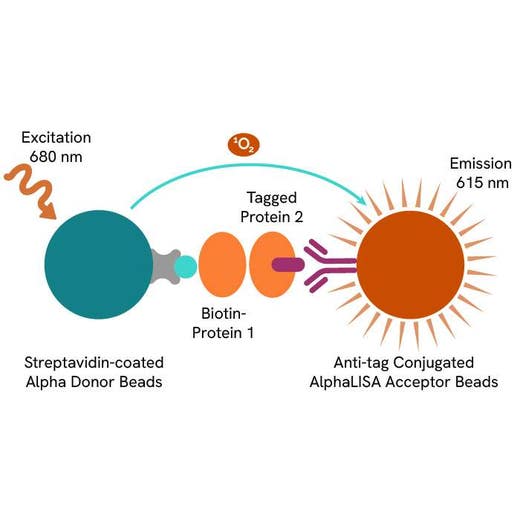
AlphaLISA technology allows the detection of molecules of interest in buffer, cell culture media, serum and plasma in a highly sensitive, quantitative, reproducible and user-friendly mode. In an AlphaLISA assay, a biotinylated PD-1 binds to the Streptavidin-coated Alpha Donor beads, while His tagged PD-L1 is captured by Anti-His AlphaLISA Acceptor beads. When PD-L1 binding to PD-1 happens, Donor beads and Acceptor beads come into close proximity. The excitation of the Donor beads provokes the release of singlet oxygen molecules that triggers a cascade of energy transfer in the Acceptor beads, resulting in a sharp peak of light emission at 615 nm.
Programmed death ligand 1 (PD-L1), also known as "cluster of differentiation 274" (CD274) or B7 homolog1 (B7-H1) belongs to the growing B7 family of immune proteins and is expressed in tumor cells. PD-L1 binds to its receptor, PD-1, found on activated T cells, B cells, and myeloid cells, to modulate activation or inhibition. By binding to PD-1, PD-L1 may inhibit ongoing T-cell responses by inducing apoptosis and arresting cell-cycle progression and thus contribute to cancer growth. Monoclonal antibodies targeting PD-1 and PD-L1 are being developed as a means to boost the immune system for the treatment of non-small-cell lung cancer, melanoma, bladder, renal, and triple-negative breast cancers.
Specifications
| Application |
Protein-Protein Interaction
|
|---|---|
| Automation Compatible |
Yes
|
| Brand |
AlphaLISA
|
| Detection Modality |
Alpha
|
| Product Group |
Kit
|
| Sample Volume |
10 µL
|
| Shipping Conditions |
Shipped in Blue Ice
|
| Target |
PD1 / PDL1
|
| Target Class |
Binding Assay
|
| Target Species |
Human
|
| Technology |
Alpha
|
| Therapeutic Area |
Immuno-oncology
|
| Unit Size |
500 assay points
|
Video gallery
AlphaLISA Human PD1 / PDL1 Binding Kit, 500 Assay Points
Resources
Are you looking for resources, click on the resource type to explore further.

Application Note
Screening for inhibitors of PD-1 and PD-L1 binding with AlphaLISA technology
Many tumor cells, which under normal, healthy conditions would be recognized by the body’s T cells and thereby targeted for...
Loading...


How can we help you?
We are here to answer your questions.