
JP

Revvity Sites Globally
Select your location.
*e-commerce not available for this region.

AlphaLISA Anti-M13 Acceptor Beads, 250 µg

AlphaLISA Anti-M13 Acceptor Beads, 250 µg

AlphaLISA Acceptor Bead Antibody Coated
Alpha Acceptor beads conjugated to anti-M13 antibody. This bead can be used to capture PIII protein of M13 phage for Alpha no-wash protein-protein interaction assays and other applications.
| Feature | Specification |
|---|---|
| Application | タンパク質間相互作用 |
| Protocol Time | Overnight at RT |
Alpha Acceptor beads conjugated to anti-M13 antibody. This bead can be used to capture PIII protein of M13 phage for Alpha no-wash protein-protein interaction assays and other applications.
Product variants
Unit Size: 250 ug
Part #:
AL182C
Unit Size: 5 mg
Part #:
AL182M
Unit Size: 25 mg
Part #:
AL182R
For research use only. Not for use in diagnostic procedures. All products to be used in accordance with applicable laws and regulations including without limitation, consumption, and disposal requirements under European REACH regulations (EC 1907/2006).
AlphaLISA Anti-M13 Acceptor Beads, 250 µg
AlphaLISA Acceptor Bead Antibody Coated
AlphaLISA Anti-M13 Acceptor Beads, 250 µg
Product information
Overview
AlphaLISA Acceptor beads conjugated to anti-M13 antibody. Anti-M13 beads bind to the G3P Protein of M13 phage. This bead can be used in conjunction with AlphaScreen Donor beads to create no-wash assays. The binding is rapid and stable, making it an ideal choice for use in a variety of assays including peptides, VHH or scFv selection and titration in phage display technology.
Formats
In a typical Alpha PPI or binding assay:
- Our 250 µg conditioning allows you to run 500 wells in 384-well format, using 20 µg/mL final concentration in a 25 µL assay volume.
- Our 5 mg conditioning allows you to run 10,000 wells in 384-well format, using 20 µg/mL final concentration in a 25 µL assay volume.
- Our 25 mg conditioning allows you to run 50,000 wells in 384-well format, using 20 µg/mL final concentration in a 25 µL assay volume.
Features:
- No-wash steps, no separation steps
- Ease-of-use: few addition steps, fast assay development
- Broad range of affinities: detect strong or weak interactions, from pM to mM affinity
How it works
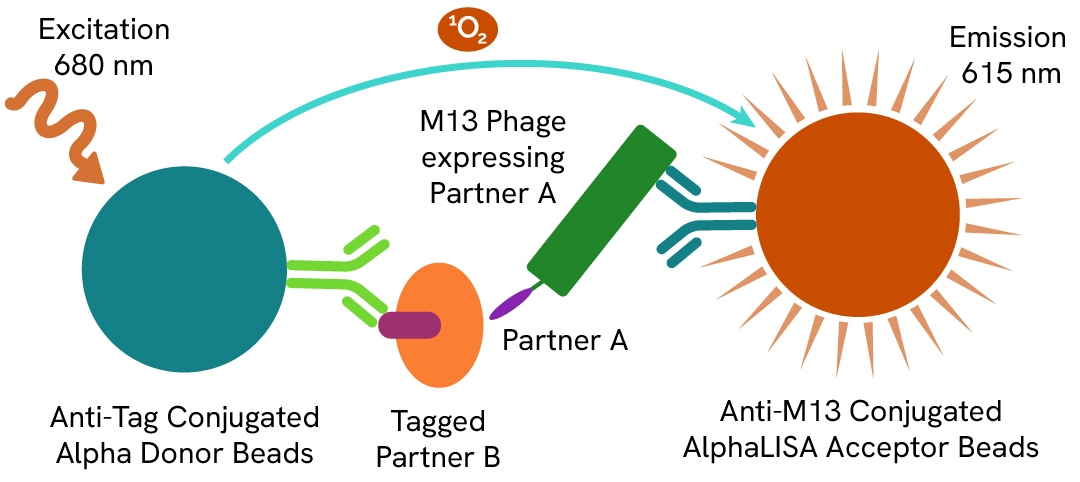
Principle of the Alpha Anti-M13 acceptor beads detection
AlphaLISA is a bead-based assay technology used to study biomolecular interactions in a microplate format. AlphaLISA assays require two bead types: Donor beads and Acceptor beads. Protein-protein interaction brings the Donor and Acceptor beads in close proximity whereby the singlet oxygen transfers energy to excite the Acceptor bead, enabling the generation of a luminescent Alpha signal. The amount of light emission is directly proportional to the binding of the 2 partners. In the example shown here, Anti M13-Acceptor bead binds to the M13 phage (partner A), while Tagged partner B* binds to an Anti-Tag Ab labeled with a donor bead.
*partner B can also be biotinylated, Fc fused or unlabeled. In these cases, use the corresponding Alpha reagent (i.e Streptavidin, anti-species, protA, …) labeled with the donor bead for the detection.
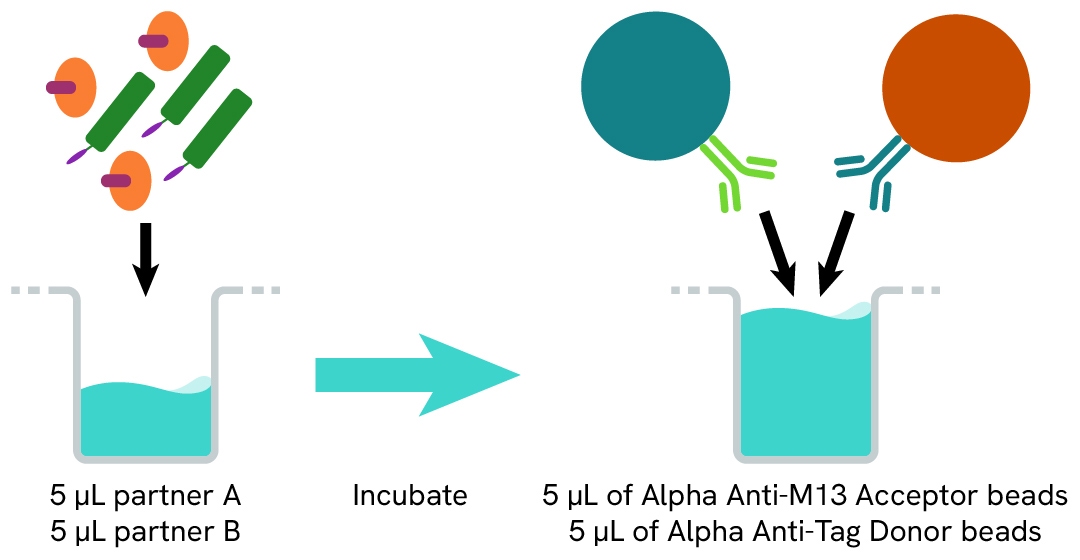
Assay protocol of the Alpha Anti-M13 acceptor bead detection
The example on the right describes the protocol using a 20 µL final assay volume for the detection of an interaction between a M13 phage expressing a target of interest (Partner A) and a tagged partner B* .Dispense the 2 partners (10 µL), add Anti-M13 acceptor beads (5 µL) and Anti-Tag Antibody labeled with a donor bead (5 µL), then incubate and read.
*partner B can also be biotinylated, Fc fused or untagged. In these cases, use the corresponding ALpha reagent (i.e Streptavidin, anti species, protA,...) labeled with donor beads for the detection.
Assay validation
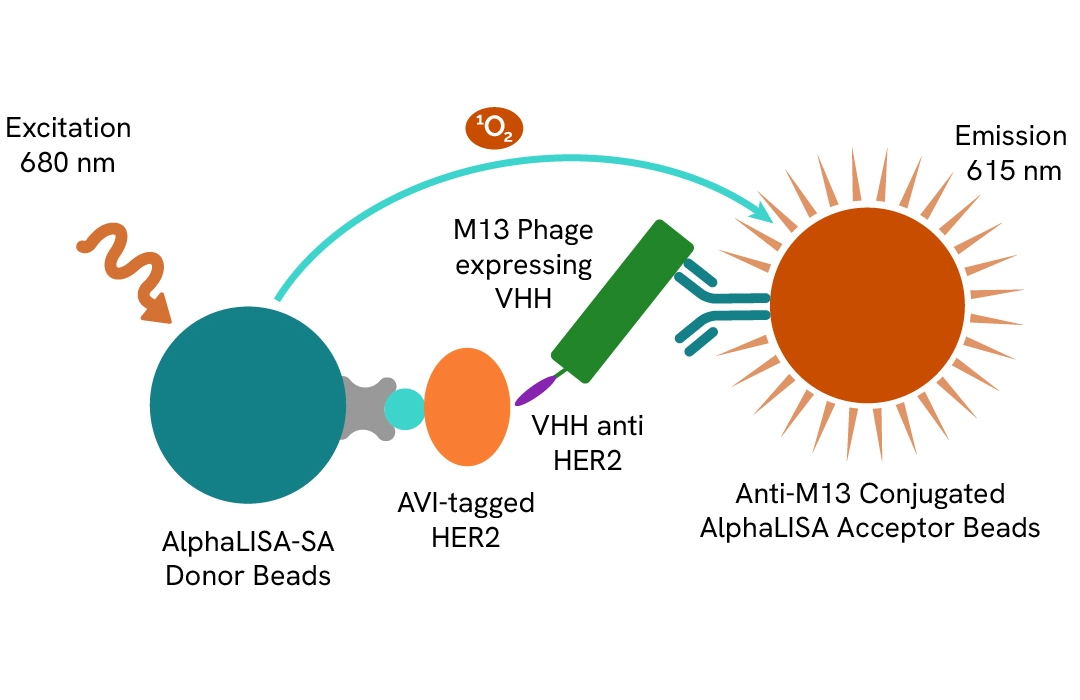
Validation of Alpha Anti-M13 beads for detecting protein-protein interactions
The Alpha Anti-M13 Acceptor beads were validated to detect protein-protein interactions (PPI) commonly used in phage display technology. In this case study, M13 phages designed to express VHH anti-human HER2 and selected by phage display were produced in E. coli in a 2YT bacterial medium. The PPI assay was performed in a 384-well shallow plate by adding 5 µL of sample, 5 µL of biotinylated human HER2, 5 µL of Alpha Anti-M13 acceptor beads at 20 µg/mL, and 5 µL of Alpha SA-Donor beads (#6760002) at 40 µg/mL. The mixture was then incubated for 20 hours at 23°C in the dark. Detection reagents were prepared in Immunoassay buffer (AL000C/F). PPI interaction was measured by recording the Alpha signal.
* If sample titration is required, It is recommended to dilute in the sample buffer or medium to avoid matrix effect.

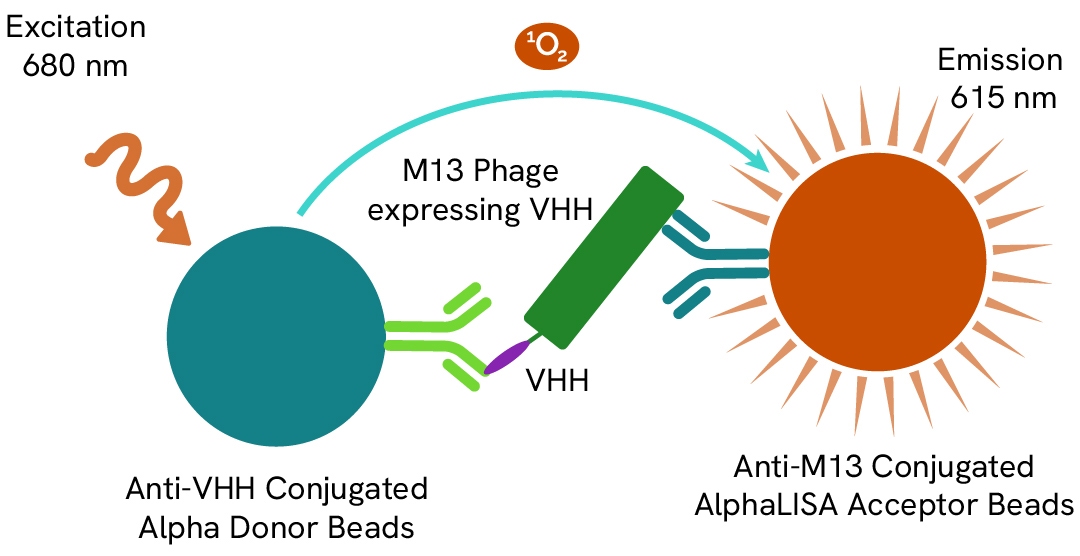
Validation of AlphaLISA Anti-M13 acceptor beads for detecting M13 phage expressing the target of interest
M13 phages designed to express VHH and selected by phage display were produced in E. coli in a 2YT bacterial medium. It is generally accepted that phage samples contain only a fraction of the expressing population (~0-10%). To validate VHH expression in this M13 production, a quality control assay was performed in a 384-well shallow plate by sequentially mixing 5 µL of unpurified sample (serially diluted*), 5 µL of IAB buffer*, 5 µL of Anti-M13 acceptor beads at 20 µg/mL, and 5 µL of Anti-VHH donor beads at 40 µg/mL (Cat#AL117). The mixture was then incubated for 20 hours at 23°C in the dark. Detection of the Alpha signal confirms that the sample contains M13 phages expressing the VHH.
* If sample titration is required, It is recommended to dilute in the sample buffer or medium to avoid matrix effect.
** Immunoassay buffer (AL000C/F) was used for this assay to dilute detection reagents.

Specifications
| Application |
Protein-Protein Interaction
|
|---|---|
| Automation Compatible |
Yes
|
| Brand |
AlphaLISA
|
| Detection Modality |
Alpha
|
| Product Group |
Beads
|
| Protocol Time |
Overnight at RT
|
| Shipping Conditions |
Shipped in Blue Ice
|
| Target |
M13
|
| Technology |
Alpha
|
| Unit Size |
250 ug
|
Resources
Are you looking for resources, click on the resource type to explore further.


How can we help you?
We are here to answer your questions.