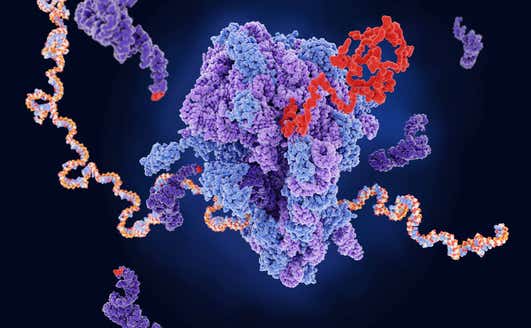




Depletion of Abundant Sequences by Hybridization (DASH) uses Cas9 ribonucleoproteins (RNPs) programmed with pooled single-guide RNAs (gRNAs) to cleave those molecules after library construction and before the final amplification. Cleaved fragments lack at least one complete adapter, so they do not amplify or form clusters, which shifts read depth toward molecules of interest while leaving upstream biology intact.1
The problem: a large share of reads go to the wrong places
Many next-generation sequencing (NGS) datasets are dominated by a few high-abundance molecules that do not answer the biological question being asked. Library composition is often skewed by ribosomal RNAs in total RNA (both in eukaryotes and bacteria), hemoglobin transcripts in whole blood, adapter dimers and a few dominant miRNAs in small-RNA libraries, and mitochondrial fragments in ATAC-seq. These molecules can consume a substantial fraction of a run, which lowers sensitivity for rare transcripts or chromatin features and raises the cost per informative read.
Concept: how DASH works
DASH addresses these problems at the library stage, which is attractive for low-input or challenging samples where RNA-level depletion is difficult.1,2,5 DASH treats a completed, double-stranded DNA library with pre-assembled Cas9 RNPs programmed to target the overabundant inserts. Cas9 cleavage requires a short sequence in the library DNA called a protospacer adjacent motif (PAM). The PAM is not part of the gRNA. It is a short “licensing” sequence in the DNA adjacent to the guide match that enables Cas9 binding and cutting.
For Streptococcus pyogenes Cas9 (SpCas9), the PAM is NGG, and cleavage occurs a few base pairs upstream of that NGG site.6 When an unwanted insert is cut even once, it will not serve as a template during the terminal PCR or cluster on the flow cell. Intact molecules amplify, cut molecules do not, so the final pool is enriched for informative fragments.1,6
Mechanism and design principles
Cas9–gRNA complexes scan DNA for a PAM, test base pairing between guide and protospacer, and then cleave. In vitro, SpCas9 behaves effectively as a single-turnover nuclease, so reaction stoichiometry matters. Using a molar excess of RNPs over estimated target molecules improves depletion completeness within practical incubations. Guide sets are usually tiled every few dozen base pairs across the abundant feature so that most library fragments contain at least one PAM-proximal cut site.
This strategy is robust to fragmentation and sequence polymorphism. The original DASH study demonstrated strong depletion of mitochondrial ribosomal RNAs with minimal distortion of global expression profiles.1,6
What programmable RNPs unlock:
- Eukaryotic RNA-seq. The founding DASH paper showed orders-of-magnitude reduction of mitochondrial rRNA with preservation of non-target expression relationships.1
- Whole blood and long-read cDNA. Long-DASH depletes hemoglobin transcripts in full-length cDNA, improving isoform discovery and shifting reads toward informative genes while remaining compatible with short- and long-read platforms.4
- Small RNA sequencing. MAD-DASH reduces adapter dimers and, when desired, depletes specific dominant miRNAs, which improve detection of low-abundance species and can remove gel cleanup steps.2
- Bacterial and metatranscriptomic RNA-seq. Cas9-based depletion of 16S/23S rRNAs lowers rRNA reads and increases coverage of mRNAs when poly(A) selection is not an option.5
- ATAC-seq. Targeting mitochondrial fragments increases unique nuclear reads and peak counts at promoters and enhancers at the same sequencing depth.3
- Single-cell and low-input contexts. scDASH applies depletion to barcoded cDNA after reverse transcription. Related work shows that tiling guides across problematic rRNAs increases genes detected per cell in single-cell datasets.8,9
Put DASH to work with our Cas9 depletion enzyme
Stop letting rRNA, globin, or mitochondrial fragments consume your read. Check out our RNA Depletion Solutions based on DASH and run a side-by-side pilot on your next library. We have products for common use cases: human rRNA, mitochondrial RNA for bulk RNA-seq or ATAC-seq and hemoglobin mRNA for whole blood or red blood cell studies. They are compatible with all library formats.
References
- Gu W, Crawford ED, O’Donovan BD, Wilson MR, Chow ED, Retallack H, DeRisi JL. Depletion of Abundant Sequences by Hybridization (DASH): using Cas9 to remove unwanted high-abundance species in sequencing libraries and molecular counting applications. Genome Biology. 2016;17:41. doi:10.1186/s13059-016-0904-5.
- Hardigan AA, Roberts BS, Moore DE, Ramaker RC, Jones AL, Myers RM. CRISPR/Cas9-targeted removal of unwanted sequences from small-RNA sequencing libraries (MAD-DASH). Nucleic Acids Research. 2019;47(14):e84. doi:10.1093/nar/gkz425.
- Montefiori L, Hernandez L, Zhang Z, Gilad Y, Ober C, Crawford G, Nobrega M, Jo-Sakabe N. Reducing mitochondrial reads in ATAC-seq using CRISPR/Cas9. Scientific Reports. 2017;7:2451. doi:10.1038/s41598-017-02547-w.
- Byrne A, Supple MA, Volden R, Laidre KL, Shapiro B, Vollmers C. Depletion of hemoglobin transcripts and long-read sequencing improves the transcriptome annotation of the polar bear (Long-DASH). Frontiers in Genetics. 2019;10:643. doi:10.3389/fgene.2019.00643.
- Prezza G, Heckel T, Dietrich S, Homberger C, Westermann AJ, Vogel J. Improved bacterial RNA-seq by Cas9-based depletion of ribosomal RNA reads. RNA. 2020;26(8):1069-1078. doi:10.1261/rna.075945.120.
- Sternberg SH, Redding S, Jinek M, Greene EC, Doudna JA. DNA interrogation by the CRISPR RNA-guided endonuclease Cas9. Nature. 2014;507(7490):62-67. doi:10.1038/nature13011.
- Dynerman D, Lyden A, Quan J, Caldera S, McGeever A, Dimitrov B, et al. Designing and implementing programmable depletion in sequencing libraries with DASHit. bioRxiv. 2020. doi:10.1101/2020.01.12.891176.
- Loi DSC, Yu L, Wu AR. Effective ribosomal RNA depletion for single-cell total RNA-seq by scDASH. PeerJ. 2021;9:e10717. doi:10.7717/peerj.10717.
- Wang KT, Adler CE. CRISPR/Cas9-based depletion of 16S ribosomal RNA improves library complexity of single-cell RNA-sequencing in planarians. BMC Genomics. 2023;24:625. doi:10.1186/s12864-023-09724-4.