


Fish are exposed to highly variable environmental conditions, requiring dynamic regulation of gene expression. Small RNAs, particularly microRNAs (miRNAs), have become a central research area in fish molecular biology because they provide a post-transcriptional regulatory layer linking development, reproduction, stress physiology, and immunity.
In teleosts, as in other vertebrates, miRNAs are ~22 nucleotide non-coding RNAs that regulate gene expression by binding mainly to 3′UTR regions of target mRNAs, promoting mRNA degradation or translational repression. Their short length, evolutionary conservation, and tissue-specific expression profiles make them powerful regulators and useful molecular markers.
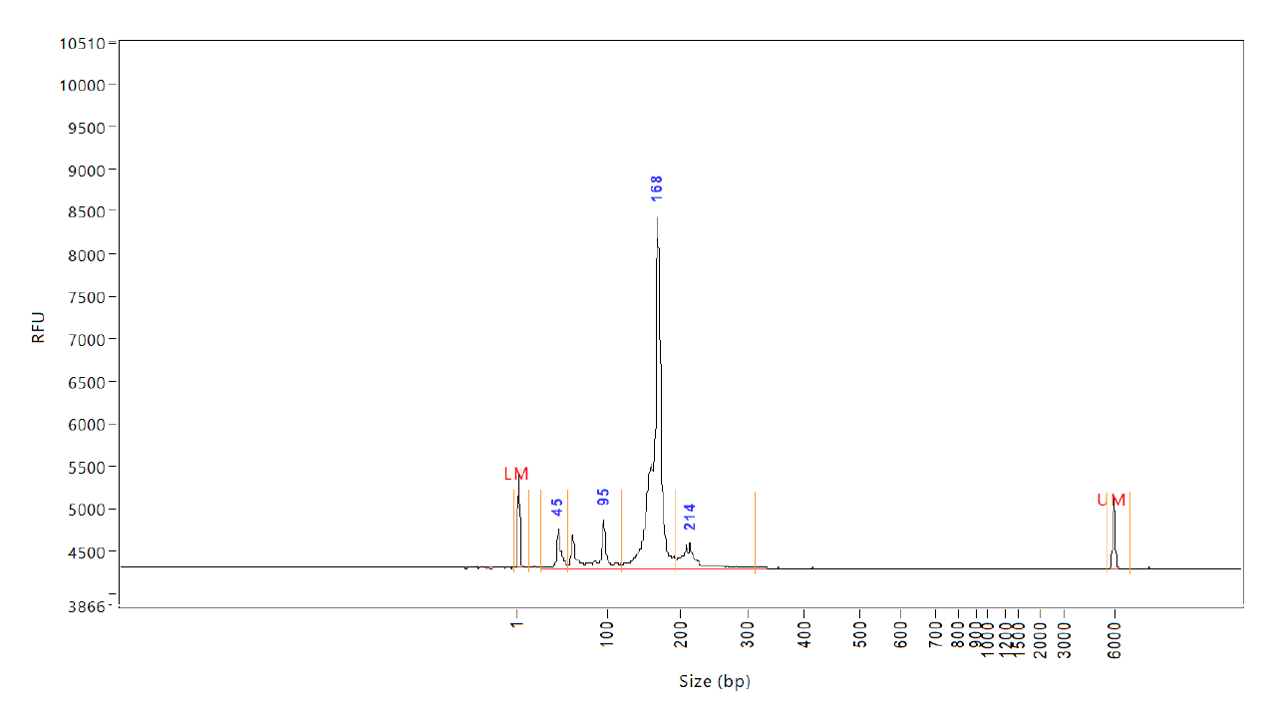
Interest in small RNAs in fish initially emerged from developmental studies in zebrafish, where miRNAs were shown to be essential for embryogenesis and organogenesis1,2. Since then, profiling efforts have expanded to aquaculture-relevant species such as Atlantic salmon, rainbow trout, Nile tilapia, European sea bass, and pikeperch3-5 (Figure 1). Across these systems, small RNA sequencing has identified conserved miRNA families (e.g., let-7, miR-1, miR-206) alongside species-specific miRNAs that exhibit tissue- and stage-dependent expression patterns.
Differential expression analyses have linked these miRNAs to processes including muscle development, reproductive maturation, metabolic regulation, and immune responses, although functional validation remains limited in many species. As in other vertebrates, pronounced tissue-specific differences in miRNA abundance are observed.
Figure 1. Fragment size distribution of a small RNA library prepared with 600 ng of RNA extracted from liver of adult pikeperch (Sander lucioperca). 17 PCR cycles were used. The dominant peak at ~168 bp corresponds to adapter-ligated library fragments containing ~21–23 nt small RNA inserts (e.g., canonical miRNAs), flanked by sequencing adapters.
Current small RNA sequencing workflows support robust identification of conserved and novel miRNAs in fishes, including non-model teleosts where reference annotations are incomplete. miRDeep2 supports de novo miRNA discovery from deep sequencing data, while miRanda and TargetScan support miRNA target prediction based on sequence complementarity and conservation features12,14.
Case studies
Reproduction and gonadal regulation
Reproductive biology is one of the most thoroughly investigated contexts for miRNA function in fish. In greater amberjack (Seriola dumerili), ovarian miRNAs were experimentally associated with apoptosis and steroidogenic pathways during maturation7. In tongue sole (Cynoglossus semilaevis), seminal plasma exosomal miRNAs have been characterized and proposed as biomarkers for sex identification and reproductive status8. Together, these studies provide evidence that miRNA expression is dynamically regulated during gametogenesis and endocrine transitions in teleosts.
Stress and immune regulation
Small RNAs are also widely studied in fish stress physiology and immunity. For example, in rainbow trout (Oncorhynchus mykiss), circulating extracellular vesicle miRNAs were shown to change in response to acute stress and cortisol exposure9. In olive flounder (Paralichthys olivaceus), plasma-derived exosomes have been isolated and characterized, with miRNA cargo responding to immune challenges10. Together, these results support extracellular vesicle miRNAs as sensitive readouts of endocrine and immune stress responses in fish.
Aquaculture species
In aquaculture-relevant percids such as pikeperch (Sander lucioperca), small RNA research has focused on early development, gonadal differentiation, and growth regulation. miRNA profiling combined with transcriptomics has helped map regulatory networks controlling larval development and sex differentiation.
For example, Verleih et al. profiled conserved and novel miRNAs across multiple pikeperch organs and developmental stages, highlighting stage- and tissue-specific regulatory patterns relevant to growth and gonadal differentiation5. Because pikeperch production depends heavily on precise broodstock and environmental management, understanding miRNA-mediated regulation offers both biological and applied value.
Evolutionary and biomarker perspectives
Teleost fishes underwent a lineage-specific whole genome duplication, generating expanded gene families that require regulatory fine-tuning15.. miRNAs are well positioned to modulate duplicated gene networks, contributing to evolutionary diversification. Additionally, circulating miRNAs remain stable in plasma due to encapsulation in extracellular vesicles or association with protein complexes11, making them attractive candidates for non-invasive biomarkers in fisheries and aquaculture management.
Conclusion
Small RNAs are studied in fishes because they are central regulators of development, reproduction, immune function, stress adaptation, metabolism, and ageing. Small RNA sequencing has enabled systematic discovery and quantification of conserved and novel miRNAs across diverse teleost species. From semelparous species such as ayu to iteroparous and commercially important fishes like pikeperch, small RNA research continues to refine our understanding of how post-transcriptional regulation shapes vertebrate life-history strategies and physiological resilience.
References:
- Giraldez, A.J., et al. (2005). MicroRNAs regulate brain morphogenesis in zebrafish. Science. 308(5723):833-8. doi: 10.1126/science.1109020.
- Wei, C., et al. (2012). Transcriptome-wide analysis of small RNA expression in early zebrafish development. RNA. 18(5):915-29. doi: 10.1261/rna.029090.111.
- Andreassen, R., et al. (2013). Discovery and characterization of miRNA genes in Atlantic salmon (Salmo salar) by use of a deep sequencing approach. BMC Genomics. 14:482. doi: 10.1186/1471-2164-14-482.
- Eshel, O., et al. (2014). Identification of male-specific amh duplication, sexually differentially expressed genes and microRNAs at early embryonic development of Nile tilapia (Oreochromis niloticus). BMC Genomics. 15(1):774. doi: 10.1186/1471-2164-15-774.
- Verleih, M., et al. (2023). The Discovery and Characterization of Conserved and Novel miRNAs in the Different Developmental Stages and Organs of Pikeperch (Sander lucioperca). Int J Mol Sci. 25(1):189. doi: 10.3390/ijms25010189.
- Pan, Y., et al. (2025). Comparative and functional analysis of exosomal microRNAs during semelparous reproduction in ayu fish. J Extracell Biol. 4(3):e70038. doi: 10.1002/jex2.70038.
- Papadaki, M., et al. (2024). MicroRNAs are involved in ovarian physiology of greater amberjack (Seriola dumerili) under captivity. Gen Comp Endocrinol. 357:114581. doi: 10.1016/j.ygcen.2024.114581.
- Zhang, B., et al. (2019). Seminal Plasma Exosomes: Promising Biomarkers for Identification of Male and Pseudo-Males in Cynoglossus semilaevis. Mar Biotechnol (NY). 21(3):310-319. doi: 10.1007/s10126-019-09881-2.
- Faught, E., et al. (2017). Plasma exosomes are enriched in Hsp70 and modulated by stress and cortisol in rainbow trout. J Endocrinol. 232(2):237-246. doi: 10.1530/JOE-16-0427.
- Jayathilaka, E.H.T.T., et al. (2022). Isolation and characterization of plasma-derived exosomes from olive flounder (Paralichthys olivaceus) and their wound healing and regeneration activities. Fish Shellfish Immunol. 128:196-205. doi: 10.1016/j.fsi.2022.07.076.
- Pegtel, D.M., Gould, S.J. (2019). Exosomes. Annu Rev Biochem. 88:487-514. doi: 10.1146/annurev-biochem-013118-111902.
- Friedländer, M.R., et al. (2012). miRDeep2 accurately identifies known and hundreds of novel microRNA genes in seven animal clades. Nucleic Acids Res. 40(1):37–52. doi: 10.1093/nar/gkr688.
- Enright, A.J., et al. (2003). MicroRNA targets in Drosophila. Genome Biol. 5(1):R1. doi: 10.1186/gb-2003-5-1-r1.
- Lewis, B.P., et al. (2005). Conserved seed pairing, often flanked by adenosines, indicates that thousands of human genes are microRNA targets. Cell. 120(1):15–20. doi: 10.1016/j.cell.2004.12.035.
- Taylor, J.S., et al. (2003). Genome duplication, a trait shared by 22,000 species of ray-finned fish. Genome Res. 13:382–390. doi: 10.1101/gr.640303.
For research use only. Not for use in diagnostic procedures.