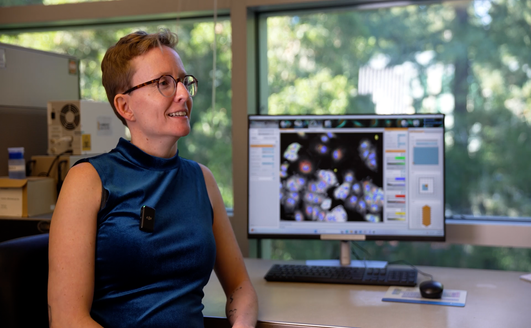



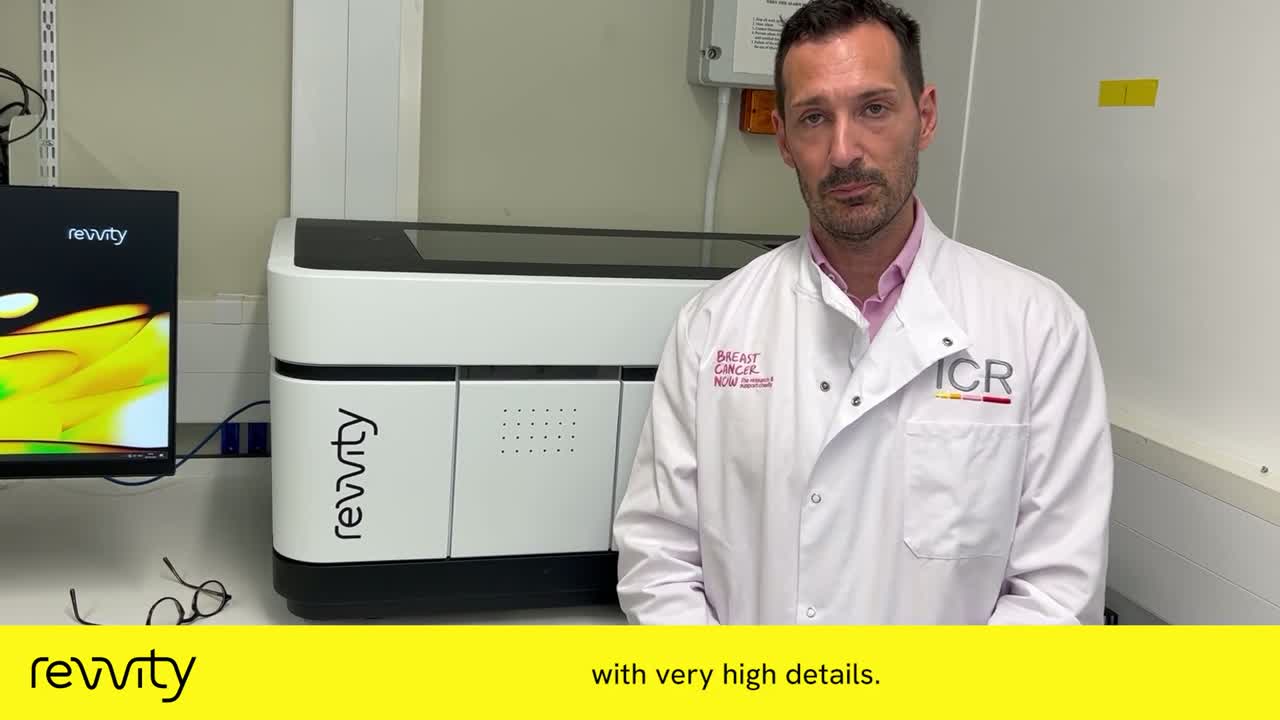
We spoke with Professor Luca Magnani, Group Leader - Breast Epigenetic Plasticity and Evolution Lab at the Institute of Cancer Research in London, UK. His group's goals reflect his ongoing commitment to innovation and research into treatments: to identify critical vulnerabilities in dormant cancer cells and to develop strategies that might lower the incidence of breast cancer.
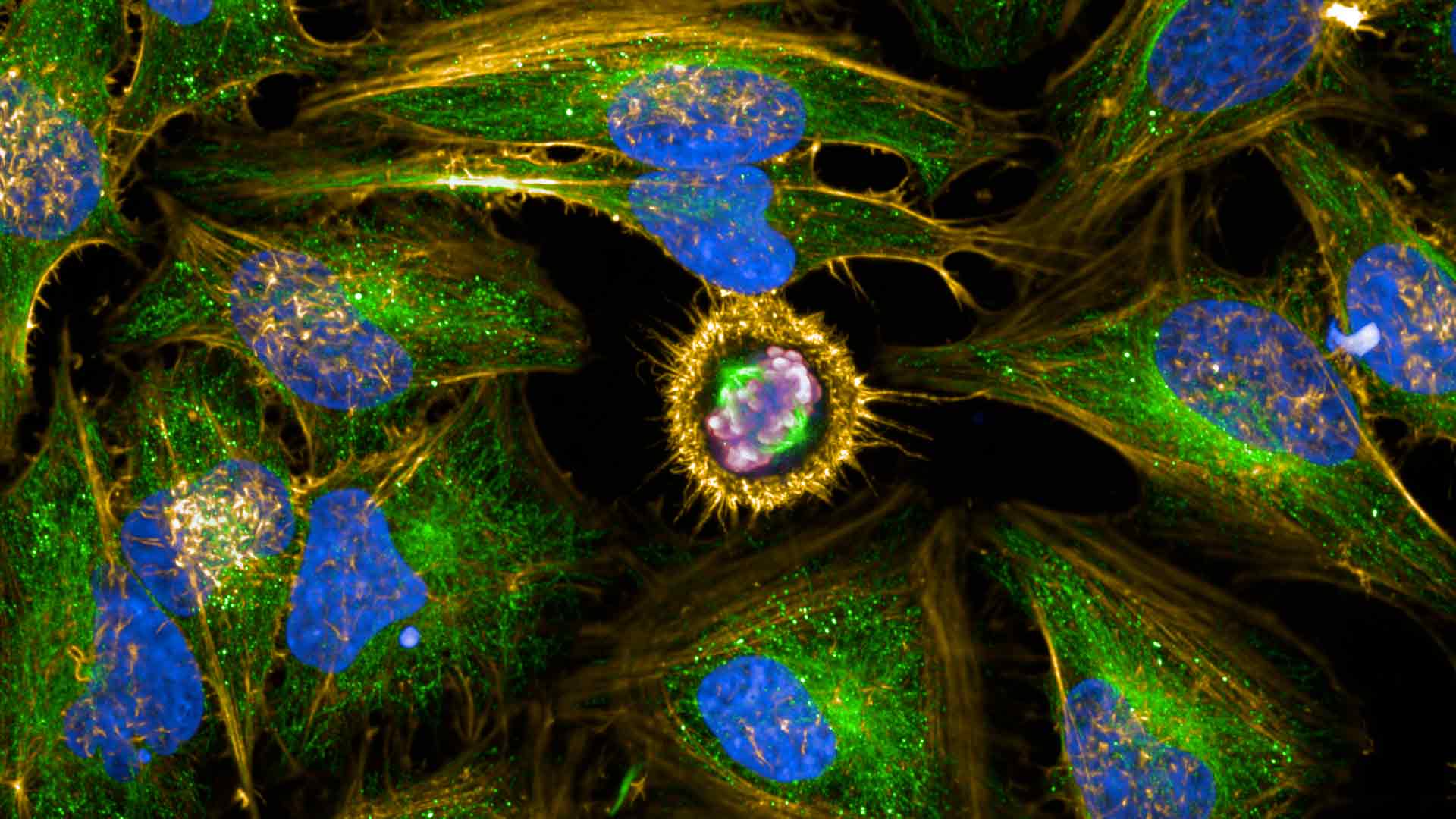
High-content imaging (HCI) has become a transformative technology in breast cancer research, empowering scientists to study complex cellular mechanisms and tumor biology with remarkable precision and scale. By combining automated microscopy, quantitative image analysis, and advanced computational tools, HCI provides detailed insights into cellular morphology, signaling pathways, and phenotypic responses that drive cancer progression and therapeutic resistance.
Q: Can you tell us about your lab and your focus areas?
Prof. Magnani: I lead the Breast Epigenetic and Evolution lab at the Institute of Cancer Research in London. My laboratory conducts research into breast cancer. And of course, we use a vast array of technology, including imaging, quite a lot of imaging. In the past, we have done a lot of confocal imaging just to try to get to the phenotype of the cancer cell in response to therapy and other sorts of perturbation.
Q: Recently, you invested in an Operetta CLS™ high-content analysis system. How will this be used in your research?
In the past, a lot of the cellular imaging technologies we used were not compatible with live imaging. And of course, a lot of the stuff we do in the lab is understanding how cells respond to therapy, how they adapt to it, and how they evolve resistance. So for us, it was very important to acquire equipment that would allow us to go much more in detail and much more longitudinally into the studies. With the instruments we used in the past we were really struggling with the specificity, with the imaging, the granularity of the image, and just the ability to really look carefully at rare events during these experiments.
Now, we think that with the Operetta CLS system, we will be able to really follow adaptation to therapy in the long term, with very high detail.
Q: Are there any particular insights that you’re hoping to gain from cell imaging using the Operetta CLS?
Prof. Magnani: The lab is studying dormancy. And dormancy is a very tricky phenotype to study because it is transient - it happens only during adaptation to therapy. And in a person, this is an invisible step. In the lab, we really want to develop long-term experiments - we are talking about months - and so this really requires a technology that allows us to do live imaging for this length of time.
What we hope to use the Operetta CLS for is to document the rare events that happen during adaptation. And more specifically, we are really invested in trying to understand how cells wake up eventually. Our previous data shows that this is a rare phenomenon, which doesn't really happen all the time and is unpredictable. Therefore, the need is really to pair confocal microscopy with long-term imaging.
Q: What are your plans for this research and imaging technology in the future?
Prof. Magnani: Currently, a lot of the technology we use is applied to standard research cancer cell lines. We really hope to adopt laboratory technology that will be compatible with organoids, for example. And of course, this means that we will be able to investigate different genetics from tumor-derived material in the 3D setting.
Q: Will your research translate to any potential drug or therapies for breast cancer?
Prof. Magnani: Our previous research has focused on the role of epigenetics in this adaptive trajectory. So, we are basically studying how cells hibernate, and after a few months, or some time, they will wake up to need resistance. We know from previous experiments that this is not a genetic mechanism but is an epigenetic-driven process. I cannot give details on the exact molecules we are focusing on, but the basic idea is that we are blocking cellular memory. While cells try to develop, this epigenetic memory will intervene and perturb the process.
The Operetta CLS high-content analysis system helps uncover deep biological understanding in both everyday assays and innovative applications, delivering the speed, sensitivity and resolution needed to reveal fine sub-cellular details. Researchers interested in exploring how high-content imaging could provide deeper insights into cellular biology are encouraged to contact Revvity to learn more.