



Trypan Blue: The tarnished gold standard
Cell counts and viability measurements are integral to a wide range of applications, from tissue culture passaging to cell therapy manufacturing. Historically, Trypan Blue (TB) exclusion has been the gold standard, where the dye is excluded from live cells with intact membranes but enters dead cells with compromised membranes, staining them dark blue.
However, the reliability of TB has come under scrutiny due to inconsistent viability measurements, especially in samples below 80% viability.
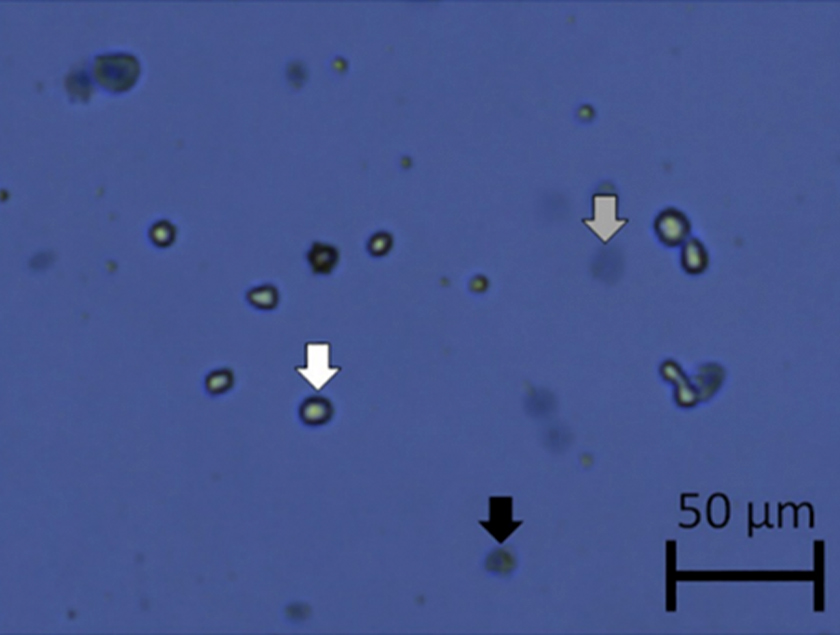
Further investigation into this phenomenon has demonstrated that TB induces morphological changes in dead cells, causing them to expand and rupture.3 These ruptured cells often appear as large, faint objects rather than classic TB-stained dead cells (Figure 1, Figure 3A). Due to their diffuse morphology, they are often missed by manual hemacytometer counting or automated brightfield counters. This results in artificially higher viability readings, which can be a significant problem for downstream assays.
Figure 1: Jurkat cells stained with Trypan Blue showing three distinct morphological populations. White arrow: Live cell with bright center, Black arrow: Dark blue, TB-stained dead cells, Gray arrow: Ruptured dead cell exhibits diffuse morphology. Adapted from Chan et al.3
Brightfield only counting methods have additional inherent flaws. One key concern is that there is no definitive way to determine whether a cell is nucleated, potentially leading to inadvertent counting of anucleated cells like red blood cells (Figure 2A). Another concern is debris, which can complicate counting, particularly with messy samples such as primary cells isolated from tissue.
AO/PI: The rise of fluorescence
An alternative to TB is fluorescent nuclear dyes such as Acridine Orange (AO) and Propidium Iodide (PI). AO is cell permeable, binds nucleic acid, and fluoresces green. PI only enters cells with compromised membranes, where it binds nucleic acid, quenches AO signal, and fluoresces red. Critically, AO/PI doesn't stain debris or anucleated cells, meaning only live, nucleated cells fluoresce green while dead, nucleated cells fluoresce red (Figure 2B). Most importantly, in the condition of cell counting and viability assessment, AO/PI is non-toxic, so PI-stained dead cells won't rupture, enabling more consistent cell counts and viability measurements (Figure 3B).
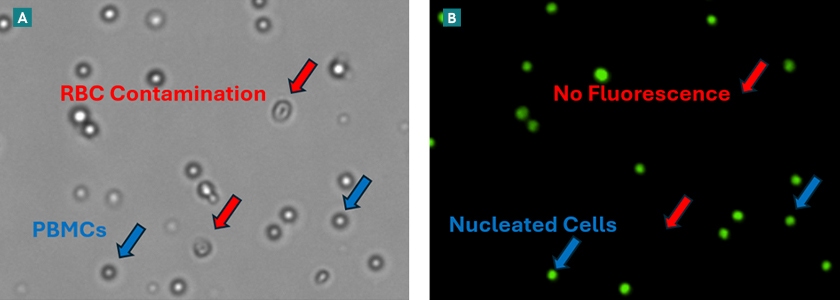
Figure 2: Brightfield and fluorescence images of PBMCs with red blood cell (RBC) contamination stained with AO/PI. RBCs can be seen in the brightfield image (A) but are excluded from the AO/PI fluorescent image (B). PBMCs can be seen in both the brightfield image and the AO/PI fluorescent image. Red arrows: RBC contamination. Blue Arrows: PBMCs.
Since dead cells aren't undercounted with AO/PI as they can be with TB, viability measurements are often 10-15% lower with AO/PI.4 This helps explain why an 80% viable sample measured with TB may behave more like a 65-70% viable sample in downstream assays.
Ultimately, selecting the right dye can prevent miscalculations that can adversely affect downstream experiments.
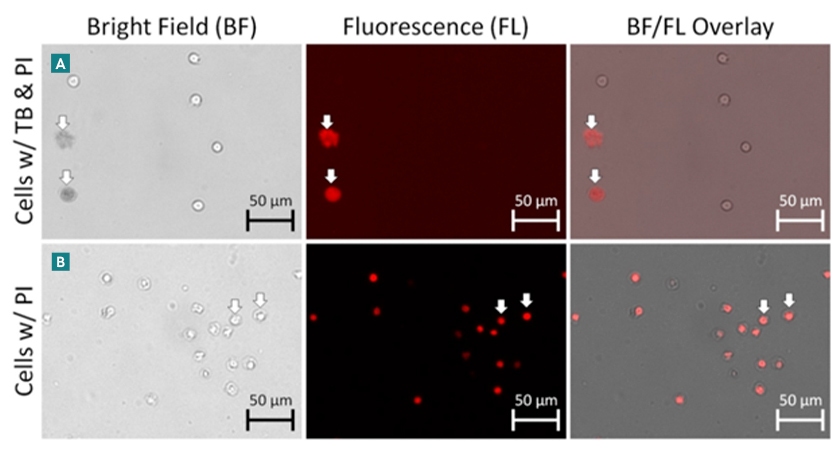
Figure 3: Jurkat cells stained with PI with or without Trypan Blue. (A) Trypan Blue and PI co-localization confirms the faint and diffuse objects are dead cells. (B) PI-stained cells maintain cell membrane morphology and do not rupture. Adapted from Chan et al.3
Choosing the right instrumentation
Using fluorescent nuclear dyes requires instruments that segment cells based on fluorescence, meaning all counting is done using fluorescent images. This is crucial because automated counters that segment in brightfield, even with fluorescence capabilities, can undercount dead cells due to the loss of membrane contrast in brightfield images. As a result, PI-stained cells may be visible in red fluorescence but not counted if they weren't identified as cells in the brightfield image.
Revvity offers dual-fluorescent instruments designed for AO/PI counting, including the Cellometer™ Ascend™ automated cell counter
 Cellometer Ascend Automated Cell Counter
for low-to-mid throughput (up to 8 samples) and the Cellaca™ PLX high-throughput image cytometer
Cellometer Ascend Automated Cell Counter
for low-to-mid throughput (up to 8 samples) and the Cellaca™ PLX high-throughput image cytometer
 Cellaca PLX High-throughput Image Cytometer
for higher throughput needs (up to 24 samples).
Cellaca PLX High-throughput Image Cytometer
for higher throughput needs (up to 24 samples).
Conclusion
The evidence indicates that while TB has served as the standard for cell viability assessment, its limitations can affect measurement reliability, particularly the rupturing of dead cells and resulting viability overestimation. AO/PI fluorescent staining, combined with proper dual-fluorescent instrumentation, provides greater consistency for cell counting and viability assessment, supporting more confident decision-making in research and therapeutic development. As cell-based applications become increasingly sophisticated, it's time to adopt methods that improve accuracy and deliver the reproducibility demanded by modern precision science.
For research use only. Not for use in diagnostic procedures.
References:
- Pierce L, Sarkar S, Chan LL-Y, Lin B, Qiu, J. Outcomes from a cell viability workshop: fit-for-purpose considerations for cell viability measurements for cellular therapeutic products. Cell & Gene Therapy Insights 2021; 7(4), 551-569.
- Chan LLY, Laverty DJ, Smith T et al. Accurate measurement of peripheral blood mononuclear cell concentration using image cytometry to eliminate RBC-induced counting error. J. Immunol. Meth. 2013; 388(1–2): 25–32.
- Chan LL-Y, Rice WL, Qiu J. Observation and quantification of the morphological effect of trypan blue rupturing dead or dying cells. PLoS One 2020; 15(1): 1–17.
- Chan LL-Y, Kuksin D, Laverty DJ, Saldi S, Qiu J (2014) Morphological observation and analysis using automated image cytometry for the comparison of trypan blue and fluorescence-based viability detection method. Cytotechnology 2014; DOI 10.1007/s10616-014-9704-5.