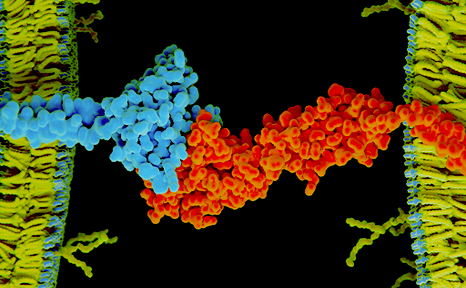




Tirzepatide (LY3298176) is an engineered dual incretin agonist approved by the FDA in 2022 under the brand name Mounjaro for improving glycemic control in adults with type 2 diabetes mellitus. By simultaneously engaging the glucagon-like peptide 1 receptor (GLP-1R) and the glucose-dependent insulinotropic polypeptide receptor (GIPR), tirzepatide mimics natural incretin hormones to enhance insulin secretion, suppress glucagon release, and improve glucose homeostasis [1-3]. Distinct from other incretin-based therapies, tirzepatide acts as a full agonist at GIPR while eliciting a partial, biased response at GLP-1R, favoring G-protein-mediated cAMP production over β-arrestin recruitment [1]. This signaling bias is crucial, as it reduces receptor desensitization and internalization, thereby prolonging GLP-1R signaling while maintaining robust GIPR activity [2].
To investigate the molecular basis of this signaling asymmetry, Sun et al. (2022) combined cryo-EM structural biology with a comprehensive suite of Revvity-powered functional assays and readout platforms, including radioligand and [³⁵S]GTPγS binding assays, the HTRF cAMP accumulation assay, Tag-lite™ for receptor internalization, and the EnVision™ plate reader. Overall, these complementary Revvity technologies provide a cohesive toolkit that integrates structural insights with quantitative pharmacology and physiological outcomes, paving the way for translating mechanistic insights into broader therapeutic strategies.
Results
Radioligand binding defines affinity differences
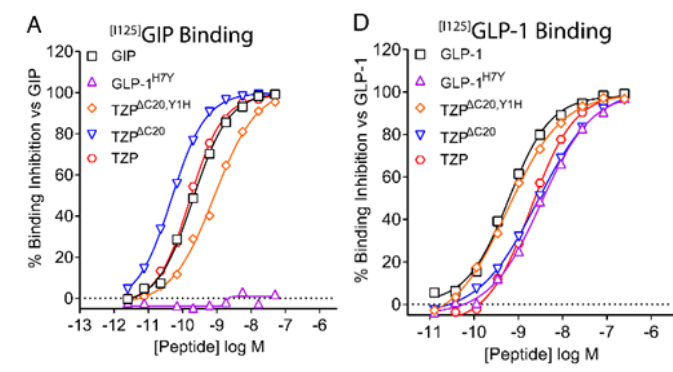
Building on structural insights gained from Cryo-EM and molecular dynamics analyses, the authors demonstrated that tirzepatide's Tyr1 residue anchors deeply within the GIPR transmembrane core, while adopting a shifted orientation in GLP-1R that alters extracellular loop interactions [1; Figures 1–3]. To determine whether these structural differences affected binding strength, radioligand binding assays were performed on HEK293 membranes expressing either GIPR or GLP-1R. Competition binding was measured as previously described by Willard et al. [2], enabling quantification of bound versus free ligand [1; Figures 4A, 4D].
This approach revealed that at GIPR (Figure 4A), tirzepatide bound with an affinity comparable to native GIP, while substitution of Tyr1 with histidine (His) reduced binding nearly 20-fold. At GLP-1R (Figure 4D), tirzepatide's affinity was approximately five times lower than GLP-1; removal of the lipid moiety did not restore affinity, but the Tyr1→His substitution restored binding to near-GLP-1 levels. These results confirmed that GIPR binding depends on N-terminal transmembrane-core contacts, whereas GLP-1R binding is mainly driven by extracellular domain interactions.
Figure 4A, 4D. Radioligand binding assays.Competitive binding of [¹²⁵I] -labeled peptide ligands to membranes from HEK293 cells expressing human GIPR (A) or GLP-1R (D). Displacement curves are shown for native ligands, tirzepatide, and analogs with Tyr1→His substitution or lipid removal. Data points represent mean ± SEM from replicate determinations, with affinities (pK_i) calculated by nonlinear regression. Adapted from Sun et al. [1].
GTPγS binding links affinity to g-protein activation
To connect receptor binding strength with functional output, [³⁵S]GTPγS binding assays were conducted on HEK293 membranes expressing either GIPR or GLP-1R. Radiolabeled GTPγS incorporation into G-proteins was measured, providing a direct readout of receptor-mediated G-protein activation [1; Figures 4B, 4E].
GIPR binding revealed that tirzepatide acted as a full agonist, matching GIP in maximal activation. Removing the lipid moiety slightly increased potency, while the Tyr1→His substitution reduced both potency and efficacy (Figure 4B). GLP-1R binding demonstrated a partial agonist response compared with GLP-1. Lipid removal improved signaling, and the combined Tyr1→His substitution further enhanced activity toward GLP-1 levels (Figure 4E). These findings highlight how lipidation and N-terminal sequence modifications can be leveraged to fine-tune signaling output.
cAMP accumulation confirms biased agonism
To assess downstream Gs-coupled signaling, cAMP accumulation was measured in HEK293 cells expressing either GIPR or GLP-1R using the HTRF Gs Dynamic Assay [1; Figures 4C, 4F]. At GIPR (Figure 4C), tirzepatide elicited full cAMP responses with potency comparable to native GIP. At GLP-1R (Figure 4F), potency was approximately 20-fold lower than GLP-1. Removal of the lipid modification increased GLP-1R potency, and the Tyr1→His substitution restored signaling to near-GLP-1 levels. This showed that while GLP-1R binding is preserved, its signaling capacity is intentionally dampened, leading to a cAMP-biased partial agonist profile.
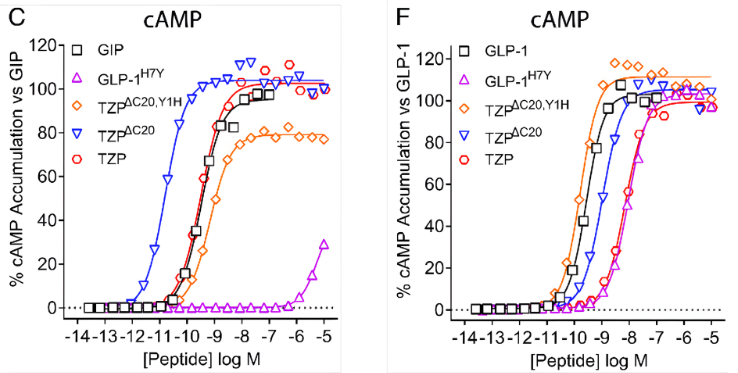
Figure 4C, 4F. cAMP Accumulation Assays. Intracellular cAMP production in HEK293 cells expressing GIPR (C) or GLP-1R (F) following stimulation with native ligands, tirzepatide, or analogs. Data are normalized to the maximal response of the native ligand, with potency (pEC₅₀) and efficacy values obtained from concentration–response curves. Adapted from Sun et al. [1].
Receptor internalization sheds light on desensitization
After defining tirzepatide's biased cAMP signaling profile, the authors next examined whether these signaling differences were linked to altered GLP-1R trafficking. Assays for GRK2 and β-arrestin-1 recruitment showed that tirzepatide is a weak, partial agonist compared with GLP-1, while removal of the C20 lipid and the Tyr1→His substitution progressively restore recruitment efficacy (Figure 5A-B). Using HEK293 cells expressing SNAP-tagged GLP-1R and a TR-FRET internalization readout, GLP-1 produced robust, concentration-dependent receptor internalization, while tirzepatide elicited substantially lower potency and efficacy for endocytosis (Figure 5C).
To determine whether this phenotype extended to a physiological context, the authors performed confocal imaging of fluorescently labeled ligands in isolated mouse pancreatic islets (Figures 5D-L). Imaging revealed prominent intracellular puncta for GLP-1 and other potent agonists, but minimal uptake for tirzepatide, with most signal at the cell surface. The Tyr1→His substitution increased internalization relative to native tirzepatide, consistent with its higher GLP-1R signaling potency. These results confirmed that tirzepatide's reduced ability to drive GLP-1R internalization is consistent with decreased receptor desensitization, supporting prolonged cAMP signaling.
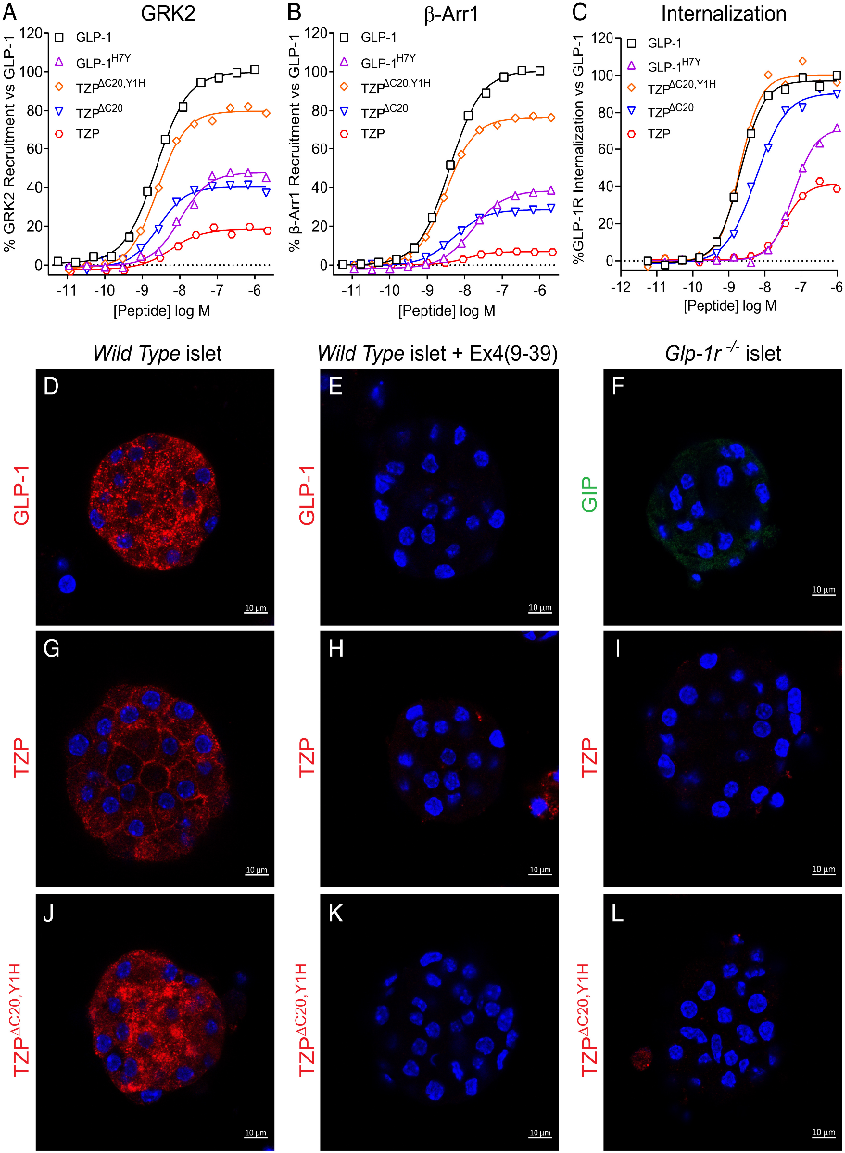
Figure 5. GLP-1R Recruitment and internalization in HEK293 cells and mouse pancreatic islets. (A) GRK2 and (B) β-arrestin-1 recruitment to GLP-1R. (C) Ligand-induced SNAPGLP- 1R internalization in HEK293 cells (concentration–response and matched-condition maxima); tirzepatide shows reduced potency and efficacy versus GLP-1.(D–L) Confocal images of fluorescent ligands in isolated mouse islets: robust intracellular puncta for GLP-1 and potent/non-acylated analogs, minimal uptake for tirzepatide; Tyr1→His substitution increases internalization. Data normalized to the maximal GLP-1 response. HEK293 assays used SNAP-tag labeling and fluorescence quantification; islet assays used live confocal microscopy. Adapted from Sun et al. [1].
Other key findings from Sun et al.:
- Cryo-EM structures (Figure 1): High-resolution snapshots of GIPR and GLP-1R bound to tirzepatide revealed how Tyr1 anchors into the receptor core and how lipidation alters GLP-1R extracellular loop networks.
- Differential binding at GLP-1R (Figure 2): Structural shifts disrupted polar networks, explaining weaker affinity and partial signaling.
- Molecular dynamics (Figure 3): Simulations showed the lipid moiety interacts more favorably with GIPR than with GLP-1R, highlighting receptor-specific effects.
- Pancreatic islet perfusion [2; Willard et al. 2020, Figure 3]: Insulin secretion was measured in isolated mouse pancreatic islets using AlphaLISA technology. Tirzepatide stimulated insulin release to a similar extent as native incretins. Deletion of β-arrestin1 enhanced GLP-1–induced secretion but had no effect on tirzepatide responses, indicating reduced GLP-1R desensitization with preserved efficacy.
Conclusion:
By integrating high-resolution cryo-EM structural studies with radioligand and GTPγS binding, cAMP accumulation, and receptor internalization assays, Sun et al. defined how tirzepatide balances dual incretin activity through biased agonism. Leveraging Revvity's advanced technologies, these structural insights were directly connected to functional outcomes, showing how subtle peptide modifications can shift receptor responses.
Specifically, Tirzepatide demonstrates strong GIP-like activation at GIPR alongside a GLP-1R profile marked by sustained cAMP signaling and limited β-arrestin recruitment and internalization. Beyond metabolic disease, these findings illustrate a general strategy for linking molecular design to functional pharmacology, offering a framework to accelerate the development of next-generation multi-receptor peptide therapeutics across diverse disease areas.
Revvity's technologies:
- Radioligand binding: [125I]-GIP(1–42) and [125I]-GLP-1(7–36)NH2 were used for membrane assays for affinity comparisons.
- GTPγS binding: Membrane [35S]GTPγS assays were used to quantify Gαs activation.
- HTRF™ cAMP accumulation assays: The cell-based HTRF cAMP Gs Dynamic detection kit was used in recombinant HEK293 lines expressing human GIPR or GLP-1R to measure cAMP accumulation.
- Tag-lite™ for receptor internalization: Tag-Lite SNAP-Lumi4-Tb (donor) was used to label HEK293 cells expressing SNAP-GLP-1R for assessing ligand-induced receptor internalization.
- AlphaLISA™: A homogeneous, no-wash immunoassay platform with high sensitivity and a large dynamic range, serving as an alternative to ELISAs.
- pHSense™: Our latest technology for GPCR receptor internalization studies.
Together, these platforms allow researchers to obtain precise, reproducible insights into ligand-receptor pharmacology and signaling dynamics, accelerating both mechanistic understanding and drug development.
For more information on Revvity's offerings, be sure to check out our Obesity, Diabetes and Metabolic Disease Reagents page!
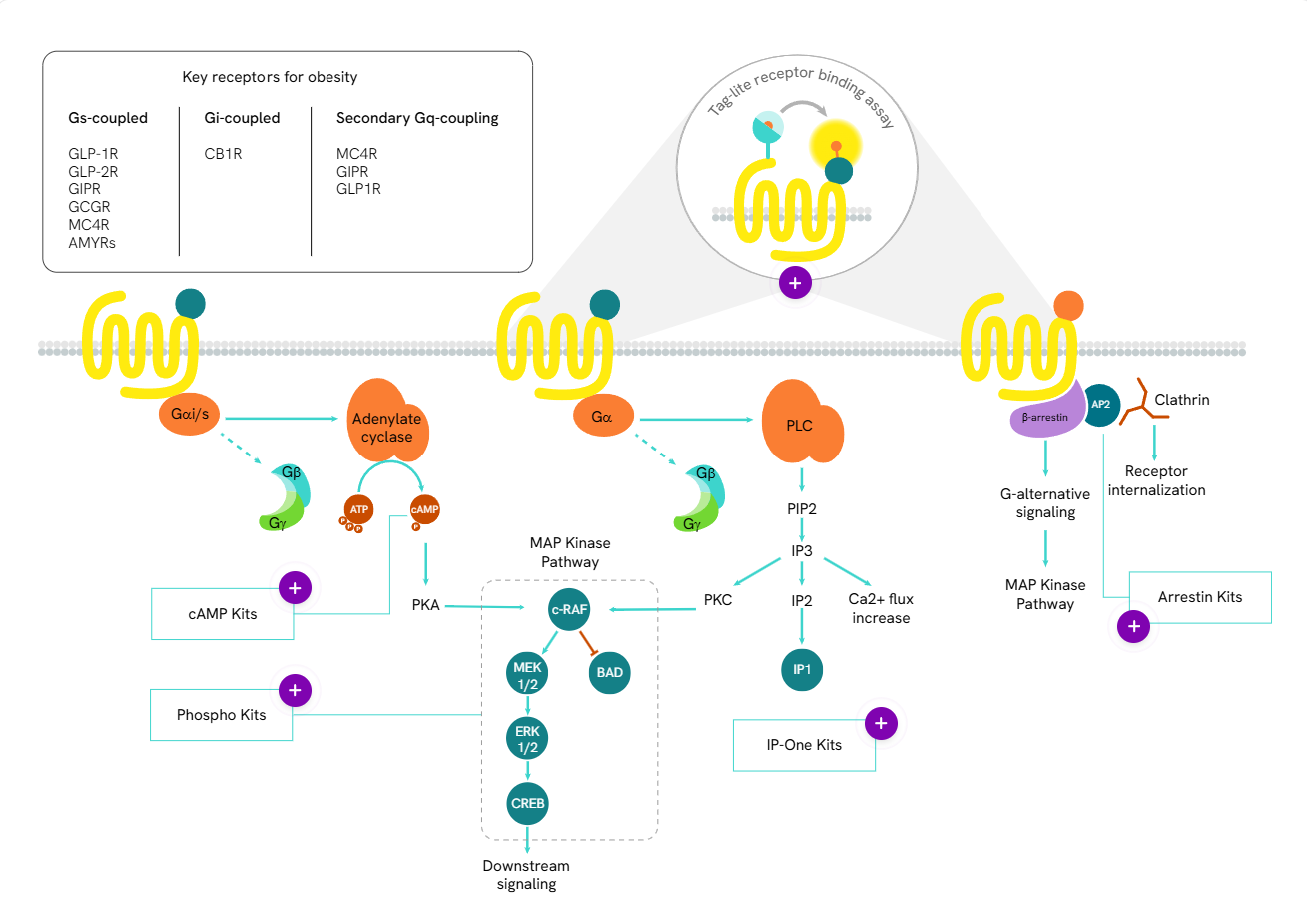
Overview of Revvity's comprehensive assay portfolio for metabolic studies. Website: Obesity, Diabetes and Metabolic Disease Reagents
References:
- B. Sun, F.S. Willard, D. Feng, J. Alsina-Fernandez, Q. Chen, M. Vieth, J.D. Ho, A.D. Showalter, C. Stutsman, L. Ding, T.M. Suter, J.D. Dunbar, J.W. Carpenter, F.A. Mohammed, E. Aihara, R.A. Brown, A.B. Bueno, P.J. Emmerson, J.S. Moyers, T.S. Kobilka, M.P. Coghlan, B.K. Kobilka, & K.W. Sloop, Structural determinants of dual incretin receptor agonism by tirzepatide, Proc. Natl. Acad. Sci. U.S.A. 119 (13) e2116506119, https://doi.org/10.1073/pnas.2116506119 (2022). Attribution Note: This blog is adapted from Sun et al. (2022), which is licensed under CC BY 4.0 (https://creativecommons.org/licenses/by/4.0/).
- Willard FS, Douros JD, Gabe MB, Showalter AD, Wainscott DB, Suter TM, Capozzi ME, van der Velden WJ, Stutsman C, Cardona GR, Urva S, Emmerson PJ, Holst JJ, D'Alessio DA, Coghlan MP, Rosenkilde MM, Campbell JE, Sloop KW. Tirzepatide is an imbalanced and biased dual GIP and GLP-1 receptor agonist. JCI Insight. 2020 Sep 3;5(17):e140532. doi: 10.1172/jci.insight.140532. PMID: 32730231; PMCID: PMC7526454.
- Farzam K, Patel P. Tirzepatide. [Updated 2024 Feb 20]. In: StatPearls [Internet]. Treasure Island (FL): StatPearls Publishing; 2025 Jan-. Available from: https://www.ncbi.nlm.nih.gov/books/NBK585056/