


For decades, the development of adeno-associated virus (AAV) vectors relied heavily on serendipity by screening large capsid libraries and hoping the right variant would emerge. However, that era is coming to an end.
The field is undergoing a fundamental shift from empirical screening towards the rational engineering of AAV capsids with a defined mode of action. This evolution promises greater control over vector performance, improved predictability of mechanism of action, and, critically, the ability to engineer cell-type specificity with precision.
Key takeaways
- AAV development is moving from screening to rational design.
- Retargeting of AAVs can improve cell-type specificity.
- Each retargeting approach comes with its own manufacturing trade-offs.
- Revvity’s AAV-Nanobody platform supports modular, scalable AAV retargeting.
What is AAV retargeting?
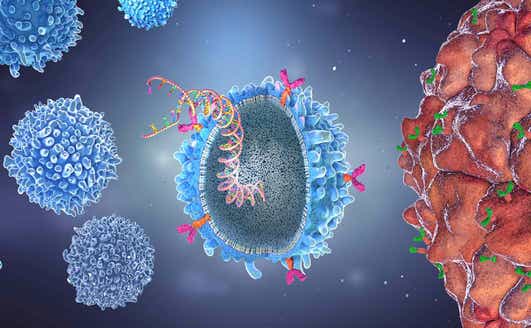
At its core, retargeting refers to the deliberate modification of an AAV capsid to redirect the vector towards a specific cell population. Rather than relying on the natural tropism of a given serotype, retargeted AAVs are designed to engage defined receptors or surface markers on target cells. This can be mediated through a variety of different ligands, ranging from small molecules, sugar moieties, aptamers, to larger polypeptides like single-chain variable fragments (scFv) and VHH antibodies, or nanobodies, and DARPin proteins.
A key advantage of modern retargeting strategies is modularity, achieved by decoupling the capsid itself from the ligand responsible for cellular targeting. This separation allows researchers to swap targeting moieties without redesigning the entire vector from scratch, opening the door to more flexible and scalable development pipelines.
Two approaches, two trade-off profiles
Within the rapidly evolving retargeting landscape, two main strategies have emerged with distinct implications for manufacturing, analytics, and regulatory strategy.
Post-production surface modification
The first approach involves attaching targeting ligands to the capsid surface after production, via covalent or non-covalent binding.
Advantages:
Greater flexibility in swapping ligands without modifying the core AAV construct
- Potentially faster iteration during early-stage development
Considerations:
- Introduces an additional manufacturing and DSP step, which can complicate Chemistry, Manufacturing, and Controls (CMC) documentation and drive up costs
- Requires robust analytical methods to confirm successful modification and ensure consistent performance
- Certain targeting domains may carry immunogenicity risks, which must be carefully assessed during development
Fusion protein-based retargeting
In this approach, the targeting moiety is expressed directly as a fusion protein within the viral capsid proteins. The ligand is genetically encoded and displayed as part of the capsid structure itself.
Advantages:
- Single-step downstream processing (DSP) with no additional modification required post-production
- Precise control over ligand display, for example, restricting expression to VP3 only, leaving VP1 and VP2 unaffected
- Cleaner manufacturing workflow
Considerations:
- Changing the targeting ligand requires adapting the AAV construct itself, adding complexity to manufacturing changes
- Fusion proteins can potentially impact AAV yields, requiring careful optimization
Choosing the right strategy
Neither approach is universally superior. The right choice depends on the therapeutic target, the stage of development, and the manufacturing infrastructure available. What is clear, however, is that both strategies represent a significant leap forward from unguided screening.
As the AAV field matures, the ability to rationally design vector tropism will become an increasingly important competitive differentiator for both gene therapy developers and the technology providers supporting them.
The age of rational AAV engineering is here. The question is no longer whether to retarget, but how.
Putting retargeting into practice with nanobody-displaying AAVs
At Revvity, we are not just observing this shift, but we are actively contributing to it. Our in-house development efforts have led to the creation of an AAV-Nanobody platform that embodies the principles of rational, modular retargeting.
Key highlights of the platform include:
- Broad serotype compatibility: Data has been generated across multiple AAV serotypes (AAV2, AAV5, AAV9), with compatibility demonstrated for multiple nanobodies, providing a strong and versatile foundation for further development.
- Flexibility by design: The technology is built to be adapted to other natural or synthetic capsids and nanobodies for the flexibility to tailor vector performance to specific therapeutic needs.
- Established manufacturing workflow: A robust and reproducible manufacturing process is already in place, reducing development risk and accelerating the path to application.
- Protected intellectual property: IP has been filed with exclusive commercialization rights, providing partners with a strong and defensible foundation for licensing and downstream development.
Revvity's AAV-Nanobody platform represents a compelling opportunity for gene therapy developers seeking a differentiated, manufacturable, and IP-protected retargeting solution without starting from scratch.
Find out more about our AAV capsid development and AAV-nanobody platform via the link below. You can also download a scientific poster presented at ASCGT here.
A commercial license is required for clinical or commercial applications using AAVs developed with Revvity technologies.