


Binder internalization
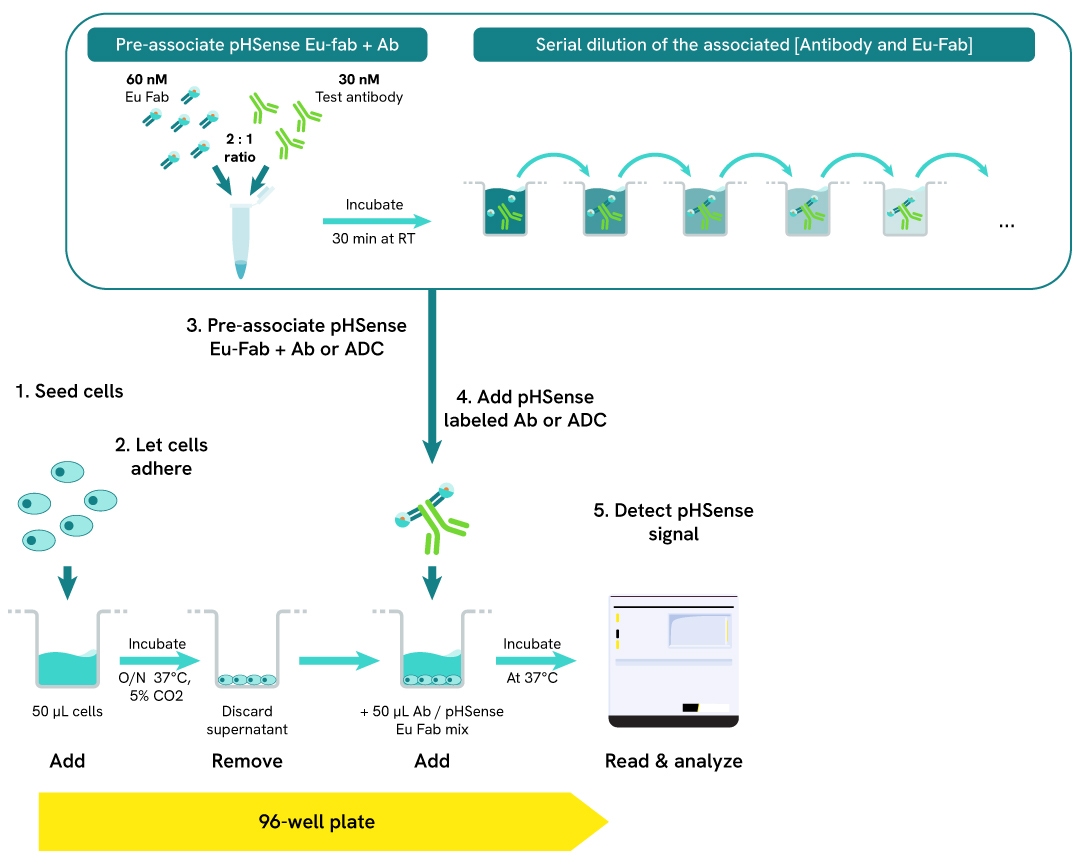
Antibodies, ADCs, or modified ligands of receptors (such as Dulaglutide) can be indirectly labeled with pHSense™ Eu Fab anti-IgG reagents (they can also be directly labeled with the pHSense dye via our custom-labeling service). The labeled binders can be applied on adherent (Figure 1) or suspension cells to detect internalization into cells. The recommended negative controls to run in parallel are: (1) using the pHSense Eu Fab anti-IgG alone and (2) replacing the test antibody or ADC with an irrelevant, same isotype control antibody (Table below).
| pHSense™ product | 1 vial (50 µg) |
|---|---|
| Human IgG1 Isotype Control | 81HUIGG1NC |
| Human IgG4 Isotype Control | 81HUIGG4NC |
| Mouse IgG1 Isotype Control | 81MOIGG1NC |
| Mouse IgG2a Isotype Control | 81MOIGG2ANC |
Table 1: Irrelevant antibody controls available from Revvity.
For a more detailed protocol, specific to the pHSense Eu anti-Fab or anti-VHH reagent used, please refer to the manual for the relevant reagent and to the "Guide ADC binder internalization".
Figure 1: Generic pHSense antibody/ADC internalization workflow (adherent cells). Cells are typically seeded in CulturPlate 96-well, white, TC Treated (Revvity Part# 6055680) in culture medium containing Fetal Bovine Serum. The next day, antibodies or ADCs are pre-associated at high concentration with pHSense Fab anti-IgG, before being diluted to their final test concentrations. The test concentration of the pre-formed pHSense Fab:Ab or ADC complexes is then added on top of the cells (time = zero), and the plate is incubated at 37°C, 5% CO2 in a cell culture incubator. The pHSense signal can be read at successive time intervals, for example at 30 min, 1h, 4h, 24h and beyond.
Receptor internalization
Receptor internalization can be detected by labeling a tagged receptor with pHSense Eu anti-Tag antibodies or with the pHSense SNAP Eu Labeling Reagent (Figure 2). Native (untagged) receptor internalization can be detected using a specific anti-receptor antibody, recognized by a pHSense Eu Fab anti-IgG reagent (Figure 3). In this case, it is important to validate that the antibody selected is: (1) not preventing the agonists from activating the GPCR (i.e., no competition for the binding pocket between the antibody and the agonist), (2) not triggering the internalization of the GPCR by itself (in the absence of the receptor agonists), and (3) not having allosteric effects on the receptor (pharmacology in functional assays should be the same in the presence or absence of the antibody).
For a more detailed protocol, specific to the pHSense reagent used, please refer to the manual for the relevant reagent.
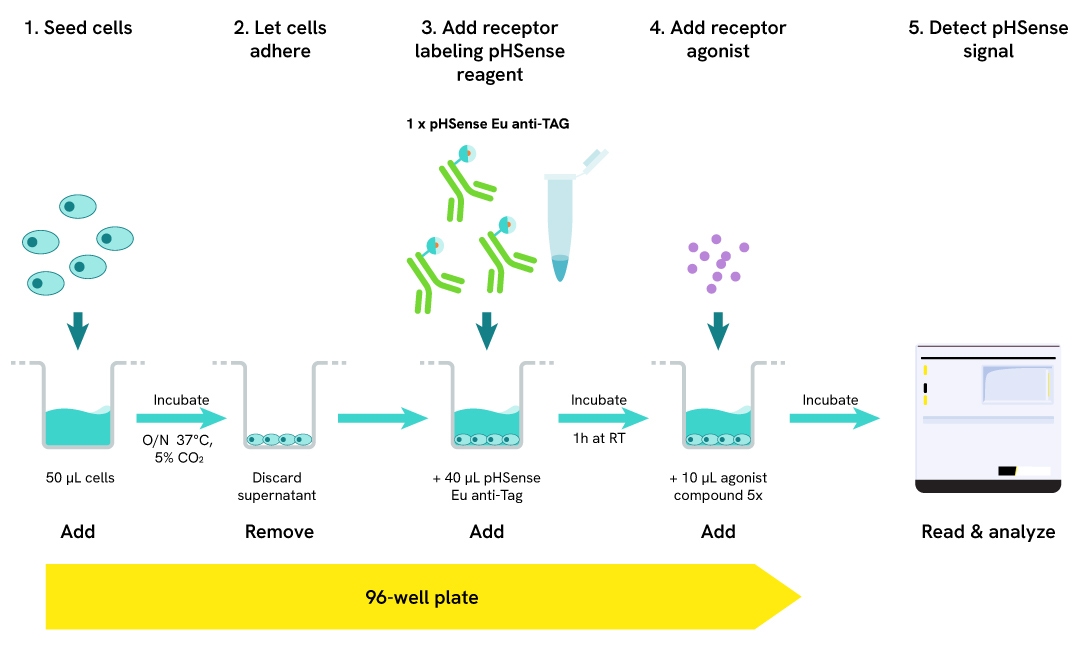
Figure 2: Generic pHSense tagged receptor internalization workflow (adherent cells). Cells are typically seeded in CulturPlate 96-well, white, TC Treated (Revvity Part# 6055680) in culture medium containing Fetal Bovine Serum. The next day, tagged receptors present at the surface of the cells are labeled for 1 h at room temperature (or at 4°C if preventing constitutive internalization during labeling is required) with a pHSense anti-Tag labeling agent, or with a pHSense SNAP tag labeling agent. An agonist of the receptor is then added (time = zero), and the plate is incubated at room temperature or at 37°C, 5% CO2 in a cell culture incubator. The pHSense signal can be read at successive time intervals, for example at 15 min, 30 min, 45 min, 1h and beyond.
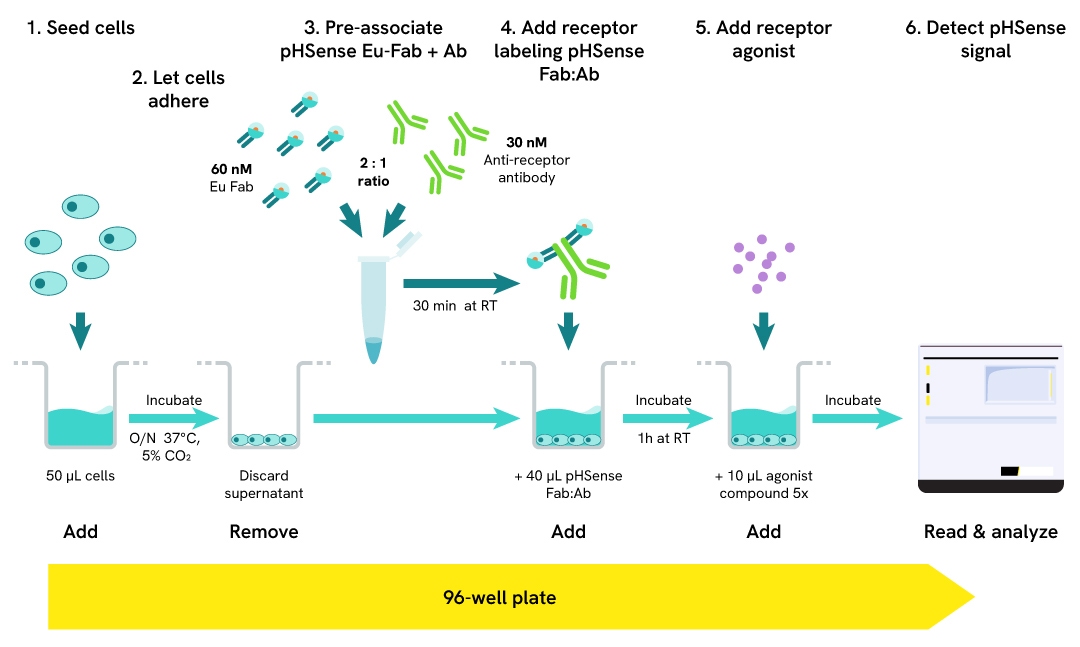
Figure 3: Generic pHSense untagged receptor internalization workflow (adherent cells). Cells are typically seeded in CulturPlate 96-well, white, TC Treated (Revvity Part# 6055680) in culture medium containing Fetal Bovine Serum. The next day, untagged receptors present at the surface of the cells are labeled for 1 h at room temperature (or at 4°C if preventing constitutive internalization during labeling is required) with a receptor-specific antibody, pre-labeled with one of the pHSense Fab anti-IgG Reagents. An agonist of the receptor is then added (time = zero), and the plate is incubated at room temperature or at 37°C, 5% CO2 in a cell culture incubator. The pHSense signal can be read at successive time intervals, for example at 15 min, 30 min, 45 min, 1h and beyond.
For research use only. Not for use in diagnostic procedures.
The information provided above is solely for informational and research purposes only. Revvity assumes no liability or responsibility for any injuries, losses, or damages resulting from the use or misuse of the provided information, and Revvity assumes no liability for any outcomes resulting from the use or misuse of any recommendations. The information is provided on an "as is" basis without warranties of any kind. Users are responsible for determining the suitability of any recommendations for the user's particular research. Any recommendations provided by Revvity should not be considered a substitute for a user's own professional judgment.
