メニュー
Revvity logo
Contact us
JP
Revvity Sites Globally

Select your location.

*e-commerce not available for this region.

australia.webp Australia
austria.webp Austria
belgium.webp Belgium
brazil.webp Brazil *
canada.webp Canada
china.webp China *
denmark.webp Denmark
finland.webp Finland
france.webp France
germany.webp Germany
hong-kong.webp Hong Kong (China) *
india.webp India *
ireland.webp Ireland
italy.webp Italy
japan.webp Japan *
luxembourg.webp Luxembourg
mexico.webp Mexico *
netherlands.webp Netherlands
norway.webp Norway
philippines.webp Philippines *
republic of korea.webp Republic of Korea *
singapore.webp Singapore *
spain.webp Spain
sweden.webp Sweden
switzerland.webp Switzerland
thailand.webp Thailand *
uk.webp United Kingdom
usa.webp United States
Breadcrumb
...
  • ホーム
  • Resources
  • Knowledge Base
  • CellCountingSub Section
  • Kinetic Measurement of AAV Vector Transduction Efficiencies To Optimize Assay Duration
Cell Counting and Image Cytometry

Kinetic Measurement of AAV Vector Transduction Efficiencies To Optimize Assay Duration

Section
Cell-based Assays for Gene Therapy Development
Celigo Applications
Cell Counting Method Selection
Cell Counting and Image Cytometry FAQs
Cell-based Assays for Bioprocessing
Cell-based Assays for Gene Therapy Development
Cellometer Applications
Modern Virology Assays
Sub Section
AAV Vector Transduction Efficiencies
AAV Vector Design
AAV Vector Transduction Efficiencies
FDA Approval for Gene Therapy
Neutralizing Antibody Screening
Topic
Kinetic Measurement of AAV Vector Transduction Efficiencies To Optimize Assay Duration
Direct Measurement Of Lentiviral Dose-Dependent Transduction Efficiencies Using GFP Fluorescence
Kinetic Measurement of AAV Vector Transduction Efficiencies To Optimize Assay Duration
Rapidly Determine the Multiplicity of Infection (MOI) Dependent AAV Vector Transduction Efficiencies to Optimize AAV Vector Design

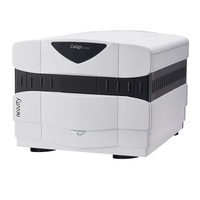
In this experiment, the Celigo™ image was used to image and quantify AAV-GFP transduction efficiencies in 96-well plate for 6 different serotypes at high, mid, and low Multiplicity of Infection (MOI)s over time.

  1. Target cells were seeded in each well of a 96-well plate and incubated overnight
  2. Cells were transduced with six types of AAV-GFP vectors at high, medium and low MOIs and incubated overnight for transduction
  3. The Celigo plate imager imaged and analyzed in brightfield and green fluorescence to measure the transduction efficiencies at three MOIs for different serotypes of AAV-GFP vectors
  4. The Celigo analyzed time points at approximately 20, 40, and 60 hours
  5. The software automatically identified and segmented cells to provide counts of both total cells and GFP+ cells

Determine changes in transduction efficiencies and gene expression levels with time-course measurements of GFP population and fluorescence intensities

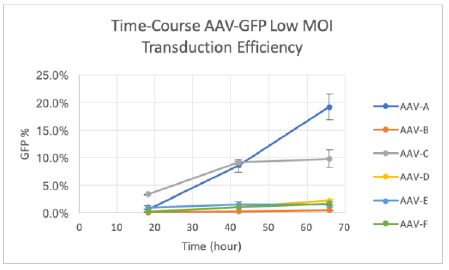
  • MOI and time-dependent increases in GFP+ cells were observed for six different AAV serotypes (Figure 1)
  • AAV-C demonstrated the highest efficiency at 20 hours for all three MOIs
  • AAV-A and AAV-C had similar percentages of GFP+ percentages at 40 hours
  • AAV-A outperformed the AAV-C at the final time point
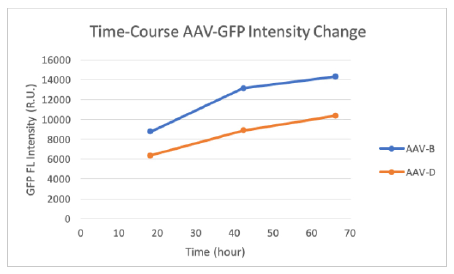
  • AAV-B showed higher gene expression over time in comparison to AAV-D (Figure 2)
     
kinetic measurement of AAV

Figure 1. A time-course plot of six serotypes of AAV vectors at low MOI. 
kinetic measurement of aav vector transduction efficiencies to optimize assay duration

Figure 2. A time-course plot of GFP fluorescent intensities for AAV-B and AAV-, were AAV-B showed higher gene expression.  
For research use only. Not for use in diagnostic procedures.

ON THIS PAGE
Revvity Logo

©2025 Revvity - All rights reserved

Revvity is a trademark of Revvity, Inc. All other trademarks are the property of their respective owners.