


Make the most out of HTRF™ assay data
Learn how to ensure the maximum significance of result interpretation by addressing the following points:
- How to perform a ratiometric data analysis step that will clear results from background or compound interference, medium effects or pipetting variations
- How to perform a 4 Parameter Logistic Regression (4PL) curve fitting with a weighting by 1/y2 for cytokine assays in order to accurately measure samples across wide ranges of concentrations.
Ratiometric data analysis: a straightforward way to eliminate compound interference or normalize data between assays
The ratiometric analysis of data is a unique feature of HTRF assays which results into significant improvement of data quality. It relies on measuring fluorescence at 2 different wavelengths from the donor and the acceptor (table 1) and processing the resulting signals into a single value that compensates for the following risks:
- Well-to-well variations that may arise from pipetting error or imprecision.
- Compounds and/or media components added in the plate that may change the photophysical properties (i.e. light quenching) in a given well, and the degree to which this occurs can vary from sample to sample.
Correction by the ratiometric analyses will provide more robust datasets between replicates (intra-assay) or between assay runs (inter-assay).
| XL665 | d2 | Green dye | |
|---|---|---|---|
| Eu3+-cryptate | 620 nm 665 nm |
620 nm 665 nm |
|
| Tb3+-cryptate | 620 nm 665 nm |
620 nm 665 nm |
620 nm 520 nm |
Table 1: recommended wavelengths to measure for the ratiometric reduction of data
Data analysis: case of standard curves in a competitive assay
Ratio and delta ratio
Five standards were plated and incubated with HTRF reagents. Their emissions at 665 nm (Acceptor) and 620 nm (Donor) were measured after incubation (Table 2.a).
The ratio must be calculated for each well individually. The mean and standard deviation can then be worked out from replicates. A 10 000-fold multiplying factor is introduced for easier data processing (Table 2.b)
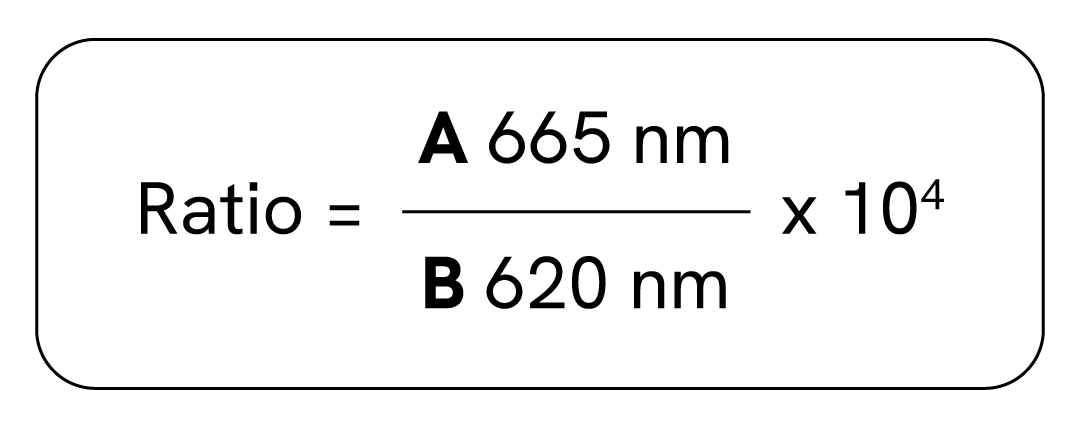
The delta ratio (ΔR) reflecting the "specific signal" is obtained by simply subtracting the background signal from the signal of each positive point (Table 2.c).
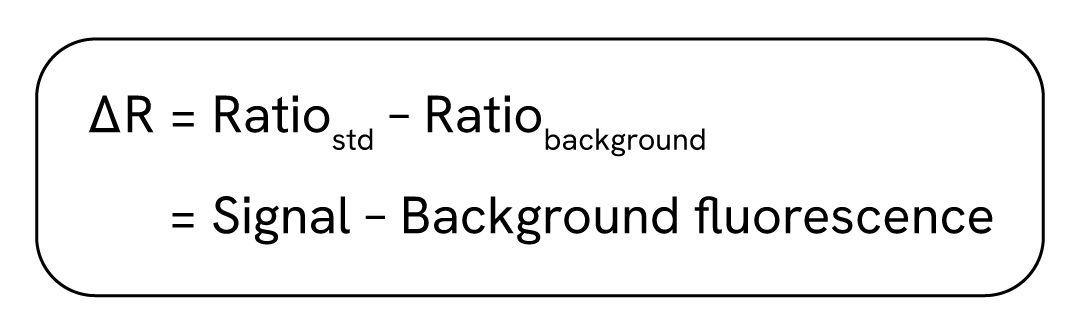
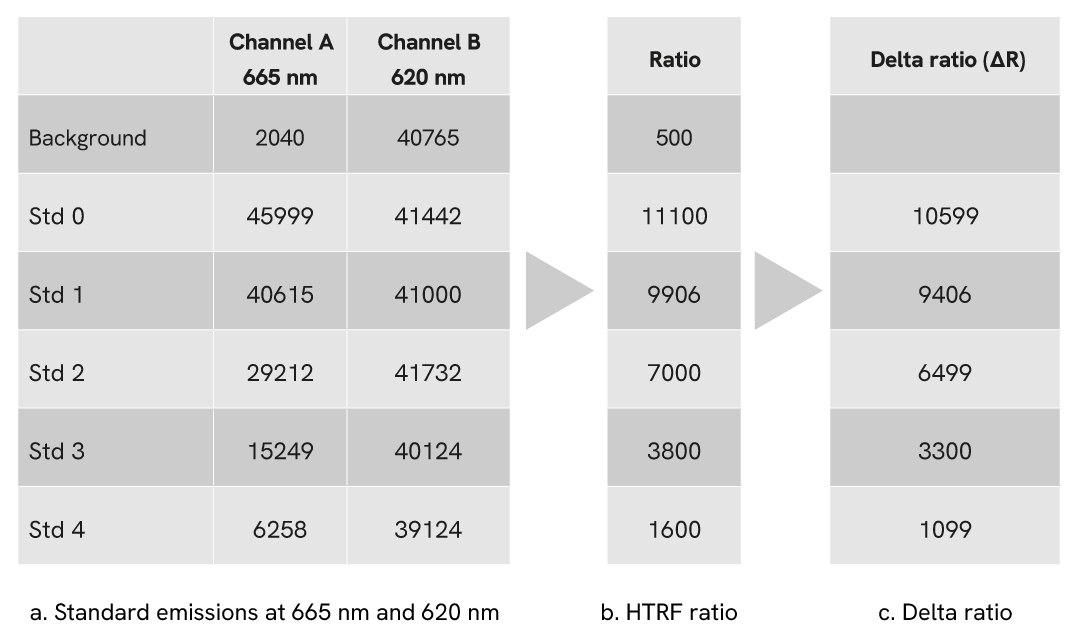
Table 2: Ratiometric reduction of a standard curve
Assay window
The window is obtained by dividing the maximum signal ratio value by the minimum signal ratio value (Table 3).
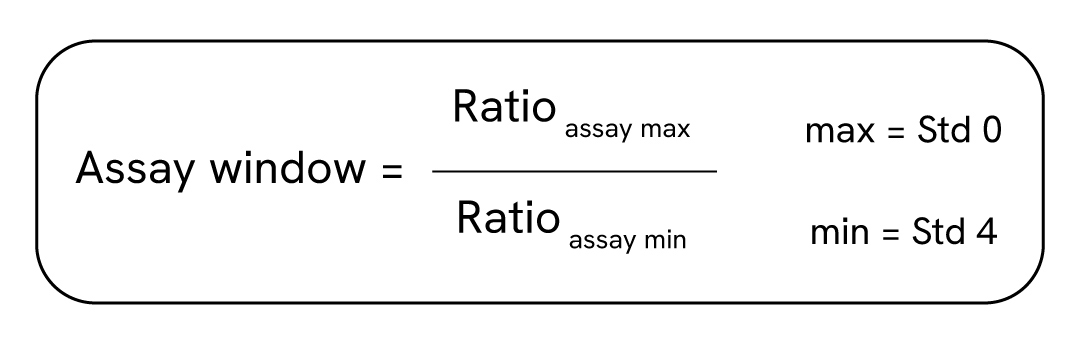
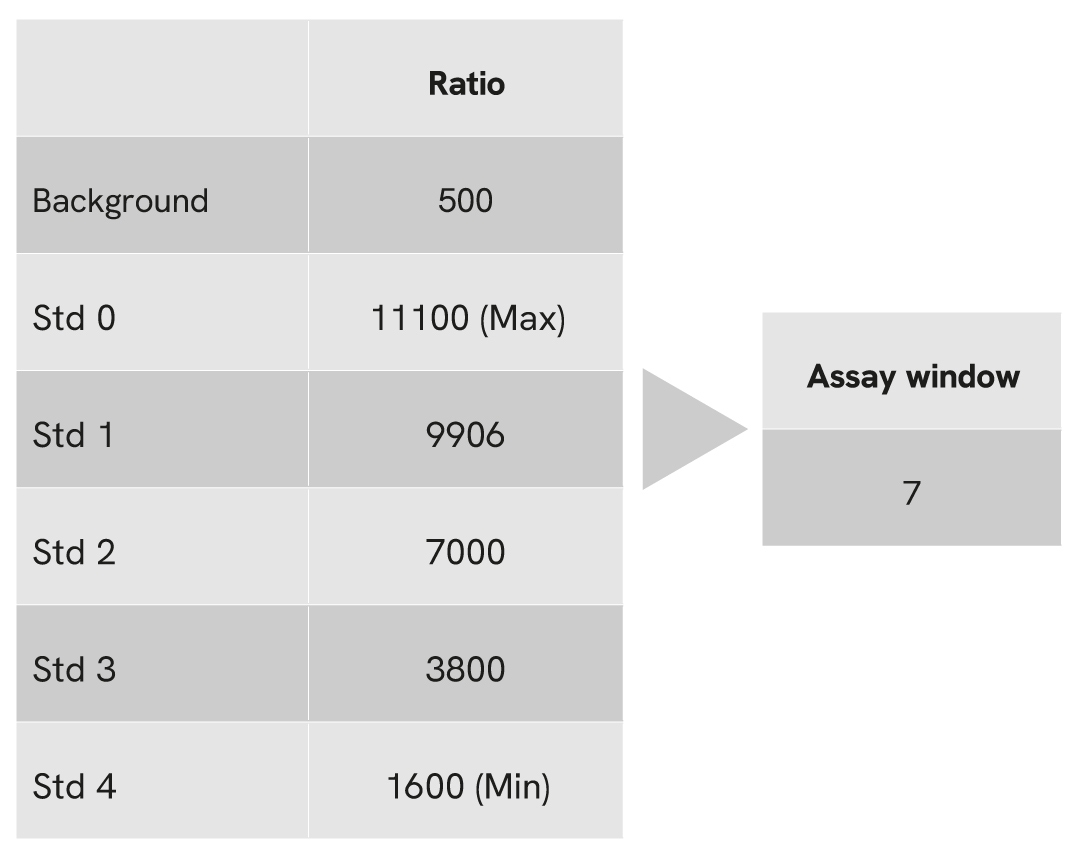
Table 3: Determination of the assay window
Data normalization for comparing two assays
Delta F for inter-assay comparisons
Delta F is used for the comparison of day-to-day runs of the same assay or assays run by different users. It reflects the signal to background of the assay. The negative control plays the role of an internal assay control.
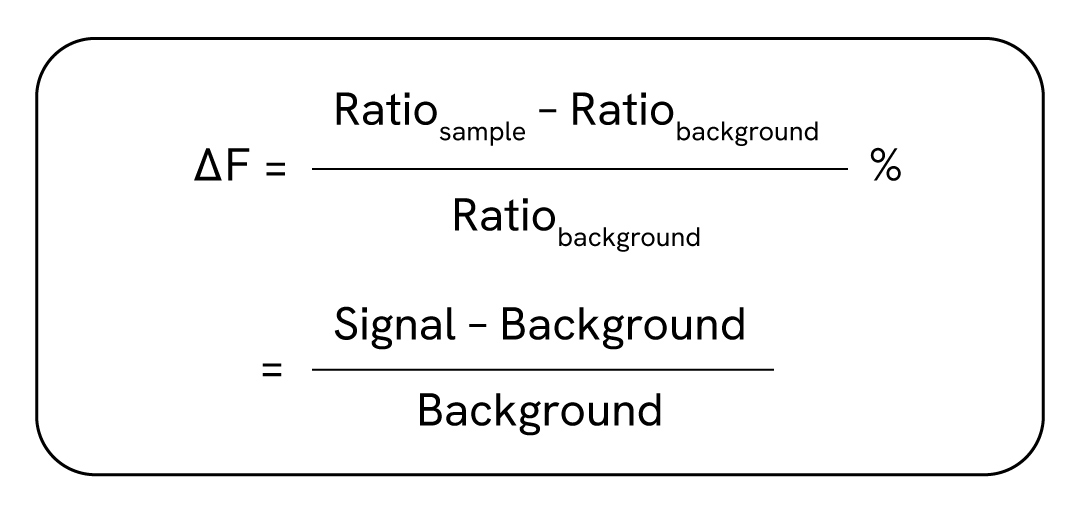
The following table only exemplifies the normalization of one of the assays (#1), but both assays compared should be treated this way.
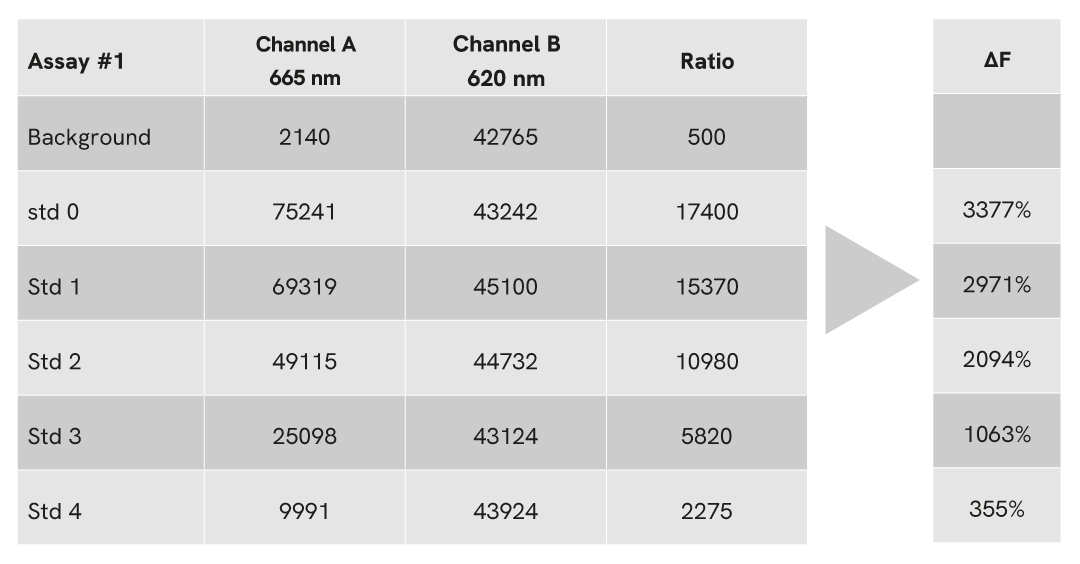
Table 4: Determination of Delta F
Delta F / Delta F max enables the comparison of two experiments
This calculation is used for normalizing the signal in competitive assays. This is done for both assays.
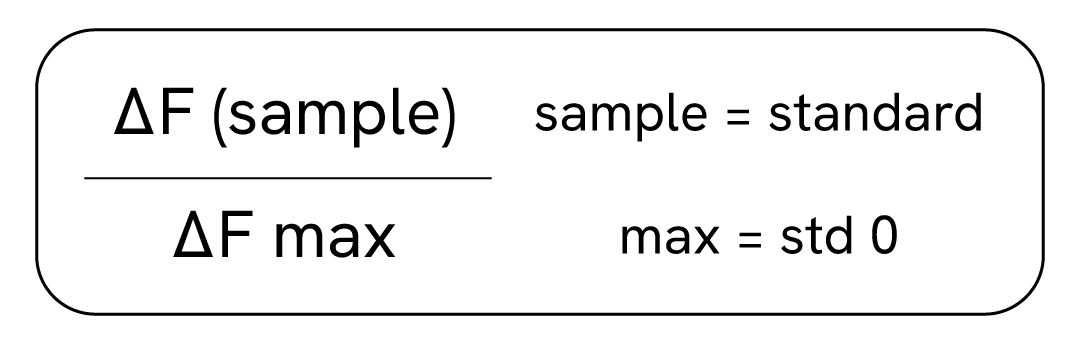
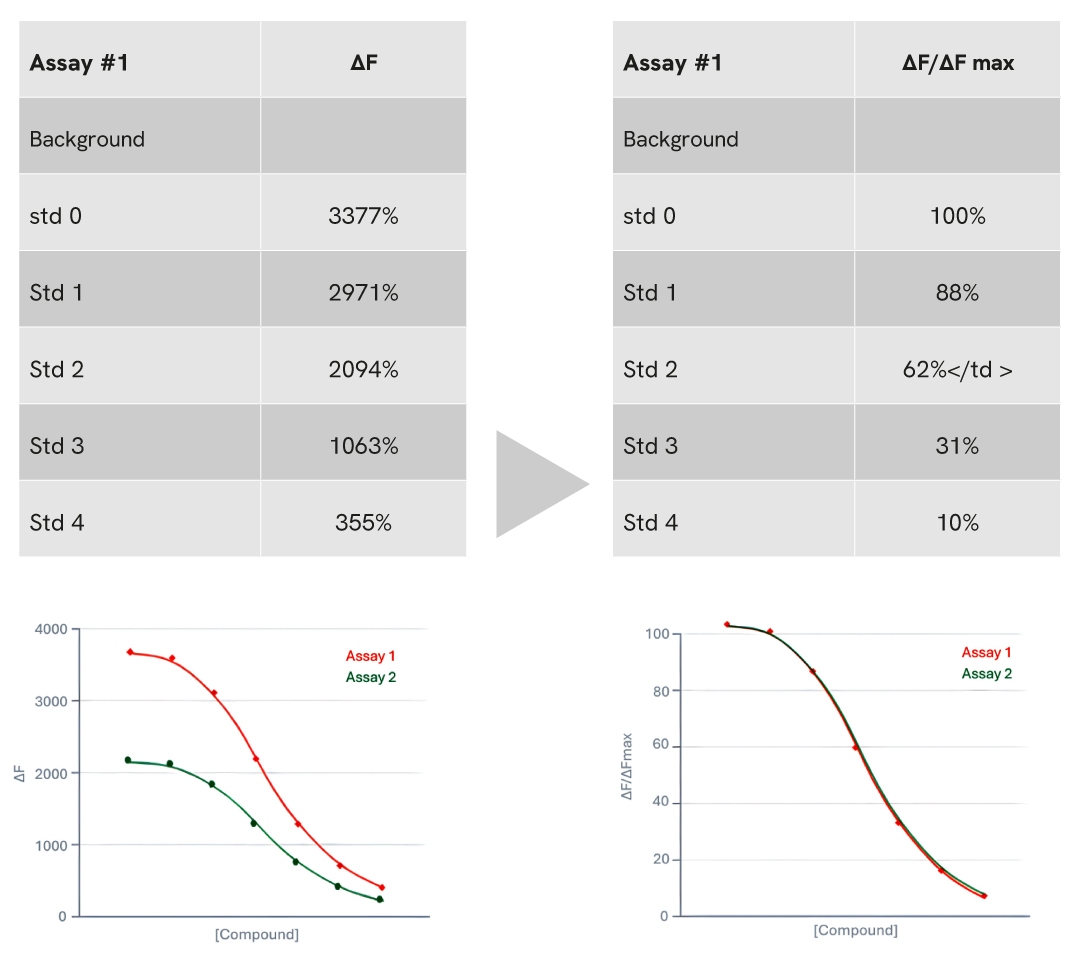
Table 5: Determination of ΔF/ΔF max
Determination of the negative control
Sandwich and direct binding assays
Sandwich assays' negative control should involve both antibody-coupled HTRF reagents to test for their respective specificity and ensure they do not generate FRET signal in the absence of their target proteins.

Figure 1A: Negative control for sandwich assays
When performing a direct binding assay (immunocompetitive assays), we recommend you perform a cryptate blank negative control with all assay components but the acceptor conjugate.

Figure 1B: Negative control for competition binding assays
4PL 1/y2 fitting for HTRF cytokine assays
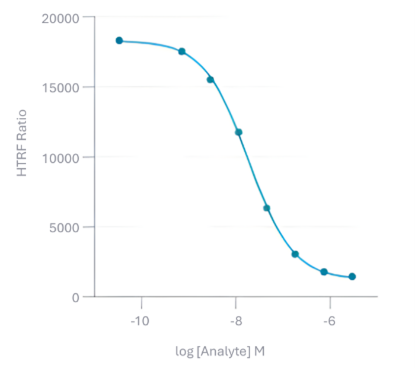
The 4 Parameter Logistic (4PL) curve is the most commonly recommended curve for fitting a sandwich immunoassay (such as ELISA or HTRF or AlphaLISA) standard curve (Fig. 1 for example).
4PL regression enables the accurate measurement of an unknown sample across a wider range of concentrations than linear analysis, making it ideally suited to the analysis of biological systems like cytokine releases. This is especially true in the low-end concentrations of the standard curve, where data points would be "lost" in a linear regression.
No need for a degree in Statistics to use this equation and analyze data. Software programs like Prism or Excel allow you to run a 4PL analysis without getting into the math, and there are free online software able to run this analysis.
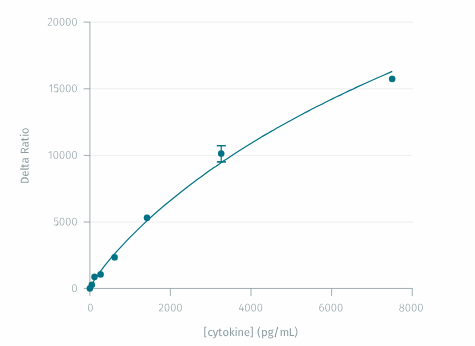
Figure 2: exemplified 4PL1/y² curve of a cytokine assay. Note that standard concentration is NOT in a logarithmic scale.
Even though linear regression is easy to use and can be run with a very low number of standard points, it is not considered the best fitting method for biological phenomena like cytokine release, especially in an immunoassay. The main drawback is that it is only applicable for samples that fall within the linear range of the assay, thus reducing analysis flexibility (dilutions …).
The 4PL equation includes 4 variable parameters related to the curve:
- Estimated response at concentration zero
- Estimated response at maximal signal
- Slope factor
- Mid-range concentration (or "point of inflexion")
To get the most out of your data, we add a 1/y2 weighting to the equation, thus making it a 4PL 1/y2 fitting. The 1/y2 correction basically considers the changes of variance occurring with an increase in signal and provides :
- A broader range of concentrations for analysis
- Accuracy in the low/high ends of the standard curve
For research use only. Not for use in diagnostic procedures.
The information provided above is solely for informational and research purposes only. Revvity assumes no liability or responsibility for any injuries, losses, or damages resulting from the use or misuse of the provided information, and Revvity assumes no liability for any outcomes resulting from the use or misuse of any recommendations. The information is provided on an "as is" basis without warranties of any kind. Users are responsible for determining the suitability of any recommendations for the user's particular research. Any recommendations provided by Revvity should not be considered a substitute for a user's own professional judgment.
