


HTRF assay principle
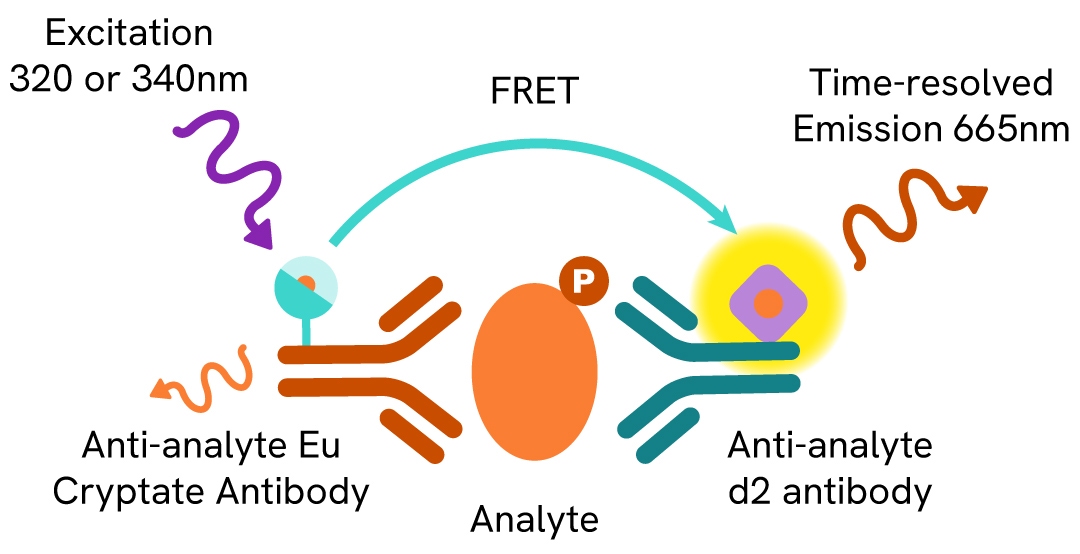
HTRF (Homogeneous Time Resolved Fluorescence) is a no-wash technology. It combines standard Förster Resonance Energy Transfer (FRET) technology with time-resolved measurement of fluorescence (TRF), eliminating short-lived background fluorescence. For a sandwich assay, two antibodies that recognize a target protein of interest are used. One antibody is coupled to a donor dye, and the other to an acceptor dye. The donor dye, when illuminated with UV excitation light, emits fluorescence at its own wavelength. However if the two antibodies recognize the analyte, then the small distance between the donor dye and the acceptor dye allows for transfer of part of the energy from the donor dye to the acceptor dye, leading to fluorescence at a wavelength specific to the acceptor dye. Such light emission from the acceptor dye is indicative of sandwich formation, and hence of the presence of the target protein in the sample. In HTRF, fluorescence at both the donor and acceptor dyes wavelengths is measured and the fluorescence from the acceptor dye is expressed as a ratio of the direct fluorescence of the donor dye. Such use of the direct emission from the donor dye as an internal reference reinforces the assay robustness.
How HTRF technology assays work
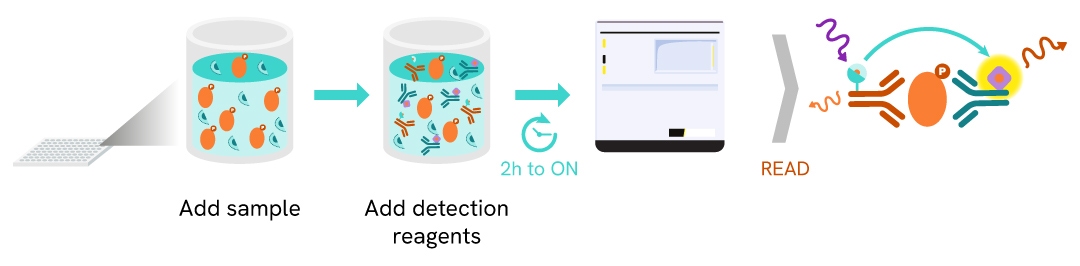
The HTRF protocol is simple and straightforward, requiring few steps
First, add your analyte or sample to your microplate, then add the detection reagents, the donor dye-conjugated anti-analyte antibody, and the acceptor dye-conjugated anti-analyte antibody. Incubate for 1 to 2 hours (up to overnight for some assays – please refer to the kit manual). The assay is then ready to be read on an HTRF-compatible or certified microplate reader. The emission of light by the acceptor dye will be proportional to the concentration of the target protein in the sample.
FRET principle - When proximity means specific signal
FRET (Förster Resonance Energy Transfer) was first theorized and investigated by Theodor Förster in 1946. It was only in the 1970s that it was exploited in biological and diagnostic systems.
It is based on the transfer of energy between two fluorophores, a donor and an acceptor, when in close proximity. Molecular interactions between biomolecules can be assessed by coupling each partner with a fluorescent label and by detecting the level of energy transfer.
FRET is governed by the physics of molecular proximity, which only allows this phenomenon to occur when the distance between the donor and the acceptor is short enough. In practice, FRET systems are characterized by the Förster's radius (R0), the distance at which FRET efficiency is 50%. The radius is highly dependent on the nature of the fluorophores and binding partners.
These fluorophores can be coupled to interacting partners so that when the partners come close enough to each other, the dyes are mechanically brought into close proximity (i.e. within Angströms). Excitation of the donor by an energy source (e.g. a flash lamp or a laser) triggers energy transfer towards the acceptor, which in turn emits specific fluorescence at a given wavelength (Fig. 1B). The donor and acceptor can be covalently grafted onto multiple partners that can associate, including two antibodies that form a sandwich on a target protein, two dimerizing proteins, two DNA strands, an antigen and an antibody, or a ligand and its receptor.
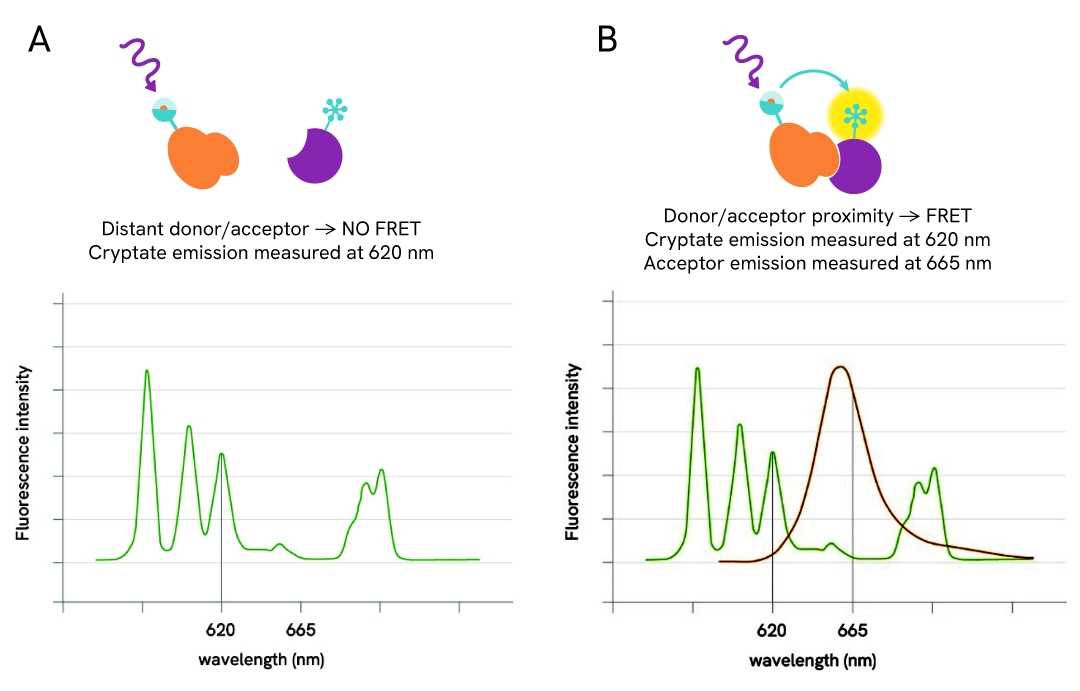
Fig 1. A. Emission spectrum of the donor dye alone. B. Emission spectrum of interacting donor and acceptor dyes. The detection of specific fluorescence at the acceptor dye emission wavelength is a sign that a FRET process has taken place due to the proximity of the two interacting partners.
Because of these spectral properties when FRET is occuring, a donor-acceptor complex can be detected without the need for physical separation of the unbound partners. Fully homogeneous assays do not require separation steps such as centrifuging, washing, filtration, or magnetic partitioning.
Traditional FRET chemistries are hampered by background fluorescence from sample components such as buffers, proteins, chemical compounds and cell lysate. This type of background fluorescence is extremely transient (with a lifetime in the nanosecond range) and can therefore be eliminated using time-resolved methodologies (where the specific signal is measured after a delay of several tens of microseconds).
How HTRF can simplify your life
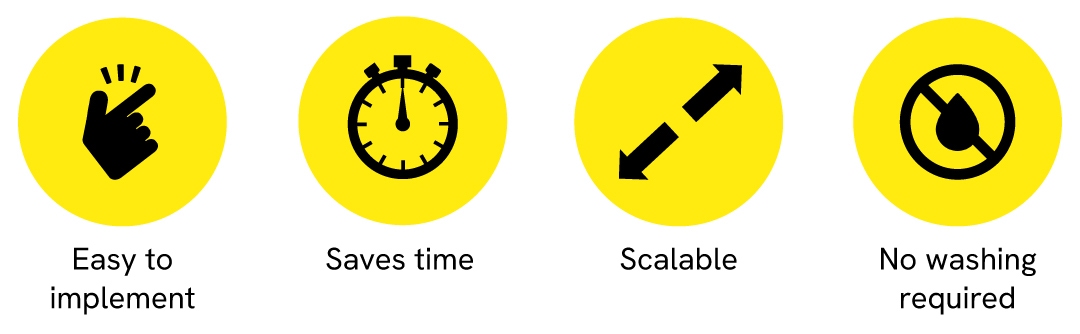
Benefit from more than 500 ready-to-use kits that contain everything you need and take advantage of this easy solution that saves you both time and money. Rapid, homogeneous, easy to use and automate, allowing extreme miniaturization and straightforward assay development – over recent years, HTRF has become the gold standard for time-resolved FRET.
HTRF is expanding research possibilities for a growing number of applications
TR-FRET has demonstrated performance in a variety of applications including GPCRs, kinases, epigenetics, PPIs, and the quantification of a wide range of biomarkers including cytokines.
For research use only. Not for use in diagnostic procedures.
The information provided above is solely for informational and research purposes only. Revvity assumes no liability or responsibility for any injuries, losses, or damages resulting from the use or misuse of the provided information, and Revvity assumes no liability for any outcomes resulting from the use or misuse of any recommendations. The information is provided on an "as is" basis without warranties of any kind. Users are responsible for determining the suitability of any recommendations for the user's particular research. Any recommendations provided by Revvity should not be considered a substitute for a user's own professional judgment.
