


Introduction
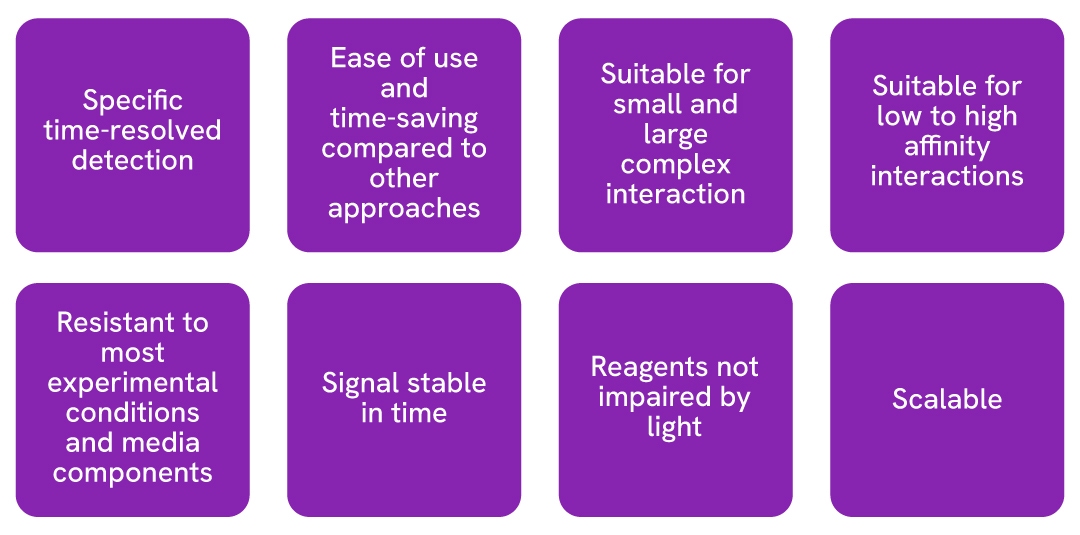
HTRF is a FRET-based technology that emerged from Jean-Marie Lehn's Nobel Prize-winning work on rare earth complexes. Due to the chemical and photophysical characteristics of these fluorescent dyes, HTRF exhibits performance levels in stability and specificity that make it unparalleled for time-resolved FRET studies. It is especially extremely stable over time, allowing repetitive measurements for days. The structure of HTRF reagents also makes assays highly resistant to most experimental conditions, including additives, chelates, DMSO, ionic strength, challenging cations, pH, temperature, and cell culture media. See the HTRF Reagent chemistry page for more details about HTRF reagents.
Suggested content
Time-resolved measurement allows the signal to be cleared of background fluorescence
HTRF combines standard FRET technology with time-resolved measurement of fluorescence, eliminating short-lived background fluorescence.
As shown in Fig. 1, introducing a time delay of approximately 50 to 150 microseconds between system excitation and fluorescence measurement allows the signal to be cleared of all non-specific short-lived emissions.
In contrast, HTRF donors emit long-lived fluorescence, and they convey this long-lived property to HTRF acceptors when engaged in a FRET process, while HTRF acceptors, if excited directly by light, only have a short-lived fluorescence, that is eliminated by the time-resolved measurement mode. Therefore, long-lived emissions signify energy transfer due to the proximity of the labeled biomolecules.
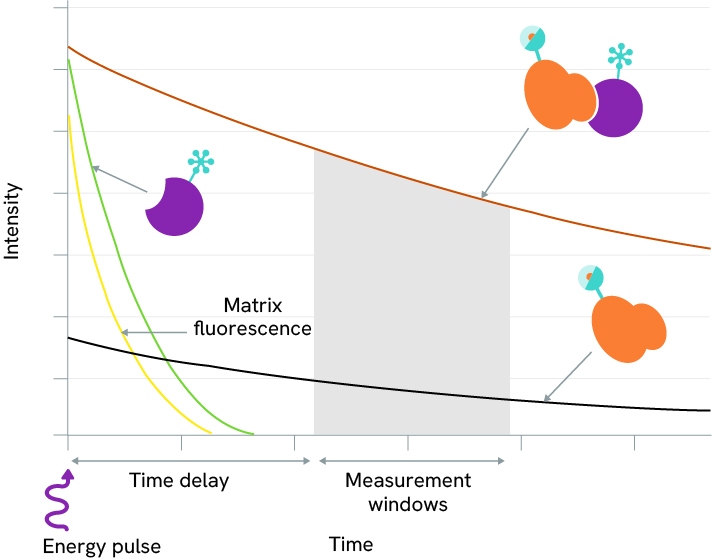
The energy pulse from the excitation source (flash lamp, laser) is immediately followed by a time delay, allowing short-lived fluorescence (from compounds, proteins, medium, non-interacting acceptor, etc.) to decay. Then, after this delay, the long-lived fluorescence from the donor dye, and from the acceptor dye engaged in a FRET phenomenon are measured.
Ease of use and sensitivity compared to ELISA and Western Blot
HTRF assays are homogeneous, and as such they do not require wash steps. They can be performed with a streamlined add-and-read protocol. These advantages make the HTRF approach more convenient and less time-consuming than other detection methods such as ELISA or Western Blot.
When compared to Western Blot, HTRF assays exhibit considerable time savings and far better reproducibility, enabling the detection of subtle variations in target quantity that a Western Blot approach could not address.
HTRF can address both small to large complexes
HTRF Förster’s radius (R0) lies between 50 and 90 Å, depending on the acceptor used. When the interacting partners are small, one would naturally expect the donor and acceptor dyes to be at a distance compatible with energy transfer. When the size of interacting partners far exceeds 50 to 90 Å, it can happen that the donor and acceptor dyes are too far apart for energy transfer to occur. However the spatial molecular 3D conformation can still position the donor and acceptor dyes at a distance compatible with energy transfer, and in such cases it is worth exploring different labeling positions on the binding partners, and different acceptors (the large size of XL665 can be an advantage in some cases) to find a setting suitable for a TR-FRET assay. In practice, a wide variety of HTRF assays involving molecular complexes of different sizes have been implemented.
These include assessment of small phosphorylated peptides (Fig. 3A), immunoassays for quantifying large glycoproteins such as thyroglobulin, and indirect detection (via secondary antibodies) of tagged complexes such as CD28/CD86 (Fig. 3B), encompassing a broad range of possible molecular distances.
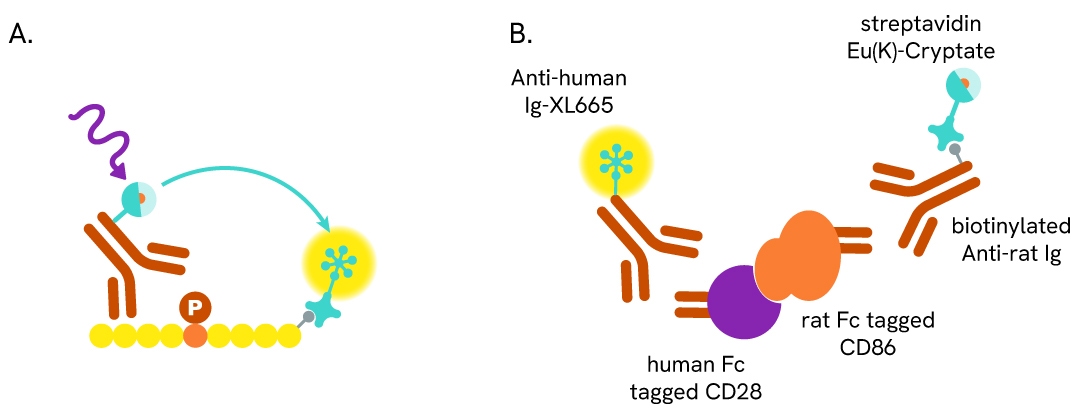
Two HTRF assays theoretically involving very different donor-acceptor distances. Detecting a phosphorylated biotinylated peptide (short distance) and CD28/CD86 association quantified by anti-tag conjugates (long distance).
Low to high affinities are properly covered by HTRF assays
Low affinity: BRD4:H4 interaction (Kd of 2 µM)
This figure shows a competition dose-response curve of the unlabeled Histone 4 (H4) Kac(5,8,12,16) peptide measured with an HTRF assay. The Ki value of 2 µM obtained agrees with the published affinity of 2.8 µM for BRD4:H4 interaction and demonstrates HTRF's relevance for studying low-affinity interactions.
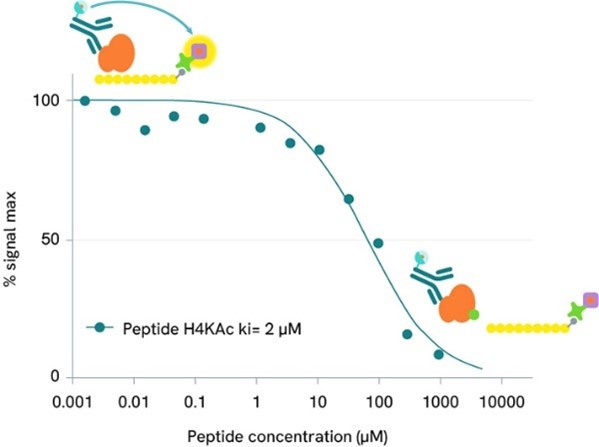
BRD4:H4 interaction : competition by a dose response curve of non-labeled H4Kac peptide of the signal generated using a biotinylated peptide and Streptavidin-d2 together with the Brd4 protein recognized by a donor labeled antibody.
High affinity: OX40-Ligand:OX40-Receptor (Kd of 300 pM)
This figure features IC50 plots showing how increasing concentrations of mAb 10541 compete with a fixed concentration of OX40L-FLAG (0.5 nM) for binding to variable concentrations of the OX40-Receptor (engaged as a -Fc fusion protein; 0.5-10 nM). The resulting IC50 plots show an expected rightward shift as the concentration of soluble OX40R-Fc increases, which indicates that HTRF provides the expected outcome when addressing high affinity interactions.
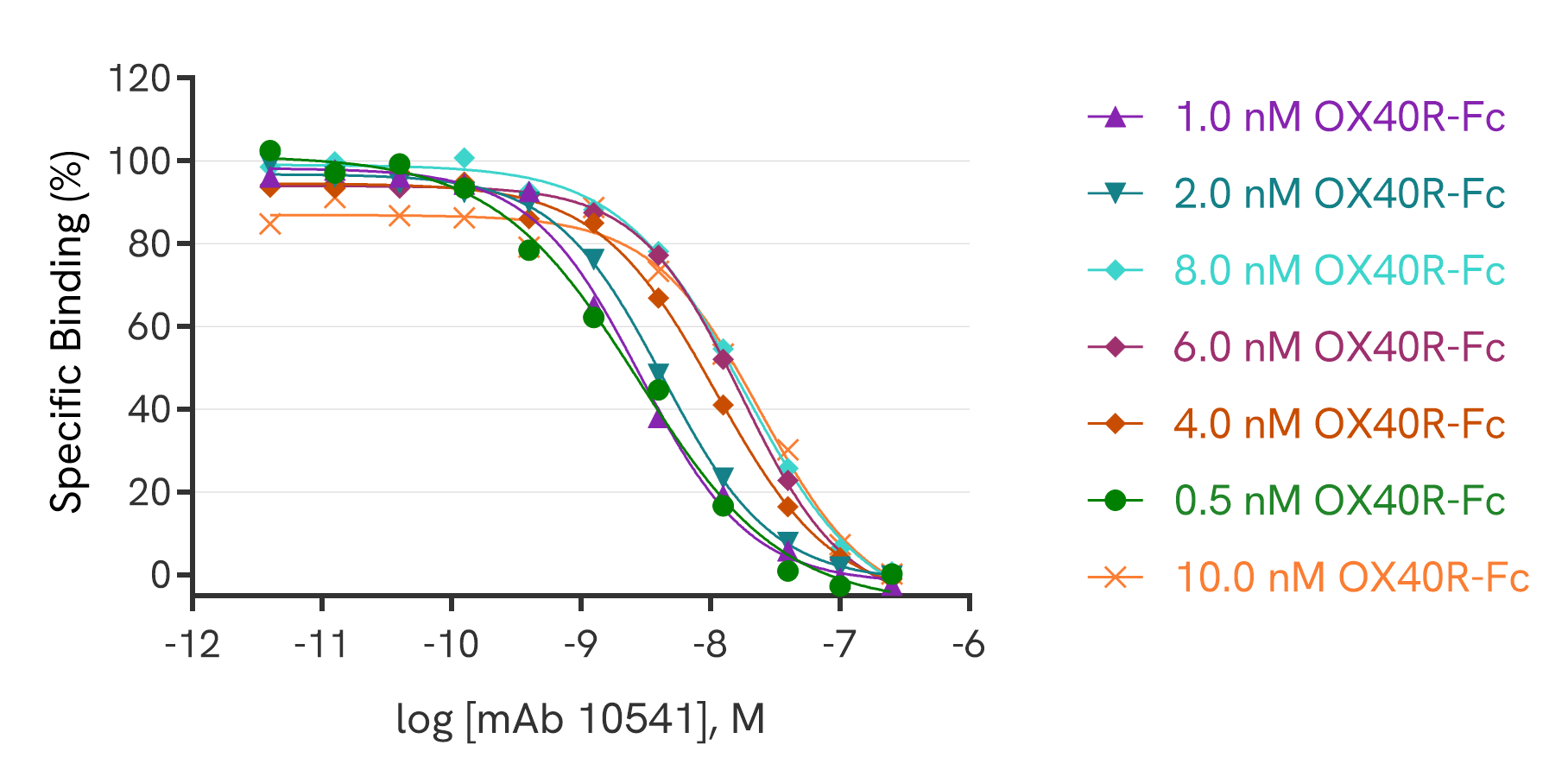
IC50 plots of mAb 10541 competing for OX40-Ligand/OX40-Receptor interaction
More published examples are featured in the Application Note entitled "HTRF PPi reagents to address low to high affinity complexes".
For research use only. Not for use in diagnostic procedures.
The information provided above is solely for informational and research purposes only. Revvity assumes no liability or responsibility for any injuries, losses, or damages resulting from the use or misuse of the provided information, and Revvity assumes no liability for any outcomes resulting from the use or misuse of any recommendations. The information is provided on an "as is" basis without warranties of any kind. Users are responsible for determining the suitability of any recommendations for the user's particular research. Any recommendations provided by Revvity should not be considered a substitute for a user's own professional judgment.
